








New Delhi: 2025 was a year when India built, connected, negotiated, and looked outward, sometimes literally into space. From tunnels bored through mountains to satellites watching the planet, ThePrint brings you 10 good things that happened in India this year.
India’s women lift the World Cup
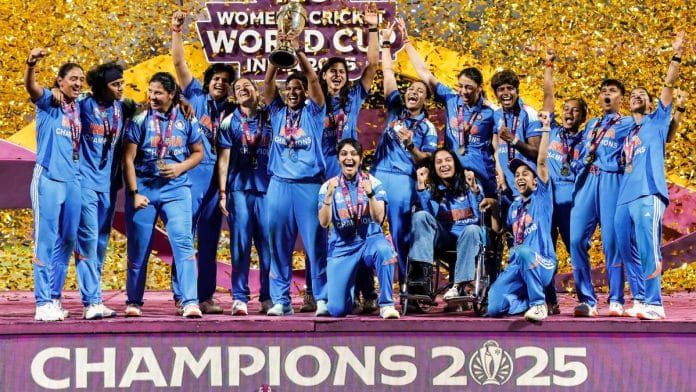
Before a packed DY Patil Stadium in Navi Mumbai, India women’s cricket team rewrote history in October. Beating South Africa by 52 runs, Harmanpreet Kaur’s side won the Women’s Cricket World Cup for the first time, ending decades of near-misses.
It was India’s third final appearance. The win also marked a generational shift: The first women’s World Cup final not featuring Australia or England. Shafali Varma, the Player of the Match, scored 87 from 78 balls—the highest by an Indian opener in a Women’s World Cup final—to set up India’s total of 298/7 against South Africa.
An all-weather route in J&K
On 13 January, Prime Minister Narendra Modi inaugurated the Z-Morh Tunnel (also known as Sonamarg tunnel) in Jammu and Kashmir, carving an all-weather route through terrain long dictated by avalanches and closures. Built at nearly 8,700 feet, the tunnel reduces a two-hour mountain journey to minutes, reconnecting Srinagar with Sonamarg through winter. The tunnel has boosted tourism in the region. The Z-Morh tunnel is named after the Z-shaped stretch of road it replaces.
Thaw in India-China tensions
India and China in 2025 took key steps toward stabilisation of strained ties. In August, Modi met Chinese President Xi Jinping on the sidelines of the Shanghai Cooperation Organisation summit (along with Vladimir Putin), while ministerial talks focused on border management and disengagement. In July, India resumed issuing visas to Chinese tourists and direct flights between the two nations, suspended since the 2020 deadly Galwan Valley clashes, also resumed in October.
Also read: Zomato, Blinkit, Zepto gig workers on strike. Dhruv Rathee, Kunal Kamra support
A safety net for gig workers
In November, the union government finally operationalised India’s four labour codes, ending nearly six years of uncertainty after Parliament cleared them between 2019 and 2020. Together, the codes fold 29 central labour laws into a single framework, aiming to simplify compliance, loosen rigidities in hiring, and extend basic protections to workers long excluded from formal safeguards. Their rollout had been delayed by opposition from trade unions and hesitation among states.
Minimum wages and timely payments are now guaranteed across sectors, while women can work night shifts and across job categories, subject to consent and safety norms. The Industrial Relations Code raises the threshold for mandatory standing orders, making it easier for firms to hire, while formalising fixed-term employment with benefits equal to permanent staff. Most consequentially, the Code on Social Security brings unorganised, migrant, gig and platform workers under a statutory safety net for the first time.
Connecting India through trains
June saw the completion of one of Indian Railways’ most demanding projects: A 272-kilometre rail line linking the Kashmir Valley to the Indian plains for the first time. From Udhampur to Baramulla, the route threads through dozens of tunnels and bridges, including the Chenab bridge—now the world’s highest railway arch. Designed to withstand extreme winds and weather, the line promises year-round connectivity for civilians, pilgrims, and commerce in a region historically dependent on air travel and precarious roads.
In September, Mizoram crossed a long-delayed threshold. Its capital, Aizawl, was connected to the national railway network for the first time. More than 170 years after railways were introduced in India, the hill state, long defined by road journeys and weather-dependent connectivity, finally got a train.
The 51.38-kilometre Bairabi-Sairang broad-gauge line links Aizawl to Assam’s Silchar and onward to the rest of the country. Sanctioned in 2008–09 and executed at a cost of over Rs 8,200 crore, the project cuts through difficult terrain, tunnels and bridges, and years of logistical delays. Mizoram also got its first Rajdhani Express, connecting Aizawl directly to Delhi.
Also read: When Shubhanshu Shukla’s teenage rebellion turned into his first triumph
An Indian back in space
Four decades after Rakesh Sharma flew aboard a Soviet mission, India returned to human spaceflight in a new avatar. Astronaut and IAF officer Shubhanshu Shukla became the first Indian to reach the International Space Station, travelling aboard the Axiom-4 mission. Nearly 20 days in orbit, he conducted experiments on muscle regeneration and bacterial growth. Shukla is also among the four astronauts selected for ISRO’s upcoming Gaganyaan mission.
India’s military achievement
In May, Indian precision strikes under Operation Sindoor hit multiple Pakistani air bases, including the high-value Nur Khan airbase in Rawalpindi, challenging Islamabad’s claims that its air defences had intercepted incoming missiles. Subsequent satellite imagery told a different story.
Images released by American space-tech firm Maxar Technologies and analysed by open-source intelligence experts showed cratered runways, damaged hangars, and demolished support structures across several bases. At Nur Khan, headquarters of the Pakistan Air Force’s Air Mobility Command, entire complexes near the strike site were later dismantled.
Also read: With only 5 launches in 2025. What’s behind ISRO’s project delays
ISRO’s LVM3 continues 100% success rate
In December, India’s most powerful rocket, the LVM3, successfully placed BlueBird 6—the heaviest payload it has ever carried—into low-Earth orbit. Built by Texas-based AST SpaceMobile, the 6,100-kg satellite was deployed flawlessly just over 15 minutes after liftoff from Sriharikota. It was the ninth consecutive success for the LVM3 since its debut in 2014, and has since had a 100 per cent success rate. The mission, though commercial, reinforced India’s ability to launch large, next-generation communication satellites.
Banking system hits cleanest point in 20 years
By March 2025, India’s banking system reached a milestone few would have predicted during the bad-loan crisis of the late 2010s. Gross non-performing assets fell to 2.31 per cent—the lowest level in 20 years—while net NPAs dropped to 0.52 per cent.
Public sector banks, once the epicentre of stress, mirrored the turnaround. Profitability rose for the sixth straight year, capital buffers strengthened, and credit growth expanded alongside deposits. Scheduled commercial banks posted record earnings, reflecting a system no longer firefighting but stabilising. Officials attributed the recovery to a decade of structural clean up: Asset quality reviews, the Insolvency and Bankruptcy Code, bank consolidation, and tighter recovery mechanisms.
India’s strides in space
In July, the joint NASA-ISRO Synthetic Aperture Radar satellite, NISAR, lifted off from Sriharikota. Designed to track subtle changes in land, ice, and groundwater, NISAR is expected to transform how scientists monitor earthquakes, floods, landslides, and climate-driven shifts. Its data will be openly shared globally, bolstering India’s growing role in space technology.
(Edited by Theres Sudeep)