





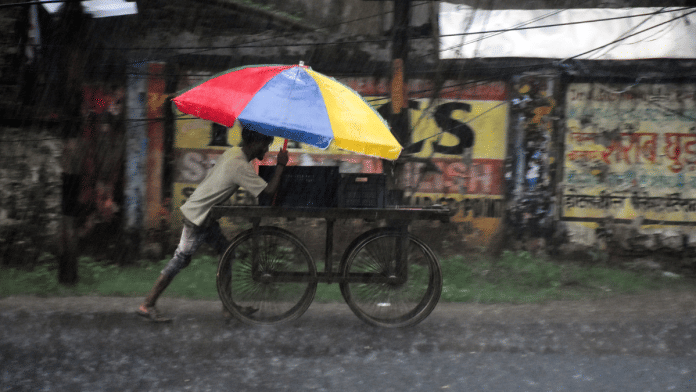



New Delhi: March began with temperatures soaring above normal for weeks. It seemed to be leading to a sweltering season, but a combination of weather systems made March the wettest in the last three years.
Weathermen said that the rainfall experienced across north and central India was caused by a combination of an intense western disturbance, an induced cyclonic circulation, and moisture-laden winds from the Arabian Sea.
India Meteorological Department (IMD) data shows that with the recent downpour, March has recorded an average rainfall of 9.4 mm — the highest in the last three years. The last time the month recorded such an intense rain spell was in 2023, when the average rainfall recording was 53.2 mm.
According to the Met department, the normal average for the month is around 12.6 mm.
Experts, however, clarified that such spells of rain are not unusual for March.
“From all the posts on social media, people might be under the impression that this is an abnormal phenomenon. But, at the end of March, we usually see such weather activities,” Mahesh Palawat, Vice President, Meteorology and Climate Change, Skymet Weather, said.
Palawat said that the rain clouds started moving away from Delhi-NCR on Friday evening. The clouds will now head toward Uttar Pradesh, Bihar, Chhattisgarh, and Jharkhand before moving eastward to West Bengal and Odisha.
“The temperatures will not rise suddenly now. We are recording snowfall in the hills, which will continue to keep the temperatures low,” Palawat said, adding that from next week there will be a gradual rise in temperatures in the region.
The March rain came as a respite, especially because the temperatures in the early part of the month had soared to record-breaking levels. In the first week, the maximum temperature crossed 35 degrees Celsius, a first in 15 years, according to Met records.
What led to the rains?
From Tuesday, a western disturbance started from the mountains and was intensified by an induced cyclonic circulation that formed over Haryana.
This led to the formation of a meteorological trough, which is an elongated area of low atmospheric pressure that often brings clouds, showers, thunderstorms, and cooler temperatures, extending to the south.
Troughs cause significant rain by forcing air upward, creating unstable weather.
Western disturbances are also large weather systems that usually form around the Mediterranean region, bringing sudden winter rain to the northwestern parts of the Indian subcontinent. These systems move from west to east and tend to converge at the Himalayas, where they form into systems that cause rain and snow.
When both of these systems overlapped, the intensity of rain over the area increased.
Another factor that played a part in the recent spell was moisture-laden winds coming in from the Arabian Sea. The increased moisture in the air led to heavier rain.
Also read: A robot went rogue at a Chinese food restaurant in California. What people are saying
March rains
IMD data shows that in the last seven years — between 2020 and 2026 — this March was the third wettest. In 2020, owing to the interactions of multiple weather systems, including western disturbances, March saw 109.6 mm of rainfall. This was over 500 per cent above the month’s normal.
In 2021, 3-4 mm of rain was recorded, while in 2022, March remained dry. Next year, in 2023, 53.2 mm of rainfall was recorded — over 200 per cent above what is considered normal for March.
IMD scientists said that in 2023, seven western disturbances were recorded.
“It has come as a surprise because in the last two years, March has remained dry and warm. But such pre-monsoon activities are not uncommon for this month,” a senior IMD scientist said.
(Edited by Aamaan Alam Khan)