








New Delhi: Nearly three years after first concluding there were no major issues with environmental clearance granted to the Great Nicobar project, the National Green Tribunal (NGT) Monday dismissed a batch of petitions, saying there was “no good ground to interfere” in its earlier order.
In dismissing the pleas, which had argued that the government had flouted NGT’s previous order, the eastern zone bench of the Tribunal in Kolkata cleared the path of the mega project.
A six-member special bench–headed by NGT Chairperson Justice Prakash Shrivastava–concluded that the project serves critical national interest that must be weighed alongside its environmental implications. This task, it said, required a “balanced approach”, it said in the 26-page order.
The bench included judicial members Dinesh Kumar Singh and Arun Kumar Tyagi, and expert members A, Senthil Vel, Afroz Ahmad and Ishwar Singh.
The Rs 81,000-crore project, formally known as the Holistic Development of Great Nicobar Island, spans over 166 sq km of the pristine tropical forest island. It involves building an international shipment port, a gas and solar power plant, an airport for civil and military use, and a sprawling township.
Of the total, about 130 sq km of land to be diverted are forests–translating to the loss of a million trees on the island.
Also Read: ‘Scientifically unsound’. Conservators flag ecological blind spots in govt’s report on forests
The litigations
NGT has now dealt with two separate challenges to the infrastructure project.
The first was filed in 2022 by Debi Goenka of the Conservation Action Trust, who contested environmental clearance (EC) granted by the Union environment ministry.
In 2023, NGT found no substantial issues with EC, but noted that there were some deficiencies to be addressed by the government. It subsequently directed the formation of a high-powered committee (HPC), headed by secretary of the Union Environment Ministry, to revisit EC granted to the project. Critics, at the time, questioned how a ministry official could judge the same ministry’s clearance.
Activist Ashish Kothari separately challenged the project in a batch of petitions, which — among other allegations — contend that the Union environment ministry did not adhere to NGT’s 2023 directions.
Another key concern raised by Kothari was that the Great Nicobar project violates the 2019 Island Coastal Regulation Zone (ICRZ) Notification, which prohibits development in ecologically sensitive coastal areas.
Monday’s order is derived from this second batch of petitions.
Project of ‘strategic and economic’ importance
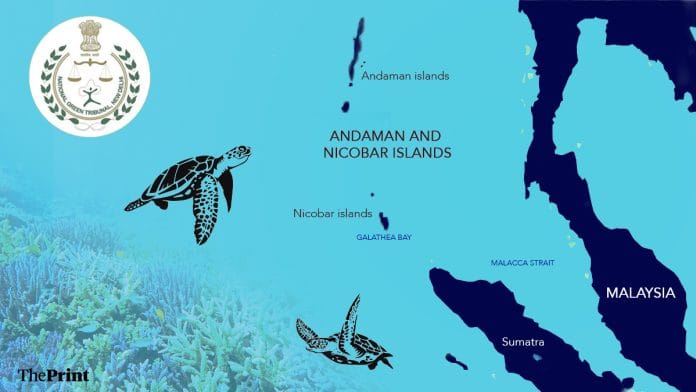
Central to the Tribunal’s reasoning was geography. Great Nicobar Island sits just 40 kilometres from the Malacca Strait, through which an estimated one-third of global trade passes, it noted.
On Monday, the bench – recalling its 2023 order and noting that its “consideration was confined to material on record” – said the project was placed explicitly in this frame of power dynamics.
It recalled: “noted (without any comment) media reports that the area is located in China’s ‘string of pearls’ strategy, which is sought to be countered by Indian Authorities under India’s Act East policy. Indian Ocean has emerged as a key intersection zone of Indian and Chinese strategic interests. There are further media reports of huge poaching of environmental marine resources of Andaman… The project will help bridge infrastructural gap in island and promote international trade, saving huge amount on transhipment cargo.”
Beyond its defence utility, the Tribunal noted that the project is expected to generate around 1,28,558 jobs and transform Great Nicobar into a global maritime hub.
“Every developmental activity is bound to have some adverse impact on (the) environment but if impact can be mitigated and advantages to the society are greater, such project(s) have to be allowed in larger public interest,” it said.
In the same vein, the Tribunal had observed in 2023 that a “hyper technical approach should not be adopted, ignoring ground reality and national security” — a principle it apparently carried forward into Monday’s order.
Environmental concerns & tribal rights
The key challenge to the project — that the port and other components fell within prohibited ICRZ-IA areas — was resolved through ground-level verification.
Kothari’s petition had argued, based on a Wildlife Institute of India (WII) report and the National Marine Turtle Action Plan, that Galathea Bay was a turtle nesting ground and a hatching site for the endangered Megapode birds.
This, the petition said, meant it was an ecologically sensitive area under CRZ, where development projects are barred.
But the Tribunal relied on what it called “ground truthing” exercise by the National Centre for Sustainable Coastal Management (NCSCM) and concluded that “no portion of the project area fell under CRZ-IA area”.
The Tribunal accepted the Union government’s position based on the NCSCM site visit and dismissed Kothari’s argument. NCSCM is a research institute that falls under the Union environment ministry.
On the petition’s concerns over destruction of coral ecosystems, the Tribunal relied on a Zoological Survey of India report that “no major coral reef exists within the work area of the project”. Instead, ZSI said, there were scattered coral reefs around the project, and these can be protected through translocation.
Third, the petitioner challenged the sufficiency of environmental impact data being limited to a single season. On this, the Tribunal accepted the government’s position that three seasons of data was not required because there is “no high-erosion site” in the Andaman and Nicobar Islands.
When it came to rights of the Shompen and Nicobari tribes, the Tribunal held that the project “will not displace or displace” any tribal people.
Limiting the footprint
The Tribunal said that the government has also committed to offset environmental damage by establishing three wildlife sanctuaries for leatherback turtles, megapodes and corals, and constructing two research stations at Campbell Bay and Kamorta for monitoring biodiversity.
Further, it noted, the government has promised to set up independent monitoring committees to oversee tribal welfare and pollution control.
But Monday’s ruling does not place the Great Nicobar project beyond all future scrutiny.
The Tribunal was explicit that its clearance was conditional on “full and strict compliance” with all environmental conditions. The clearance stands, but any violation of the ICRZ conditions, the shoreline protection mandate, or any other environmental obligation during actual construction will constitute fresh grounds for legal challenge.
“The shoreline of the island will be protected ensuring no loss of sandy beaches as these beaches provide nesting sites for turtles, bird nesting sites, apart from protecting the islands,” it said.
Petitioners can now approach a higher court to appeal the NGT’s order.
(Edited by Prerna Madan)
Also Read: ‘Application of mind not proportionate to number of pages’—Why SC has expressed ‘anguish’ at NGT