







By Tom Bateman and Kyung Hoon Kim
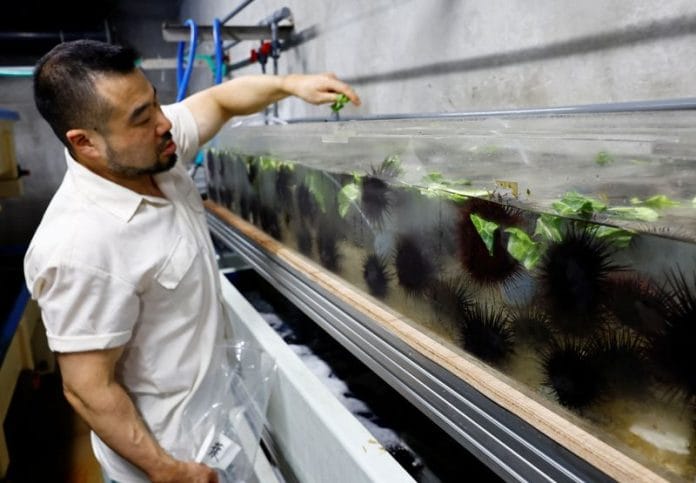
KANAGAWA, Japan (Reuters) – In Japan, researchers are feeding vegetables to hungry sea urchins – a popular sushi ingredient – to try and stop them from eating dwindling stocks of ocean seaweed.
The country is struggling with a “desertification of the sea” or “isoyake” problem, where the coastline faces a stark decrease in seaweed forests that host a diverse array of marine life and support the livelihoods of local fishers.
In Sagami Bay off the coast of Kanagawa, just south of Tokyo, the seaweed bed areas have decreased 80% over the past three decades, according to Kanagawa Prefectural Fisheries Technology Center researcher Yutaka Harada.
Scientists think overgrazing by herbivore sea urchins is a factor behind the phenomenon, along with the possible effects of a rising sea temperature and stronger tidal waves. But controlling the animal’s population is not an easy task.
“There are a lot of sea urchins in the areas where seagrasses have disappeared,” said another Kanagawa researcher Shozo Takamura. “Divers and fishermen dive down in their bathing suits to collect and get rid of them, but their numbers have barely fallen.”
Unlike the urchins sold to luxury sushi bars, most sea urchins in coastal Kanagawa do not have many edible parts, making it less commercially viable for the fishers to keep catching them.
But researchers are studying ways to nurture the creature caught in Kanagawa.
“The urchins we’re raising here at the research centre, which are Pacific purple sea urchins, really love vegetables,” like surplus cabbages that are given to us and Japanese mustard spinach, said Harada.
Local sea urchins tend to have a paltry 2-3% edible parts, but the lab-fed ones are as much as 20% edible, with less bitter taste, he added.
The project’s findings mean the local urchins could become more valuable, creating a bigger economic incentive to catch them, and sparing the remaining ocean seaweed.
“We’re working towards raising even tastier sea urchins on land and selling them to support our efforts against ocean desertification,” Harada said.
(Reporting by Tom Bateman and Kyung Hoon Kim; Writing by Kantaro Komiya; Editing by Alexandra Hudson)
Disclaimer: This report is auto generated from the Reuters news service. ThePrint holds no responsibilty for its content.