







By Fatos Bytyci and Ognen Teofilovski
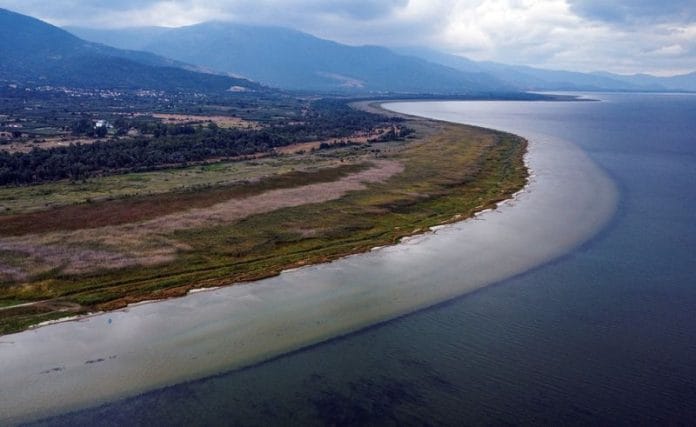
LAKE PRESPA, N. Macedonia (Reuters) – Fisherman Vancho Vasilevski’s boat frequently runs aground when he sails on Lake Prespa, one of Europe’s oldest lakes and home to more than 2,000 species of fish, birds, mammals and plants, in a sign of how much water the lake is losing.
“In the last two, three months the water has dropped 36 centimetres and in last days probably another two or three centimetres,” said Vasilevski, who is in his late 60s.
“It will go down more. There is no rain, no winter, no snow, no rivers. Only one river is coming into the lake… This is a disaster, a natural disaster.”
The decline has continued over decades – the water at Lake Prespa, which is situated high in the mountains and is 5-million-years-old, is now more than 8 metres (8.74 yards) lower than the late 1970s. In a 2022 report, NASA said that satellite images showed the lake had lost 7% of its surface area and half of its volume between 1984 and 2020.
With a surface area of around 260 square kilometres, more than twice the size of Paris, more than two thirds of the lake belongs to North Macedonia and the rest to Greece and Albania.
The United Nations Development Program (UNDP) has warned some wildlife species at the lake are at risk of extinction because of the destruction of their habitat through harmful farming practices, erosion, untreated waste and waste waters.
Any drop in water level can affect Lake Ohrid, a much larger lake just 10 km from Prespa and which draws around one third of its water from Prespa.
Environmentalists have said lack of rain, evaporation and overuse of water for irrigation by all three countries are the main reasons for the water loss.
Dragan Arsovski, a biologist from Skopje-based NGO Macedonian Geological Society, said the lake’s level has risen and fallen over the centuries and nature has survived. But today people are failing to adapt and take action.
“There are some things when it comes to global climate change that we simply cannot change and we need to adapt to what is to come. Some things perhaps we can change, like our everyday habits,” he said.
Pesticide use by fruit farmers has led to the rapid growth of biomass that endangers endemic species.
“All (pesticides) go in the underground waters, in the lake, they go everywhere and are very dangerous for Prespa,” said Mende Pandevski, harvesting plums close to the lake.
(Editing by Alexandra Hudson)
Disclaimer: This report is auto generated from the Reuters news service. ThePrint holds no responsibilty for its content.