





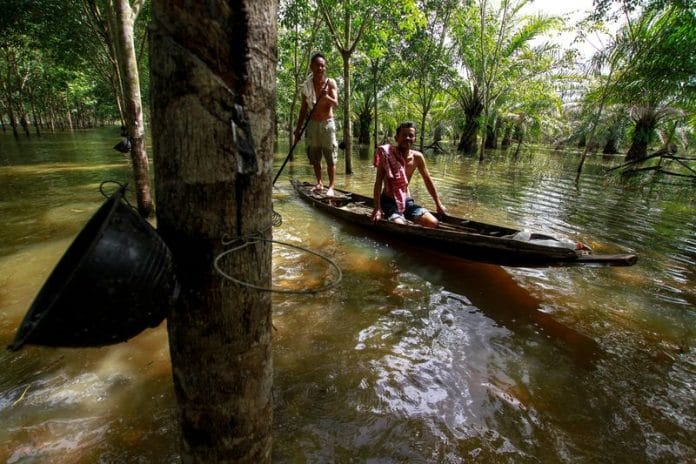


SINGAPORE (Reuters) – Forest loss driven by rubber production in Southeast Asia could be two to three times higher than estimated, highlighting the challenges facing importers under pressure to find sustainable supplies, research showed on Wednesday.
Increasing global rubber demand is adding to pressure on natural forests and driving biodiversity loss, with Southeast Asia, responsible for 90% of global production, bearing the brunt, an international team of researchers warned.
The researchers, in a paper published by Nature, said that previous data suggested rubber was a relatively minor problem when it comes to deforestation, compared with commodities like soy and palm oil.
But high-resolution satellite data, which helped identify more plantations run by smallholders, suggested that forest losses “greatly exceed” previous estimates.
More than 4 million hectares of forest have been lost to rubber plantations since 1993, with two thirds of it in Indonesia, Thailand and Malaysia, they said.
More than 14 million hectares of land in the region – including China’s main rubber-producing provinces of Yunnan and Hainan – are devoted to rubber, up from 10 million in 2020.
Total losses could be even higher, with many plantations launched during a rubber boom 20 years ago now converted to other uses following a price crash in 2011.
A law will come into effect in the European Union at the end of next year to prevent commodity importers from buying goods that contribute to forest loss.
The law originally applied to soy, beef, palm oil, wood, cocoa and coffee, with rubber added at the request of EU lawmakers last December.
To avoid fines, importers must provide information proving that products do not come from land deforested after 2020.
The rules could encourage buyers to source rubber from big producers with less complicated supply chains, said Antje Ahrends of the Royal Botanic Garden Edinburgh, lead author of the study published on Wednesday.
“Given the multitude of stages in the rubber supply chain, and the scattered nature of rubber production, it is difficult for traders and manufacturers … to locate exact rubber sourcing areas and to verify that no deforestation has occurred,” she said.
Organisations like the Forest Stewardship Council are working to improve traceability for smallholders – responsible for 85% of global production – and ensure their rubber can be sold in Europe, she said.
(Reporting by David Stanway; editing by Robert Birsel)
Disclaimer: This report is auto generated from the Reuters news service. ThePrint holds no responsibilty for its content.