





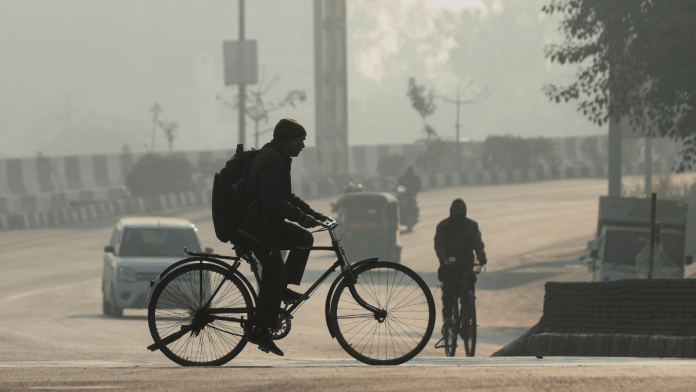



New Delhi: The capital’s air quality remained firmly in the ‘severe’ category for the third consecutive day as a combination of toxic haze and fog blanketed the region Monday.
Meteorologists said the season’s first spell of ‘severe’ air quality index (AQI) was a result of calm winds and high humidity.
“Currently, Delhi is getting easterly winds. These winds are not only calm, but are also bringing moisture, which aids pollution accumulation,” said Mahesh Palawat, vice-president of meteorology and climate change at Skymet Weather, a private weather forecasting service.
The Central Pollution Control Board’s 4pm bulletin said average AQI was 427 on Monday.
At 431, Delhi’s 24-hour average AQI exceeded the 400-mark – i.e. ‘severe’ category – for the first time this winter on Saturday. AQI deteriorated to 461 Sunday—the worst reading this season.
On CPCB’s scale, air quality is categorised into six bands: 0-50 (good), 51-100 (satisfactory), 101-200 (moderate), 201-300 (poor), 301-400 (very poor), and 401-500 (severe).
On Monday morning, the India Meteorological Department (IMD) reported the city’s first smog spell, with visibility at Delhi IGI airport dropping to 50 metres at 6:30am before gradually improving to 200 metres by 8:30am and 500 metres by 11am.
Clear views of Dense #Fog over #Pakistani, #Punjab, #Haryana, #Delhi, and #UttarPradesh. @SkymetWeather @JATINSKYMET pic.twitter.com/S52AqGmD06
— Mahesh Palawat (@Mpalawat) December 15, 2025
News agencies reported that around 250 flights were delayed, and dozens more cancelled, across north India.
Also Read: Delhi’s air is choking its sports events—cyclothons and marathons cancelled due to AQI
Calm winds & no WD effect
Meteorologists said the shift from north-westerly to easterly winds on Saturday (13 December), combined with low wind speed and high moisture, led to thermal inversion—when warm air, instead of rising to the upper atmosphere, settles above a layer of cooler air near the ground, trapping pollutants close to the surface.
Also affecting weather conditions is fewer-than-usual western disturbances (WD) this winter. Typically, two to three WDs are recorded during the winter season.
IMD officials said a western disturbance affected the region on Saturday, but it wasn’t strong enough to clear pollutants. WDs are weather phenomena that typically originate over the Mediterranean and lead to non-monsoonal rainfall in north India.
“Western disturbance this time of the year brings the temperature down, and if it is strong enough, it can cause spells of rain as well,” an IMD official told ThePrint.
Environmentalists said Delhi’s annual pollution crisis highlights the government’s failure to address the city’s own emission sources, especially since official data indicates the impact of stubble burning was lower than normal this year.
“Delhi, despite being the capital, is facing an air emergency. It is like the governments have abandoned the citizens. There is no discussion or even an attempt to find solutions for this annual problem. People have been abandoned to save themselves,” said Vimlendu Jha, a Delhi-based environmentalist.
Weather forecasters predicted partial relief from Tuesday afternoon.
“The wind direction will change to north-westerly again, and it will also start picking up speed. This will disperse the pollutants to some degree,” Palawat said.
(Edited by Prerna Madan)