





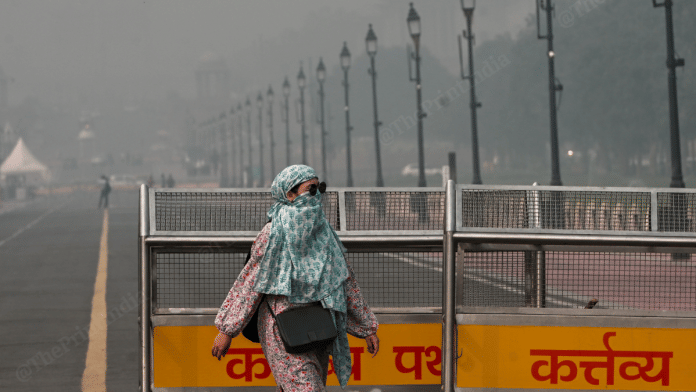



Bengaluru: Vehicular emissions and not stubble fires are the biggest contributions to Delhi’s foul winter air, a new analysis by the national capital-based think tank Centre for Science and Environment (CSE) has shown.
It also showed that the level of fine pollutants has shown no improvement since 2022, indicating that pollution control measures being implemented by government agencies have not been effective.
The report released Monday shows a repeated pattern where PM2.5 rises and falls which is in sync with the nitrogen dioxide during morning and evening peak and rush hours, showing the pivotal role of the traffic in daily pollution rise.
Nitrogen dioxide shows a sharp and immediate peak from tailpipe emissions, whereas PM2.5 accumulates more slowly but stays trapped under shallow winter boundary layers. Carbon monoxide, another harmful gas where vehicles are the biggest emitters, has shown an exceeding rise across the city.
“What’s more worrying is the daily synchronised rise of PM2.5 and other toxic gases such as nitrogen dioxide (NO2) and carbon monoxide (CO), largely from vehicles and combustion sources, creating a toxic cocktail that has gone unnoticed,” CSE executive director-research and advocacy Anumita Roychowdhury said in a statement.
She added that the trends signal an urgent need for deep rooted shifts in infrastructure and systems to upscale action for cutting emissions from vehicles, industry, power plants, waste, construction and household energy.
This winter, 22 monitoring stations recorded carbon monoxide above the safe eight-hour limit on more than 30 of the first 59 days. Dwarka Sector 8 recorded 55 exceedance days, while Jahangirpuri and Delhi University’s North Campus recorded 50 days each.
This rise simultaneously in PM2.5, nitrogen oxide and carbon monoxide forms what the report calls a “toxic cocktail”, which is dangerous because it comes from the daily combustion sources like vehicles, household fuels and waste burning. Each winter, the core combustion problem gets weaker attention and control measures only continue to focus on dust and construction, the report said.
Stubble burning, which is the dominating factor in the public conversations every year, was much lower this particular season. According to the CSE, the contribution of farm fires stayed below 5 percent for most of the early winter period. This had peaked to 22 percent only briefly on 12-13 November and hovered around 5 to 15 percent on a few days. The decline in fires is also linked to heavy monsoon floods in Punjab.
But even with this dip, Delhi’s air quality hardly made any positive change. Almost all of November, the air stayed in the very poor to severe category and PM2.5 remained the critical pollutant on most days. The reduction in smoke only prevented extreme one-day spikes but did not clean the overall daily average which proves that Delhi’s own emissions now drive the baseline pollution levels.
One of the most critical observations is that Delhi’s PM2.5 trend has plateaued since 2022. Between 2018 and 2022, there was a clear improvement which had helped partly by the slowdown during the pandemic. But since 2021-22 onwards, PM2.5 levels have stabilised at a high level with no reduction signs.
The city’s annual average even rose sharply to 104.7µg/m³ in 2024. Early-winter averages this year appear slightly lower than last year, but when compared to the three-year baseline, there is no change at all. This means Delhi is now breathing consistently toxic air throughout the year, with no sign of a downward trend.
The report highlights that the pollution hotspots in Delhi have multiplied. Traditional hotspots such as Jahangirpuri, Bawana, Wazirpur and Anand Vihar continue to record extremely high PM2.5 levels, but newer hotspots like Vivek Vihar, Nehru Nagar, Alipur, Sirifort, Dwarka Sector 8 and Patparganj have now joined the list.
Even the smaller regions of the National Capital Region, which had relatively cleaner gaps are now facing severe and prolonged smog. Bahadurgarh, for example, saw a ten-day smog spell with an average intensity higher than Delhi’s. This shows that the entire NCR now behaves as one polluted airshed, with no room left for natural dispersion.
In conclusion, the CSE report warned that Delhi has reached an inflexion point. Small and temporary measures will not solve the pollution problems anymore. Without deep structural changes in transport, energy, waste management, industry and household fuels, the city risks losing whatever gains it made in earlier years.
(Edited by Tony Rai)
Also Read: Lockdown-like curbs can drastically reduce air pollution in Delhi, says study