





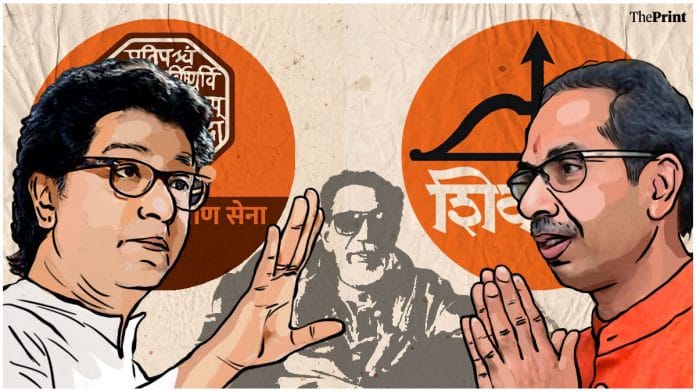



Mumbai: Reunited after 20 years, the Thackeray brothers are aggressively pushing the ‘Sons of the Soil’ agenda, saying that those not born in Mumbai could never understand the city’s issues. Their claim? If the BJP, after the Centre and state, now comes to power in the municipal corporations, Marathi people will suffer an identity loss.
Calling Maharashtra Chief Minister Devendra Fadnavis and others “outsiders in Mumbai”, Maharashtra Navnirman Sena (MNS) leader Raj Thackeray told Saamana executive editor Sanjay Raut and director Mahesh Manjrekar in an interview, “Fadnavis is from Nagpur, so many others are also outsiders. One will never know what Mumbai’s Mumbaikars want unless one is born in Mumbai.”
Saamana is the Uddhav Thackeray-led Shiv Sena’s mouthpiece. The elections for 29 municipal corporations in Maharashtra, including the Brihanmumbai Municipal Corporation (BMC), will be held on 15 January, and the results will be declared on the next day.
Raj expressed concerns over the growing population of outsiders in the Thane district, which, he said, had the highest number of municipal corporations in any region—eight. Saying this, he claimed North Indians had been flocking to the area not only to make a living but also to boost the voting population with their kind.
“Today, the people coming to Maharashtra are not just coming to make a living, but also to increase their voter count. At least 56 trains from the North come to Mumbai every day and go back empty,” he said. “Municipal corporations are set up according to population. Thane district has the maximum number of corporations—eight, including the Palghar district—while Mumbai has one and Pune has two. The growing population is a result of outsiders coming and increasing their voting population.”
During the Saamana interview, the once-estranged and now-reunited Thackeray brothers spoke at length on several issues. These ranged from possible reasons behind uncontested election victories in Maharashtra to Mumbai’s rising AQI (Air Quality Index), which they called “a result of town-planning failure”. Also, they questioned the “double standards” of Chief Minister Devendra Fadnavis’s accusations of corruption against them, without checking into “his Pawar-laden backyard”—a reference to the Ajit Pawar-led Nationalist Congress Party (NCP).
In the same interview, Shiv Sena (UBT) leader Uddhav Thackeray said that while the upcoming elections appeared like a Marathi vs Marathi fight, the BJP has its allies in its palms, and they now “work in the master’s place”.
Additionally, Raj countered the CM’s recent “corruption and confusion-yuti” dig at the brothers, saying, “Fadnavis shouldn’t make comments on corruption. They were the ones who took ‘bail gadi (bullock cart)’ for Ajit Pawar, and now, they say that the court case is still ongoing.”
Of late, Maharashtra Deputy Chief Minister Ajit Pawar and his family have received significant relief in long-standing legal cases involving benami assets.
Also Read: Internal fighting saw Mahayuti & MVA form unlikely ties in some seats. How they fared in Maharashtra
Marathi ‘manoos’ vs North Indians
The two brothers, in the interview, said that Maharashtra and Marathi ‘manoos (people)’ were above everything else for them. This was why they had reunited after 20 years, they claimed.
“These people are still trying to separate Mumbai from Maharashtra—just like during the era of the Samyukta Maharashtra movement—when they were planning to separate Mumbai from Maharashtra and Gujarat had asked for Mumbai,” Raj said, speaking about the movement for a united Maharashtra that had spread like wildfire across the region, including in Mumbai city, in the 1950s.
“Now these people are making coercive statements that the mayor will be a North Indian or Hindu,” Raj warned, adding, “Today, they are at the Centre; they are at the state; if they come to the corporations, Marathi manoos will be helpless, tomorrow.”
“We cannot watch all this unfold helplessly; that is why we have come together,” Raj said, calling for renewed efforts to turn the tide.
Speaking on similar lines, Uddhav marked the history of the Sena, which his father, Bal Thackeray, founded in 1966 to bring the ‘Sons of the Soil’ under one umbrella.
The Sena, he recalled, was formed six years after the Samyukta Maharashtra movement.
The party, considered an extension of the movement, rallied for the economic rights of Marathi ‘manoos’ after Maharashtra’s creation in 1960.
“After the movement ended, between 1960 and 1966, the situation Raj just explained had been created, and people were losing morale. The Shiv Sena was founded with the principles of establishing the spirit and consciousness of the Marathi people and to give them more power,” Udhhav said.
The Samyukta Maharashtra movement had brought together Marathi leaders—mainly from the Left parties—who pressed for the creation of a Marathi-speaking state, with Bombay at its core. The Thackeray brothers’ grandfather, Keshav Thackeray, popularly known as Prabodhankar, was one of the movement’s key figures and influenced the young cartoonist, Bal Thackeray. In the aftermath of the state’s creation in 1960, Prabodhankar had eventually left the multi-party organisation that led the movement due to differences with its communist members.
“While in politics, people always move in and out of parties and coalitions are made and broken. But here, they were not just trying to break the Shiv Sena but completely dissolve it and take away its entire existence,” Uddhav Thackeray said in the interview.
On unopposed elections & air pollution
Several Mahayuti candidates have been declared winners unopposed in the Pune Kalyan-Dombivli Municipal Corporation, among others, following a mass withdrawal of nominations by rival candidates. Uddhav has some thoughts on these elections—“Why are these candidates not from our parties or from Pawar sir’s Nationalist Congress Party or any Independent? That cannot be just a coincidence.”
On this issue, Raj hinted at candidates being bribed to pull back nominations, saying, “NOTA is not an option because the rest were paid ‘Nota (notes)’.”
For another issue—the air quality index in Mumbai—Uddhav blamed construction of more and more high-rises and bridges, the Metro’s expansion, and dug-up roads, all “under the pretence” of development. “Development is required, but not all at the same time. That leads to pollution. There’s dust and cement particles all over the city,” he said.
“There are a large number of redevelopment projects in Mumbai, Thane, Navi Mumbai, Panvel, and neighbouring regions. But there is no town planning. That is destroying the city and the air quality. Pune is being destroyed at a faster rate,” Raj said in a rejoinder.
“From the time that Uddhav’s government collapsed in June 2022—a few months before that—the corporations were dissolved. From 2022 to 2025, no elections. Now, in 2026, elections happen. I will, in the upcoming days, give a detailed interview explaining why there was a four-year delay and what the planning was behind this. Especially what they planned in one year, 2024 to 2025,” Raj added.
(Edited by Madhurita Goswami)
Also Read: BJP’s sweep, boost for Shinde, MVA’s fall—what local body polls say about power play in Maharashtra
Good old tactic. These idiots will never understand that BJP is more smarter than you and already declared that Mumbai’s mayor will be a Marathi candidate. They don’t have anything else to fight on so this is what’s left for them. It’s kind of funny.
They are so useless. I hope this would be the end of Thackeray’s political career.