





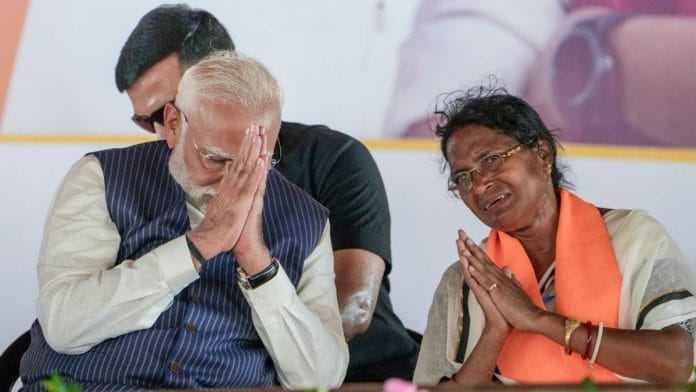


New Delhi: Ratna Debnath, the mother of the trainee doctor who was raped and killed inside RG Kar Medical College and Hospital in August 2024, was leading by around 5,000 votes against Trinamool Congress’s Tirthankar Ghosh from West Bengal’s Panihati, early trends by the Election Commission showed.
Kalatan Dasgupta of the Communist Party of India (Marxist) was in the third place.
The result in Panihati—where all three major candidates are first-time contenders—is among the more closely watched outcomes of this West Bengal assembly election.
A constituency long considered safe for the TMC, Panihati sits within the Dum Dum Lok Sabha seat, a party stronghold since 2009 that it retained comfortably in the 2024 general election. But the RG Kar case, and the role each of the three principal candidates played in its turbulent political afterlife, transformed it into a contest that cut well beyond its boundaries.
The murder of Debnath’s daughter inside a government hospital triggered nationwide outrage and drew the Supreme Court into the matter. Thousands—students, housemakers, professionals and senior citizens—flooded Kolkata’s streets in the weeks that followed, demanding justice.
Debnath, a rank outsider to electoral politics, kept her campaign tightly focused on women’s safety and accountability for her daughter’s death.
A vocal critic of the state government’s handling of the case, she framed her decision to contest in blunt terms: it was her only path to fighting the TMC. She also ran explicitly against dynastic politics, telling voters that “one family rules Panihati”.
Her candidacy was amplified by the BJP from the start.
Smriti Irani, former Union minister for women and child development and former MP from Amethi, accompanied Debnath when she filed her nomination papers. Prime Minister Narendra Modi arrived in Panihati on 24 April to campaign alongside her, attacking the TMC for failing to protect women in Bengal and promising a fresh investigation into the RG Kar case should the BJP win.
The party has sought to convert public anger over the case and the TMC’s handling of it into electoral support, particularly among women and urban middle-class voters.
Debnath’s main opponent carries the weight of that very case.
Tirthankar Ghosh is the son of Nirmal Ghosh, a founding-era TMC loyalist who has held the Panihati seat since 2011.
The elder Ghosh was questioned by the Central Bureau of Investigation in 2024 over allegations that he had ordered the hasty cremation of the RG Kar doctor to forestall a second post-mortem examination. The agency eventually found no evidence of a wider conspiracy, with the case against the sole arrested accused, Sanjay Roy, standing as filed.
But the doctor’s family and the Opposition have continued to allege a TMC-led cover-up, and that shadow has followed Tirthankar Ghosh’s campaign throughout.
The third key contender is Kalatan Dasgupta of CPI(M), a youth leader who was among the first to reach RG Kar on the night of the crime and helped prevent police from removing the body from the scene.
He went on to organise and lead many of the subsequent protests, and the CPM has pitched his candidacy as a reminder that it was the Left—and not the BJP—that gave the RG Kar movement its street presence.
Dasgupta’s campaign has otherwise also focused on Panihati’s quotidian concerns: pollution, clean drinking water, and the adequacy of government schools and hospitals in the constituency’s largely urban wards. His presence as a credible contender raises the possibility that the anti-TMC vote could split in a constituency with deep Left roots.
Sahaj Sankaran is an alum of ThePrint School of Journalism, currently interning with ThePrint.