








Mumbai: India’s sustainability transition is no longer driven solely by climate idealism.
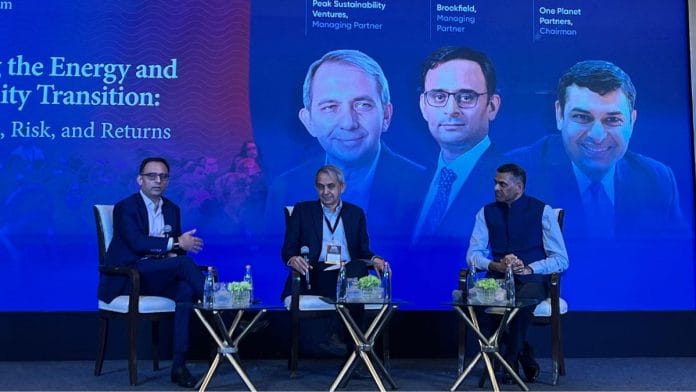
Wharton India Economic Forum’s 30th edition brought together experts from across the climate and finance sectors at St. Regis Mumbai.
At the 10 January event, the experts discussed how India’s sustainability journey is evolving from a narrative of climate intent to one grounded in economics, infrastructure, and long-term returns.
At a panel titled ‘Navigating the Energy and Sustainability Transition: Infrastructure, Risk, and Returns’, industry leaders outlined why India’s climate pathway was increasingly pragmatic, rather than ideological.
The country’s sustainability outcomes will hinge on scale, cost competitiveness and regulatory pressure, along with the ability to finance proven technologies beyond pilot stages to make economics, infrastructure, and governance the decisive forces in shaping India’s energy transition, argued Samir Shah, managing partner at Peak Sustainability Ventures; Nawal Saini, managing partner at Brookfield; and Mukund Rajan, chairman of One Planet Partners.
For much of the past decade, India’s climate ecosystem has been experimental—startups testing new technologies, policymakers announcing targets, and investors scouting for the next breakthrough—and the panellists argued that that phase was ending.
“We have to look at companies which eventually can scale and move the needle on climate. That is the most important outcome,” Samir Shah said, warning that pilots and niche solutions—irrespective of whether those were innovative—will not materially alter India’s emissions trajectory.
He described climate investing as “one of the most complex, interrelated, multi-generational challenges”. Noting that urgency alone does not guarantee impact, in a large nation like India, he said the country required solutions for mass adoption and long-term durability.
Also Read: How consumers react to misspelled brand names
From experimentation to execution
India, the panellists argued, is past the stage of climate experimentation. The real challenge now is translating innovation into nationwide impact.
“Climate investing is perhaps one of the most complex, interrelated, multi-generational challenges we face. But complexity cannot become an excuse for small thinking. In India, unless something scales, it doesn’t matter,” said Peak Sustainability Ventures’ managing partner, Samir Shah.
He warned that fragmented efforts risk wasting time in a decade where speed matters. The emphasis, he said, must shift to platforms and businesses that can deliver impact across millions of users and large physical systems.
Nawal Saini echoed this view from an infrastructure perspective, noting that India’s energy transition can not happen in parts. “At this scale, you do not build for perfection, you build for deployment,” he said, arguing that bankability and execution capacity matter as much as l. technology.
“India does not have the luxury of slow transitions,” he said, while adding, “We need solutions that work at scale—fast, and reliably.”
Intermittency and the role of storage
Concerns surrounding renewable intermittency, often cited as a limitation of solar and wind, were described as transitional rather than structural.
Solar generation plunges at night and under cloudy conditions. The weather patterns cause the wind output to fluctuate. Unlike coal or gas plants, renewables could be used to match any demand, at will.
For a power system like India’s, where electricity demand is rising rapidly, reliability was critical—variability creates operational challenges. The grid must always balance supply and demand in real time. If generation falls suddenly and there is no backup, it can lead to instability, outages, or the need for expensive emergency power.
That is why intermittency has long been one of the main technical constraints to India’s clean energy ambitions. “The intermittency issues of solar are intermittent problems. They will get solved,” Saini said, emphasising technology evolution—rather than ideology—will address reliability concerns. “What links it all together now is batteries,” he added, pointing to rapid advances in storage that are changing grid dynamics.
Batteries store excess solar or wind power when generation is high and release it when production drops or demand spikes. This allows renewable energy to behave more like conventional, dispatchable power.
In India, lithium-ion batteries are already under deployment at the grid scale. Pumped hydro storage, which uses surplus power to pump water uphill and releases it later, is emerging as another key solution. Longer-duration storage technologies are also under development.
As storage costs fall, renewables become increasingly reliable, reducing the need for coal or gas as backup. Shah reinforced this point, noting that in public debates, “intermittency” was frequently overstated. “Every energy system has constraints. The question is whether you can engineer around them at scale,” he said.
Mukund Rajan added that storage would also reshape risk assessment. As grids stabilise, he said, renewables will increasingly be seen as dependable infrastructure rather than experimental assets, lowering financing costs over time.
Niche with regulations
Sustainability in India is no longer confined to renewable energy projects. It is increasingly being woven into the fabric of the economy—across manufacturing, infrastructure, finance and agriculture—driven as much by regulation as by market forces.
“Solar and sustainability are not vertical but horizontal,” said Samir Shah.
Regulation has emerged as the key force pushing this horizontal integration.
“Corporates usually move reluctantly unless there is a little more of the stick,” said Mukund Rajan. “
But the good news is that India has provided both sticks and carrots.”
ThePrint was the digital media partner for the 30th edition of the Wharton India Economic Forum.
(Edited by Madhurita Goswami)
Also Read: Airtel, boAt, D’YAVOL—Bads of Bollywood is a B-school in marketing & promotion