





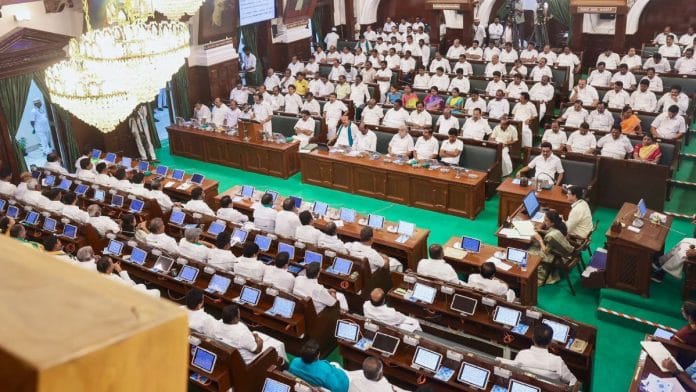



Chennai: Ahead of state polls, in the interim Budget presented in the Tamil Nadu Assembly Tuesday, the DMK government accused the Centre of creating an “artificial fiscal crisis” for the state by withholding funds, tightening borrowing and making unilateral deductions from state accounts.
Presenting the budget, Tamil Nadu finance minister Thangam Thennarasu said, Tamil Nadu’s fiscal strain was “largely the result of actions taken by the Centre”, adding that these measures had a “destabilising impact” on state finances even as welfare commitments continued.
His remarks came a day after a high-level committee set up by the Tamil Nadu government on Union–state relations submitted its report to Chief Minister M. K. Stalin, examining fiscal, administrative and constitutional friction between the Centre and states.
Presenting updated figures, Thennarasu said Tamil Nadu’s outstanding debt, initially estimated at Rs 9.29 lakh crore in the 2025–26 Budget Estimates, had risen to Rs 9.52 lakh crore in the Revised Estimates. This included Rs 9,523 crore linked to Chennai Metro Rail Phase-II, which the state argues should appear in the Centre’s accounts.
Excluding this component, the adjusted debt stands at Rs 9.42 lakh crore, as per the state government’s estimates. For 2026–27, the interim Budget projects total outstanding debt to increase to Rs 10.62 lakh crore. The minister said Centre-level accounting and funding decisions had “artificially inflated” the state’s debt burden.
Tamil Nadu’s interim Budget for 2026–27 places the total expenditure outlay at Rs 3,93,272 crore in Revenue Expenditure and Rs 59,562 crore in Capital Expenditure, bringing the total capital outlay (including net loans and advances) to Rs 73,270 crore.
The state also emphasised that this interim Budget only seeks approval for essential expenditure and follows convention by avoiding new schemes, as the full Budget will be presented by the new government after the 2026 elections.
On the fiscal front, Tamil Nadu’s debt-to-GSDP ratio stands at 26.12 per cent for 2026–27, after excluding amounts linked to the Chennai Metro Phase-II book adjustment. The state highlighted that this figure remains within the thresholds recommended by the 15th Finance Commission, which benchmarks sustainable debt levels for Indian states.
Borrowings for 2026–27 are pegged at Rs 1,79,810 crore, with repayments of Rs 60,413 crore, taking the total outstanding debt to Rs 10.62 lakh crore by March 2027.
Pending Union funds and fiscal pressures
Finance Minister Thangam Thennarasu said the state’s fiscal pressure had intensified because Union funds were “withheld, reduced or unilaterally deducted”. He cited delayed releases under ‘Samagra Shiksha’, reduced allocation for the Jal Jeevan Mission, pending Finance Commission grants, the Rs 1,709 crore IGST deduction “without consultation”, and the mandatory transfer of 5 per cent of outstanding guarantees to the Guarantee Redemption Fund as key examples.
Thennarasu argued that these measures significantly reduced Tamil Nadu’s fiscal space, constrained borrowing limits, weakened liquidity and created additional pressures on welfare and infrastructure spending.
Situating the matter within India’s federal structure, the minister said the challenges stemmed from “withholding of release of funds for centrally sponsored schemes, curtailment of tax revenues without due consultation, or unfair imposition of conditions to mandate expenditure”.
Despite this, he said, Tamil Nadu remained committed to welfare delivery and fiscal consolidation.
The Opposition criticised the budget. AIADMK leader Edappadi K. Palaniswami described the 2026 budget as a “grand ear-piercing festival” (ear-piercing in Tamil proverb means lying), stating that the government had ignored protests and public concerns, He predicting a return of the AIADMK to power.
Former BJP state president K. Annamalai said the budget failed to address the needs of workers, employees, students and welfare-dependent groups. He argued that the government focused more on blaming the Centre than responding to public concerns and said delays in projects such as the Madurai Metro and Coimbatore airport expansion stemmed from the state’s failure to submit required proposals and funding commitments.
(Edited by Viny Mishra)
Also read: Steady growth rooted in ‘Dravidian model’. How Tamil Nadu more than doubled its GSDP in 10 yrs
At this rate, we need a calculator, a lawyer, and popcorn to understand one budget speech.
The budget session should be titled as “Who owes whom?”