





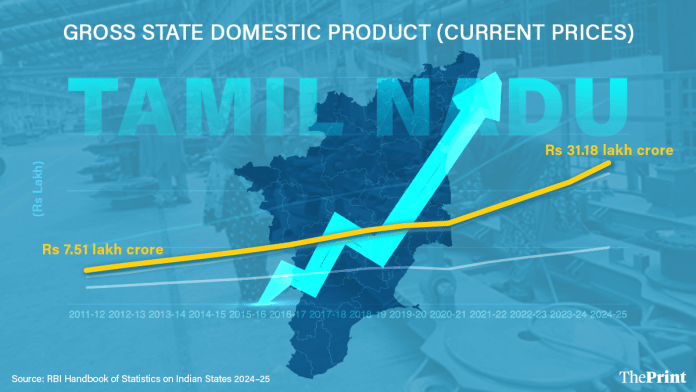



New Delhi: With its Gross State Domestic Product (GSDP) having more than doubled over the past decade, Tamil Nadu remains one of India’s strongest state economies.
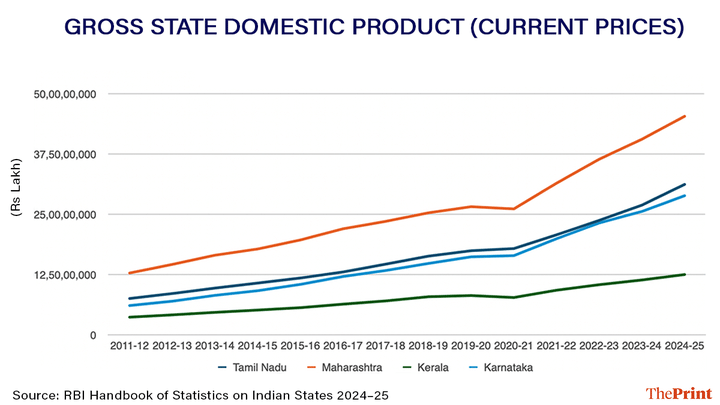
According to the Reserve Bank of India’s Handbook of Statistics on Indian States 2024–25 released last week, the state’s GSDP—the monetary value of goods and services produced in a state—increased from about Rs 14.6 lakh crore in 2017–18 to Rs 31.18 lakh crore in 2024–25, finishing second behind Maharashtra.
But the state’s meteoric economic rise did not happen overnight. Successive governments—starting with the Indian National Congress in the 1950s, to the alternating DMK (Dravida Munnetra Kazhagam) and AIADMK (All India Anna Dravida Munnetra Kazhagam) governments focused on welfare schemes over the past few decades—set up a strong base.
“Up to the 1990s, the state focused on social parameters—education, health—while the Union government was focused on capital and investment,” said K. Jothi Sivagnanam, a professor of Economics at the University of Madras, explaining the state’s strong performance. “This ‘Dravidian Model’ gave Tamil Nadu a foundation to build on.”
Sivagnanam added that after the Indian economy was opened up in the early ’90s, Tamil Nadu was the prime destination for foreign investment. It had a skilled, educated labour force—many of whom were English speakers—that attracted companies to the region.
And the focus was never on just one industry, but rather a “cluster development” model—automobile components, textile, leather and granite industries all found a footing in the state. “If there is no software, there is no Bengaluru. But in Tamil Nadu, we are not dependent on one industry,” said Anand Sreenivasan, a Chennai-based investor who runs Money Pechu, an Economics-focused YouTube channel.
Royal Enfield, TVS Motors and Ashok Leyland all have factories in Tamil Nadu, which has become a hub for auto components. Near Vellore, the leather industry processes raw leather and makes finished goods. In November 2023, the Crocs factory at Perambalur footwear park was inaugurated.
“From the late 1950s, we have had a practice of setting up industrial estates. In 1958, Guindy Industrial Estate was one of the country’s first industrial areas,” said Sreenivasan, adding that the Tamil Nadu Small Industries Development Corporation (TANSIDCO) has been operational since 1970.
Gross State Value Added from manufacturing has steadily surged over the years, reinforcing the state’s position as a factory powerhouse. The figure increased 87 percent from Rs 2.81 lakh crore in 2017-18 to Rs 5.27 lakh crore in 2024-25.
Also Read: Goa, Kerala lose sheen as more foreign tourists pick Maharashtra & Bengal, shows RBI data
Growth balanced with social development
The state’s economic performance is especially impressive, considering that the state has performed well across health and education parameters as well, balancing growth with social development.
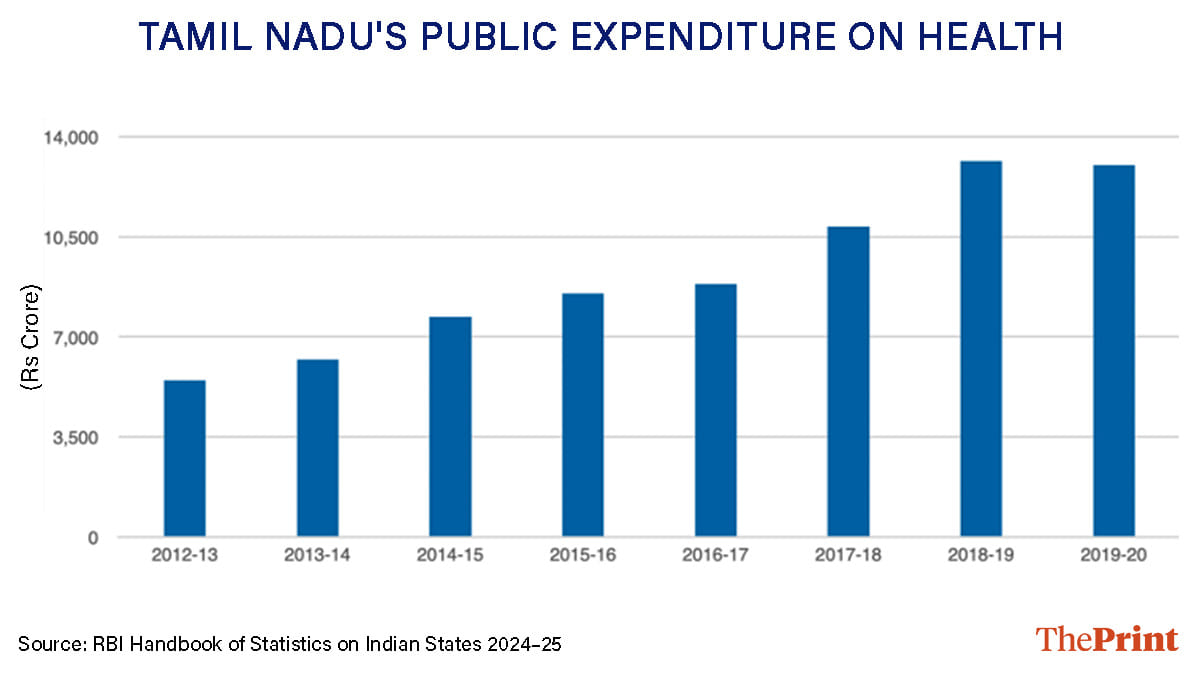
In 2012-13, the state’s public expenditure on health stood at Rs 5,484 crore. This figure increased by 137 percent to Rs 13,012 crore in 2019-20, second only to Maharashtra (Rs 14,756 crore).
This focus on public healthcare has permeated to parameters like life expectancy, which is among the highest in the country. Average life expectancy increased from 69.8 years in 2008-12 to 73.4 years in 2019-23, marginally trailing other states, like Himachal Pradesh (74.4 years) and Kerala (75.1 years).
Tamil Nadu has a history of focusing on public health schemes. In 1957, then chief minister C.N. Annadurai had promised subsidised rice because it was a period of high inflation and drought. “The focus was always on welfare. The politics got shaped by the issues of the people,” said Sivagnanam.
Sreenivasan pointed to the strength of primary health centres and private hospital networks in the state. Apollo Hospitals—the largest private hospital chain in India—is headquartered in Chennai. The state also sees a significant influx of foreigners for medical tourism.
“We have a very strong public delivery system,” said Sreenivasan, adding that when gas prices hit people’s pockets, the government started a programme in September 2023, where nearly 1.5 crore families received Rs 1,000 per month for gas cylinders. “Apart from the mid-day meal scheme—which was pioneered here before being expanded to the rest of the country—now students also get free breakfast in school.”
But according to RBI data, the state’s birth rate has fallen steadily over the last two decades, dropping from nearly 16 births per 1,000 people in the mid-2000s, to about 12 per 1,000 in 2023. Tamil Nadu is now well below the national average and has one of the lowest fertility levels—below replacement rate—among large Indian states.
Also Read: South rising, west slipping: India’s export map is being redrawn, shows RBI data
Solid education outcomes, but unemployment a concern
Education outcomes continue to remain strong. The state’s Gross Enrolment Ratio (GER) at the secondary level (from Class 9 to 12) stood at around 89.4 percent in 2024–25, compared to the all-India average of 68.5 percent.
“DMK brought a benchmark in revenue spending. They spent 40 percent of revenue expenditure mostly on the social sector, including education,” said Sivagnanam. But he added that a lot of credit goes to the state’s longest serving chief minister—K. Kamaraj—who pioneered the concept of “aided schools” in the late 1950s.
Government-aided schools in Tamil Nadu are private schools that are financially supported by the state through grants and payment of teacher salaries, but are still independently run. “Kamaraj said that every village should have a school, and no child should have to walk more than 5 km for high school,” said Sreenivasan.
He went on to add that several industrialists, like HCL’s Shiv Nadar who benefitted from the public education system, have gone on to start their own institutions. Some sponsor thousands of students’ college education every year.
“His [Nadar] years at PSG College of Technology, Coimbatore, where he got admission in spite of being a rural student, inspired him to create educational institutions out of gratitude,” said Sreenivasan.
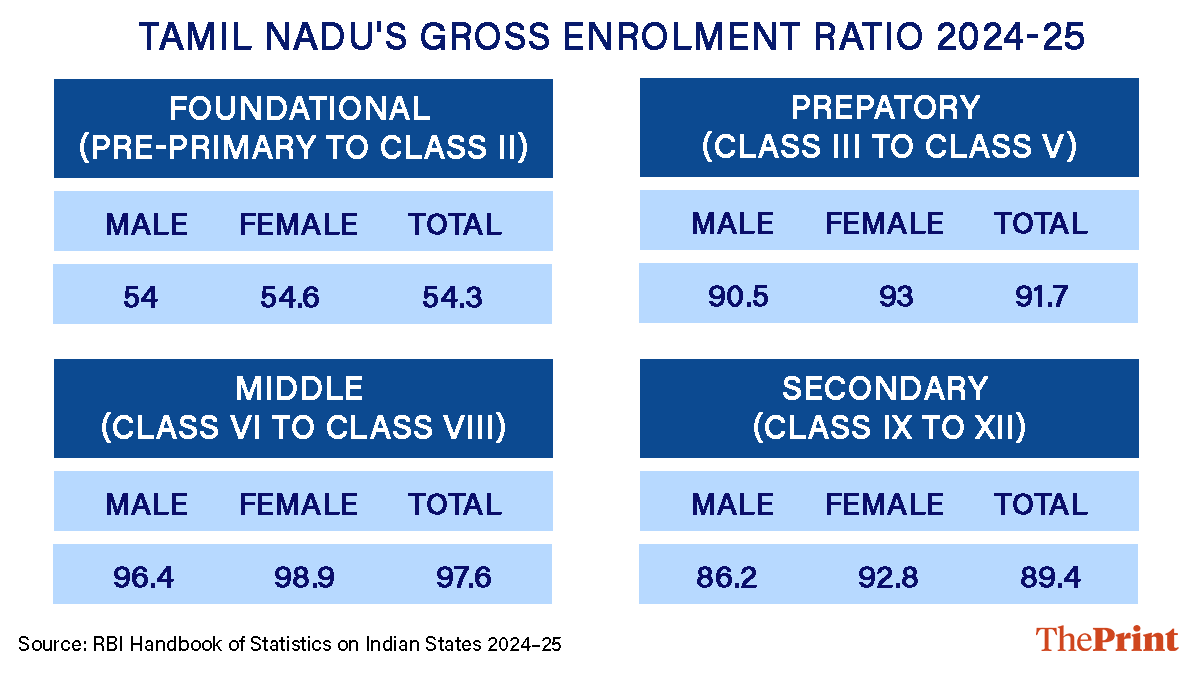
The state has also achieved near gender parity in schooling, with the Gender Parity Index close to or above 1 across most levels of education, indicating almost equal enrolment of boys and girls. These figures place Tamil Nadu among the best-performing large states in terms of school education outcomes.
“Tamil Nadu was also one of the first states to start a first-generation graduate scheme, where education fees are partly subsidised by the government,” said Sreenivasan, adding that the state’s 70 percent reservation policy also helped the state create educated manpower.
But urban unemployment remains a concern, specifically among the urban population. In 2023-24, Tamil Nadu recorded 40 people unemployed per thousand—greater than Gujarat (23 per thousand) and Madhya Pradesh (28 per thousand). This figure is still less than the national average of 51 per thousand people unemployed in urban areas.
Fiscal pressures are also visible, with higher expenditure commitments in health, education and welfare adding strain to state finances, even as capital spending continues.
But the combination of economic scale, manufacturing strength and demographic transition places the state in a different category, compared to many of India’s fast-growing but younger states. The mix of these factors is bound to shape its economic priorities as well as political issues, like delimitation, at the national level.
(Edited by Mannat Chugh)
Also Read: India’s merchandise exports to US rising month-on-month despite Trump tariffs, govt data shows
“Dravidian model” is a political slogan and has no bearing on the governing of the state. The reporter cannot use the slogan without providing any evidence to connect the slogan to the growth. If the reporter and The Print wants to present a complete analysis, they should review the full set of 182 tables in the RBI handbook and then make the claim if Tamil Nadu or any other state is leading in growth etc. Else this appears to be a planted article with various graphs etc in favor of a state and does gross injustice to the RBI report and your own credibility.
For example, the state interest payments of TN is now 62456 crores (24-25) about 50% more since the current government took over in (21-22 figures). How does that impact the growth?
How much of this growth is from borrowed money ? The state’s debt has gone to 5+ lac crore. Why does the media paint a picture which is not true ?