





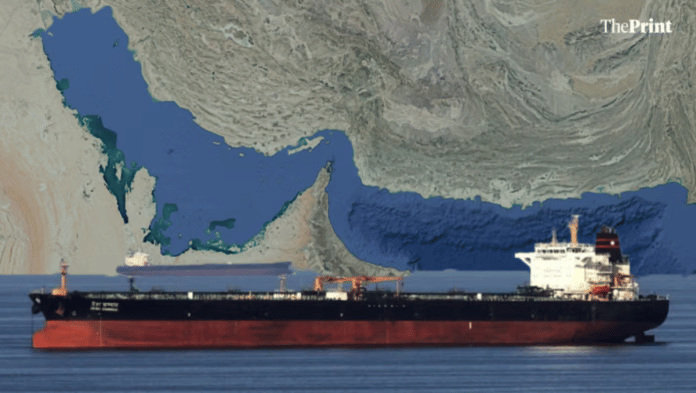



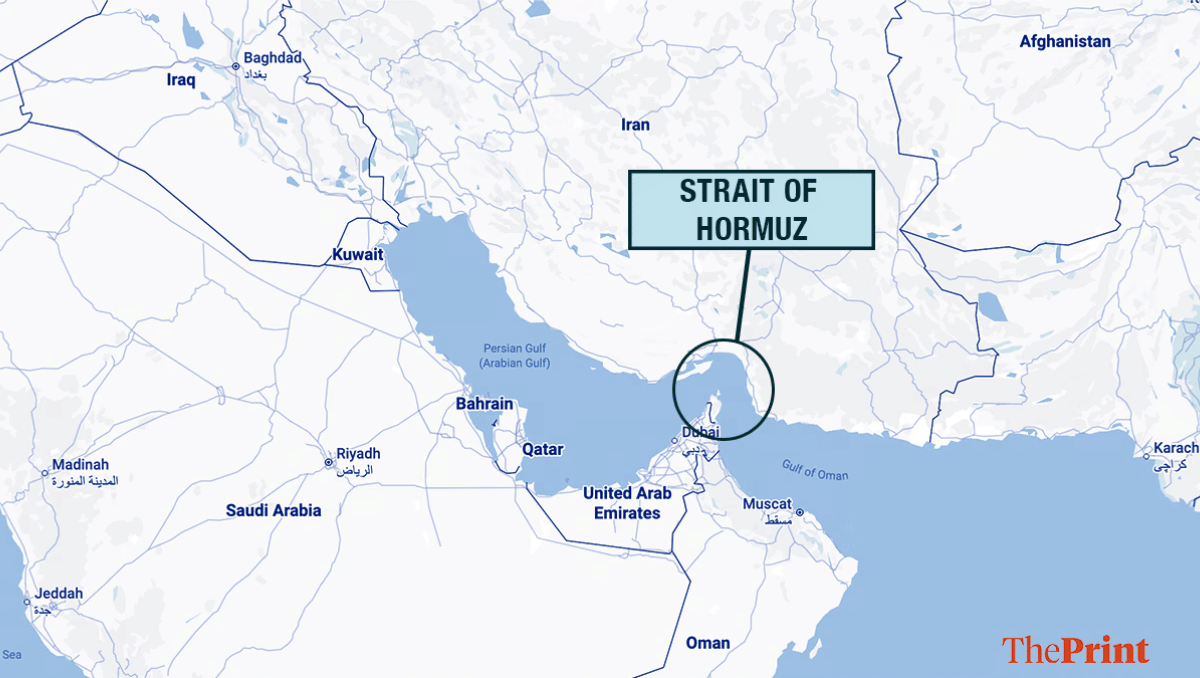
New Delhi: As the war between Israel-US and Iran escalates, the Strait of Hormuz, a sea passage between Oman and Iran via which passes around 20 percent of the global crude, has once again emerged as a critical chokepoint for global energy flows, threatening to spike oil prices substantially.
For India, while crude oil exposure remains significant, its liquefied petroleum gas (LPG) imports face a higher vulnerability.
India imports roughly 80–85 percent of its LPG requirements, with the bulk sourced from Gulf suppliers such as Qatar, Saudi Arabia, United Arab Emirates and Kuwait — almost all of which comes through the Strait of Hormuz, according to Sumit Ritolia, lead analyst for refining and modelling at global trade intelligence firm Kpler.
“Unlike crude, India does not maintain large strategic LPG reserves, and terminal storage buffers are comparatively limited,” he told ThePrint. “As a result, while crude disruptions would likely transmit primarily through prices initially, LPG flows could face tighter logistical constraints more quickly,” he said.
Kpler vessel tracking data shows that approximately 2.5–2.7 million barrels per day — about 50 per cent of India’s crude imports — transit the Strait of Hormuz. These volumes largely come from Iraq, Saudi Arabia, the UAE and Kuwait.
Last week, ThePrint reported on India’s likely concerns regarding crude supply disruption in the Strait of Hormuz.
Over the past few months, India’s reliance on Middle Eastern barrels from Saudi Arabia, Iraq and the UAE has risen as Indian refiners pivoted away from Russian volumes, thereby increasing the relative weightage of Gulf crude oil in the import basket to nearly 50 percent.
This shift has made India more sensitive to disruption in the Strait of Hormuz.
India has diversified its crude oil purchases over the last few months from Russia, the United States, West Africa and Latin America, but it comes with a logistical trade-off.
“Barrels from the Atlantic Basin involve substantially longer voyage durations — typically 25–45 days compared to roughly 5–7 days from the Gulf,” Ritolia pointed out.
“While diversification provides supply continuity, it comes with higher freight exposure and longer supply chains. Middle Eastern crude therefore retains a clear logistical advantage and remains structurally important to India’s supply stability,” he said.
Kpler data shows Russian cargoes remain available in the Indian Ocean and Arabian Sea region, including volumes held in floating storage vessels, providing India with an option if Middle Eastern supplies tighten.
“Should Middle Eastern inflows tighten, Indian refiners could pivot back toward Russian grades relatively quickly,” Ritolia said. “The presence of ‘oil on water’ in close proximity to Indian ports provides near-term supply elasticity and commercial flexibility. This optionality serves as an important buffer in the event of temporary Gulf disruptions.”
However, for India the impact of oil supply crunch will be limited in the short-term due to availability of strategic reserves.
Replying to a question in Parliament in February, Union Petroleum Minister Hardeep Puri said that India is holding strategic reserves of around 74 days including reserves in caverns, refineries and floating platforms.
Price shock before supply shock
Globally, the initial impact of the current escalation is likely to be driven by price rather than volume.
According to Reuters, Brent crude jumped 4.5 percent to $76.07 a barrel on Monday, though it briefly topped $82.00 at one stage, while US crude climbed 3.9 percent to $69.59 per barrel.
“In the current escalation scenario, the initial impact is likely to be price-driven rather than volume-driven,” Ritolia said. “A geopolitical risk premium would lift Brent prices, alongside increases in freight rates and war-risk insurance costs. Even in the absence of physical shortages, landed crude costs for Indian refiners would move higher.”
This would result in higher import bills for India, alongside other potential macroeconomic challenges.
“While rhetoric may price in extreme outcomes, Kpler’s base case does not assume a prolonged full closure of the Strait of Hormuz,” he said. “Temporary slowdowns, rerouting, or heightened maritime security checks are more plausible scenarios.”
However, if the conflict were to prolong, India could deploy its strategic petroleum reserves, while refiners maintain operational crude stocks that can bridge short-term gaps.
“In addition, depots, ports and refining systems hold inventories of key petroleum products — including diesel, gasoline, ATF and LPG — which can be managed strategically during disruptions,” Ritolia said.
However, from a consumer point of view, immediate relief or shock at the retail outlets may not materialise.
“From a domestic pricing standpoint, we do not expect an immediate increase in retail fuel prices by OMCs in the near term,” Ritolia said. “Although fuel pricing is deregulated, adjustments typically follow sustained crude strength rather than short-lived volatility.”
(Edited by Ajeet Tiwari)