





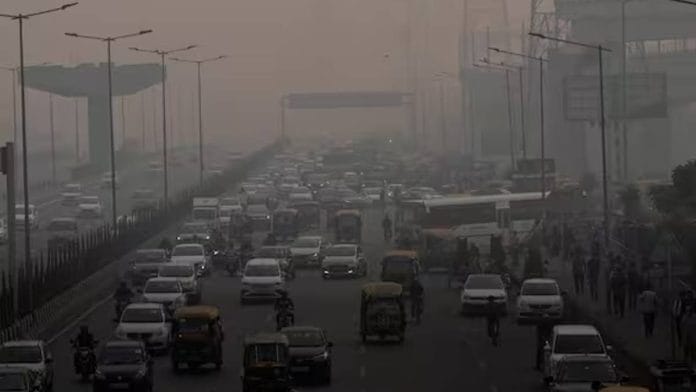



New Delhi: India’s push towards net-zero transport is being delayed by overwhelming dependence on roads, weak charging infrastructure, lack of investment and fragmented planning, according to a new NITI Aayog report released Tuesday.
The report, ‘Scenarios Towards Viksit Bharat and Net Zero—Sectoral Insights: Transport’, is one out of a series of sector-specific documents that outline what India must do to meet its long-term development goal of ‘Viksit Bharat’ by 2047, while working towards net-zero emissions by 2070. Net-zero transport refers to bringing down greenhouse gas emissions from transport as close to zero as possible.
According to the report, while the transition is technically possible, it warns that India’s current transport system is not aligned towards the vision. “Road transport continues to dominate (78 percent of passengers, 66 percent of freight), while rail and waterways are underutilised due to connectivity and governance gaps,” the report states.
This heavy dependence on road transport, NITI Aayog argues, is driving higher fuel consumption, congestion and emissions, even as demand for mobility continues to rise. “Emissions from the transport sector account for about 10 percent of overall GHG emissions in the country in 2020, with road transport contributing around 90 percent of the transport sector emissions,” the report adds.
In 2025, India’s passenger travel stood at 6,410 billion passenger-kilometres (BPKMs), with road transport accounting for 78 percent, while rail was limited to 17 percent. Air travel contributed four percent and metro systems just one percent.
Freight movement (goods transport) was also road-dependent. Out of 4,661 billion tonne-kilometres (BTKMs), roadways carried 66 percent, rail 22 percent and waterways only eight percent. Pipelines and air freight accounted for the remaining share.
The report flags this imbalance as a big hurdle in reducing carbon emissions from transport, particularly since road-based travel and freight are more energy intensive and polluting, compared to rail and inland waterways.
“Countries with stronger rail and waterways share long-term efficiency of diversified modal system. India should aspire to strengthen rail and waterways to reduce over-dependence on road transport,” the report states.
Electric vehicles (EV), often projected as the backbone of India’s clean mobility transition, are also constrained by infrastructure gaps. NITI Aayog points to India’s limited public charging ecosystem as a major barrier. “India has only 52 public charging points per million people, compared with 2,540 in China and 580 in the US,” the report says.
This shortage, it says, increases range anxiety about the battery’s life and slows EV adoption, especially for commercial fleets that require fast-charging access.
The report also flags the risk of supply chain dependence, warning that India’s EV transition remains vulnerable due to overall reliance on imports. “India is dependent on Chinese imports for critical minerals, cells, chips, and power electronics,” it says, calling this a strategic vulnerability that could expose the sector to price shocks and geopolitical risks.
The report also makes the case for a phased transition strategy. “The transition strategy should begin with the phased elimination of polluting diesel vehicles and the adoption of lower-emission technologies such as CNG, hybrids, and electric vehicles,” it says.
NITI Aayog estimates that implementing the net-zero transport pathway will require “USD 4.3 trillion in cumulative investment till 2070”, which is about 25 percent higher than the “USD 3.44 trillion” required under a current-policy pathway.
It says the investment would deliver long-term benefits, such as “lower fuel imports, improved air quality and health outcomes, greater energy security, and robust industrial and employment growth in batteries, charging, hydrogen, and recycling”.
NITI Aayog’s recommendations
To unlock a net-zero transport pathway, NITI Aayog calls for a sharper, time-bound policy push on clean vehicles, freight efficiency and clean fuels. It recommends that adoption of Zero-Emission Vehicles (ZEVs) should be treated as a “key priority”, and urges the government to “formalise segment-wise ZEV acceleration through 2035” across two-wheelers, three-wheelers, cars, buses and trucks.
A major focus is on expanding charging and swapping infrastructure, with the report pushing for “public and corridor-based charging and swapping infrastructure” backed by safety and interoperability standards.
“Strengthen regulatory and financial enablers by mandating EV-ready infrastructure in all new public buildings and 10-20 percent of private buildings, retrofitting existing public spaces, and providing capital and operational subsidies for charging infrastructure until it reaches commercial viability,” the report states.
It adds that high-utilisation fleets, such as buses, taxis and logistics vehicles, should be prioritised through aggregated procurement, while electrification should be targeted along major freight corridors. “Strengthen domestic manufacturing of batteries, cells, and power electronics with Production Linked Incentive (PLI) backed supply chains to secure competitiveness and local value creation,” the report says.
On freight, NITI Aayog suggests modal rebalancing and freight efficiency by expanding multimodal logistics parks, inland waterways and coastal shipping supported by Dedicated Freight Corridors (DFCs) and seamless trans-shipment. The report further suggests, “Use congestion and parking pricing, alongside safe walking and cycling networks, to reduce dependence on private vehicles and road freight.”
(Edited by Vidhi Bhutra)
Also read: Amit Shah launches Bharat Taxi, the govt-backed alternative to Ola, Uber. Drivers will be ‘owners’