








Bengaluru: Karnataka is estimated to see its total liabilities cross Rs 11.20 lakh crore in the next four years, according to the 5th state finance commission report which recommended several measures to shore up revenues to mitigate the growing fund crunch.
The measures include tax reforms, increasing non-tax revenue, asset monetisation, rationalisation of schemes, reducing non-scheme based committed expenditure (salaries), debt management, improving efficiency in GST collections, entertainment tax and several other initiatives.
There are also proposals such as implementing the parking policy, London-model congestion charges, use of CSR funds, and increasing the property tax net to raise capital for developing its growth engine Bengaluru, the Commission noted.
“Public debt receipts, which reflect the borrowings of the state, have progressively increased reaching Rs 1,16,000 crores in 2025-26 (Budgeted Estimate, or BE) from Rs 44,549 crores in 2022-23,” according to the Commission’s report.
According to the Medium Term Fiscal Plan (MTFP), Karnataka is estimated to borrow Rs 1,32,000 crore in 2026-27 fiscal year, representing a 13.8 percent growth over the corresponding year.
“Without raising loans, there cannot be any development,” Karnataka Chief Minister Siddaramaiah said a day before presenting the budget on 6 March.
Even during the Budget, Siddaramaiah dedicated nearly seven of his 208-page budget to emphasise the declining inflows of funds from the Centre, justifying the higher borrowings.
“The cow that yields abundant milk requires proper care,” he said in his budget, chiding the Union government.
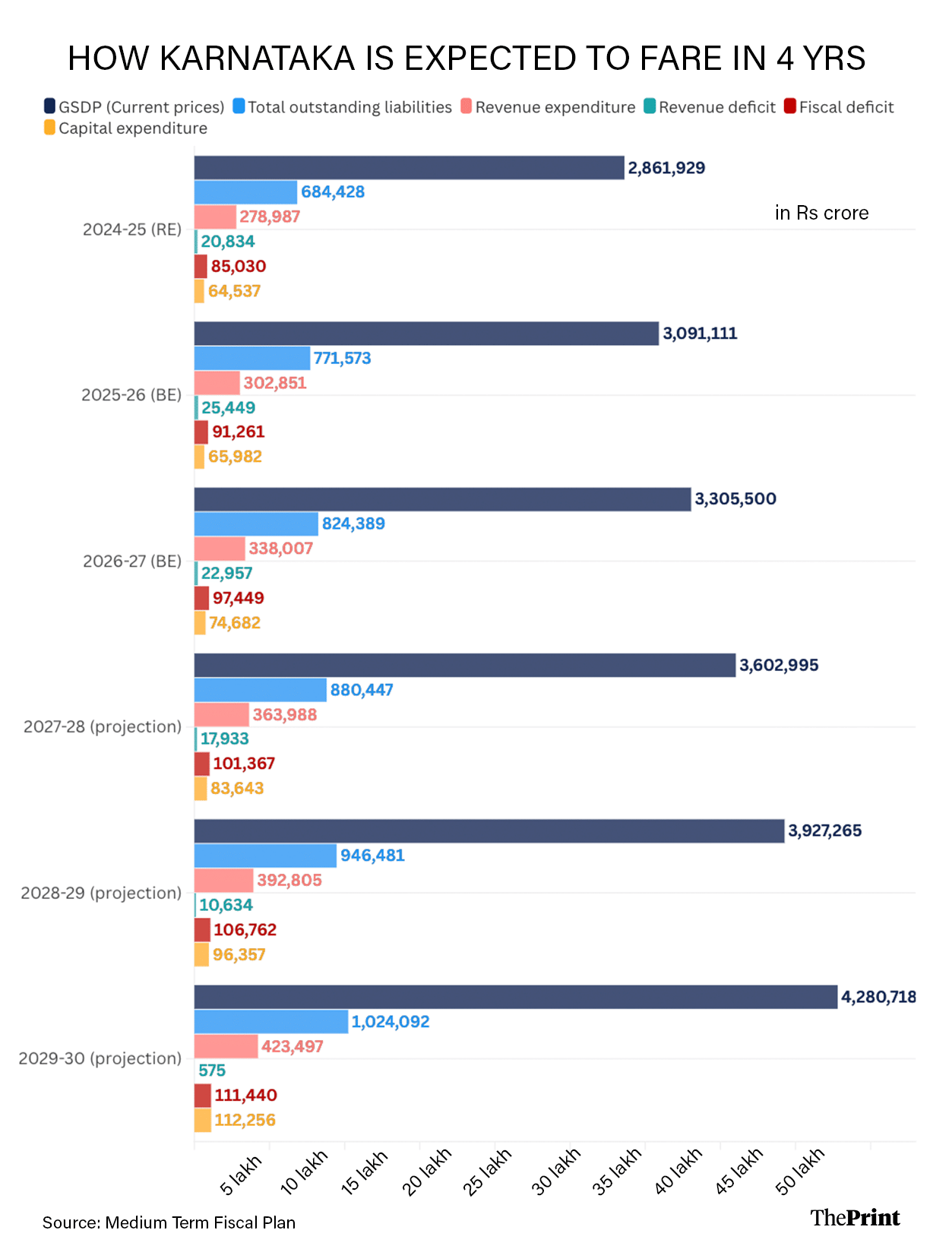
Karnataka, however, remains one of India’s biggest growth drivers and its Gross State Domestic Product (GSDP) (current prices) is projected to increase from Rs 25,67,340 crore in 2023-24 to Rs 48,30,867 crores in 2029-30.
However, multiple government finance reports show that a significant chunk of this growth will have to rely on higher borrowings.
Siddaramaiah, who also holds the finance portfolio, is now attempting to identify resources which can be monetised to help mitigate the growing fund crunch and reduce borrowings.
Karnataka is among the biggest growth engines of India, contributing significantly in the services and other sectors, attracting a steady flow of foreign direct investment (FDI) and other capital by global corporations who want to set up shop in the southern state.
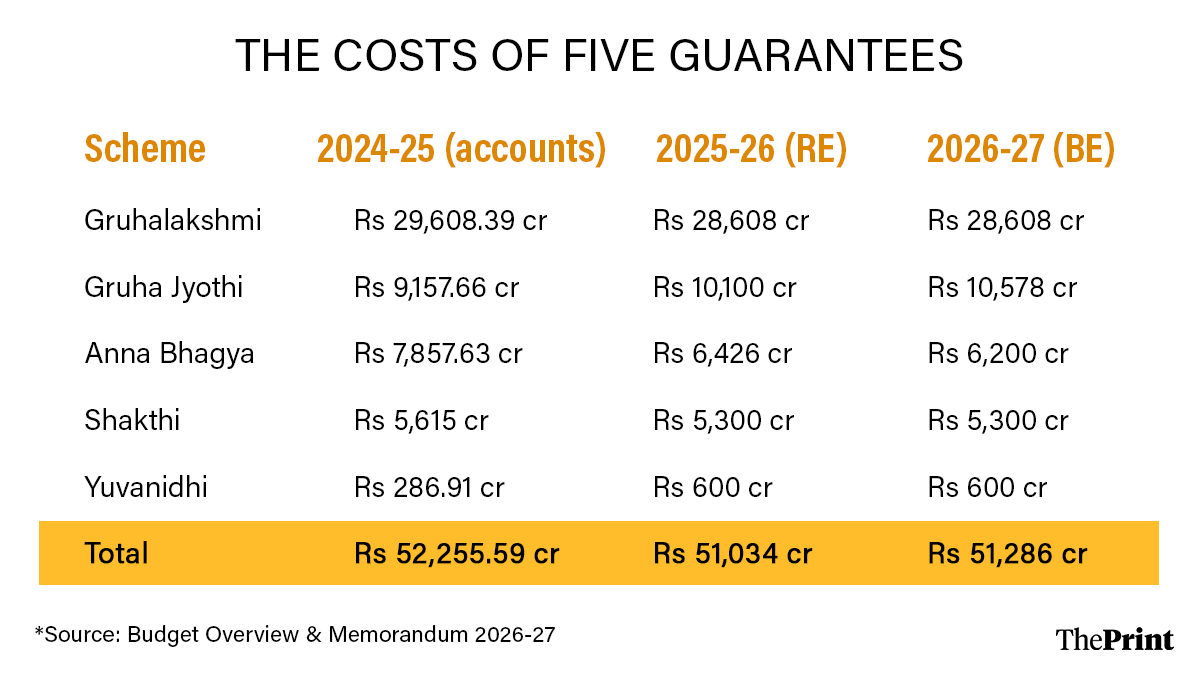
But the Congress government has been criticised for prioritising funding its flagship guarantee programmes over building long-term assets that can generate employment and boost the local economy.
Also Read: Bengaluru traffic woes may get ‘London-style’ solution. State finance panel proposes congestion tax
Rise in fiscal deficit
Though the southern state has consistently maintained a growth rate higher than the national average, Karnataka has been forced to rely on debt to raise capital to fund welfare, development and other activities, according to the Commission’s report.
The government has so far spent Rs.1,21,598 crore up to February 2026 and has budgeted around Rs 52,000 crore for the 2026-27 fiscal.
Though Siddaramaiah makes his case for higher borrowings, the burden of debt continues to rise. The interest payments to service these debts alone has seen an uptick from Rs 30,826 crore in 2023-24 to Rs 36,122 crore in 2024-25.
“For 2025-26 (BE), interest payments are estimated at Rs 45,600 crore and are further projected to rise to Rs 53,332 crore in 2026-27 (BE), reflecting the cumulative impact of higher borrowings undertaken to finance capital investment and offset revenue shortfalls from Central transfers,” according to the MTFP.
This would mean that interest payments will account for 1.85 percent of the GSDP in 2029-30 as against 1.26 percent in 2024-25.
It further added that the total liabilities as a percentage of GSDP are increasing steadily from 23.94 percent in 2024-25 (Revised Estimate, or RE) to 24.91 percent in the current year. Though the Commission noted that the liabilities will remain within the fiscal limit, the liabilities are expected to be in the range of 23.19 percent in 2029-30.
Barring a few sources of state taxes like excise and stamp duties, Karnataka has to rely more on debt and as a result its revenue and fiscal deficit continue to rise.
Estimated revenue deficit (when revenue expenditure exceeds revenue receipts) in 2026-27 is Rs 22,957 crore, and the MTFP suggests that the state will go into a surplus only by 2029-30.
But, the fiscal deficit will continue to rise. Fiscal deficit, which indicates the government’s total borrowing needs over non-debt receipts, has steadily increased from Rs 85,030 crore in 2024-25 to an estimated Rs 99,449 crores in 2026-27. By 2029-30, Karnataka’s fiscal deficit is projected to reach Rs 1,11,440 crore, according to the MTFP.
“Going forward, strengthening expenditure efficiency, enhancing the quality and productivity of capital outlay, rationalising committed expenditure such as subsidies and ensuring prudent management of debt and contingent liabilities will be critical to sustaining fiscal stability and advancing the State’s developmental objectives,” the MTFP suggested.
(Edited by Tony Rai)
Also Read: Karnataka’s economic survey lays bare a 500% income gulf between its richest and poorest districts
I would like to do so many bad things to Peddaramaiah in my dreams.