








From Thai farmers racing for diesel to Indian refinery executives monitoring the Persian Gulf through the night, energy buyers across import-dependent Asia are feeling the impact of a dramatic crunch.
US and Israeli attacks on Iran have triggered days of retaliatory strikes, taking out oil and gas production, shuttering export plants and all but closing the Strait of Hormuz, the narrow waterway connecting some of the world’s largest producers with the rest of the world.
While oil prices have remained remarkably contained in the face of an historic crisis — even with energy executives and traders warning that $100 crude may be close — for many in the world’s top-consuming region, the convulsions are already all too real.
Stock for power distributors and refineries began to falter in the middle of the week, leaving some to cut back. Prices for some industrial end-users have already spiked. Singapore’s providers of fuel for ships are among those rationing supply, while the Philippines has said it will shorten the work week for government offices to save energy. Bangladesh has limited the illuminated decorations festooning streets during the holy month of Ramadan.
Even China has asked refiners to curb exports to protect domestic stocks.
“In a week, if this situation continues, the entire industry could come to a standstill,” said Zafar Iqbal Sarwar, who runs ZIS Textiles Pvt. in the Pakistani industrial hub of Faisalabad. The company, which supplies home textiles to supermarkets in Europe and the US, uses gas in dyeing processes.
Airport closures in Qatar and the United Arab Emirates have also made it impossible to send samples to customers, he added.
“The fuel shortage is in front of you, it will start in two to three days. Petrol pumps are asking for fuel and they are not getting it,” he said. “Our input costs have gone up 35%.”
Disarray has been spreading after just days of war, and for many the risks are rising.
Fertilizer production that requires natural gas is disrupted in countries like India and Pakistan, raising the prospect of higher food prices or a hike in subsidy bills as upheaval continues. Farmers in northern Thailand, meanwhile, have been waiting in long queues to secure diesel, fearful of missing the rice harvest due in the coming weeks.
“In town, it’s a 15% projected increase in the price of diesel. The Thai government has frozen the price for two weeks, but there’s quite a lot of uncertainty,” said Abhi Agarwal, co-founder of Living Roots, an agricultural company in Chiang Mai working with farmers in the north of Thailand.
“A lot of farmers have been going to gas stations and bringing barrels. At the moment, a lot of gas stations don’t even have gas.”
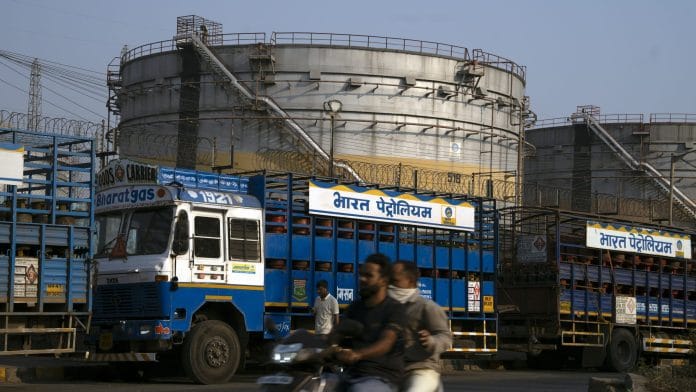
India — which imports the lion’s share of its oil and relies on the Strait of Hormuz for nearly half of those shipments — is among the most impacted economies. It had been paring down purchases of Russian oil under US pressure, turning instead to the Middle East, only to this past week find its oil stuck, costs rising and its currency falling.
“It is a highly fluid situation, but risks to India’s economy cannot be downplayed,” said Dhiraj Nim, an economist with ANZ Banking Group Ltd.
The US has offered some unexpected reprieve in the shape of a waiver that allows India to buy Russian oil for 30 days, a departure for Washington after months of demanding lower shipments from Moscow’s producers. Refiners have rushed to take advantage, snapping up millions of barrels of oil already on the water and within India’s reach — despite high prices.
“The purchase of Russian oil will come at a premium versus a discount in February, so it is not cheap. But given supply shortage, getting access to crude oil is more important than the purchase price,” said Sonal Varma, an economist with Nomura Holdings Inc.
Until Friday morning, Indian refiners had been watching the war with growing trepidation. At least one, Mangalore Refinery and Petrochemicals Ltd., was forced to suspend product exports and to shut a crude processing unit due to low stockpiles. The government had been considering contingency plans for days.
Reliance Industries, which operates the world’s largest refinery complex, set up a monitoring center to watch developments in the Middle East and track opportunities for procurement elsewhere, with senior executives working through the night, according to one person familiar with the situation. The company declined to comment.
The US concession to India has been widely welcomed, even with fine print. But for many it is at best a partial fix, and one that does not alleviate India’s most immediate crunch points — liquefied natural gas, a key industrial fuel in the region, and liquefied petroleum gas, used for cooking. India is the world’s second-largest LPG buyer and gets more than 90% of its supply from the Middle East.
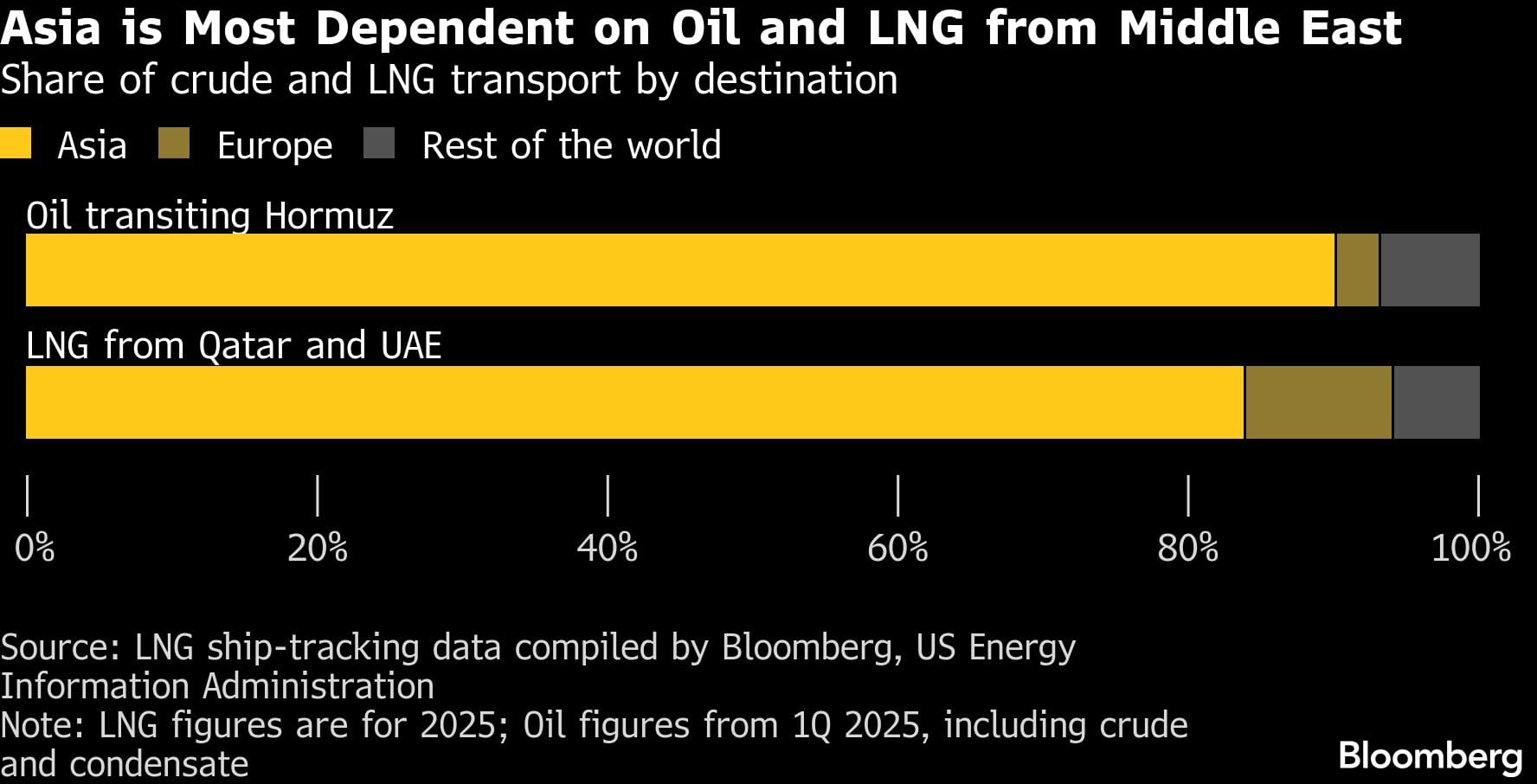
In gas, part of the issue for India — and for the rest of Asia — is that the halt to Hormuz traffic hit during a period when LNG supply from the US and Australia was being diverted to the Atlantic to take advantage of better prices, exacerbating already low supplies in Asia.
When QatarEnergy declared force majeure on deliveries after an Iranian drone strike, it triggered an avalanche of cancellations — LNG importers left gas distributors waiting, and they in turn deprived downstream customers. Qatar provides 30% of China’s LNG needs, roughly half for India and 99% for Pakistan.
“We are back in gas crisis territory,” said Saul Kavonic, an energy analyst at MST Marquee. “This big issue with gas today is all the easy levers to pull to reduce gas demand were already pulled in 2022. There are far fewer redundancy and efficiency gains available to deal with LNG shortages today.”
Buyers in Asia’s developed countries, which can pass down costs to consumers, have been busy buying shipments for April onward. Taiwan, a global chipmaking hub that depends heavily on seaborne imports, rushed to purchase alternative LNG supply for next month, while South Korea is preparing to do the same.
Others are trying to preserve their supply. Some Japanese utilities are halting units at power plants to conserve fuel, while Chinese companies have scrapped plans to re-export shipments overseas.
For most, though, the only options are price hikes and production curbs. Adani Total Gas Ltd., which provides natural gas to homes, industries and vehicles, tripled the prices of gas supplied to industrial consumers beyond 40% of their daily allocation. Gas suppliers including Petronet LNG Ltd. and Gujarat Gas Ltd. have invoked force majeure to restrict deliveries to their customers, citing shipment disruptions.
A prolonged outage risks crimping power generation into April and May, when temperatures can climb to record levels across South and Southeast Asia, and demand from coolers and air conditioning stretches the grid. Thailand, Bangladesh and Vietnam are scouring the market for shipments for March and April.
For many ordinary consumers, a hike in prices will mean turning to other options well before then. Shaila Devi, a 50-year-old apple and vegetable farmer in mountainous Himachal Pradesh, in northern India, last bought a gas cylinder for about 1,050 rupees (just over $11) a month ago. She is waiting to hear back from her local supplier before deciding whether to buy her next.
“Otherwise,” she said, “there is always wood.”
–With assistance from Preeti Soni, Rajesh Kumar Singh, Srinidhi Ragavendran, Stephen Stapczynski, Hallie Gu, Pratik Parija, Nicholas Lua and Rakesh Sharma.
Disclaimer: This report is auto generated from the Bloomberg news service. ThePrint holds no responsibility for its content.
Also read: Will US waiver on Russian crude help India offset Middle East losses? What market analysts say