





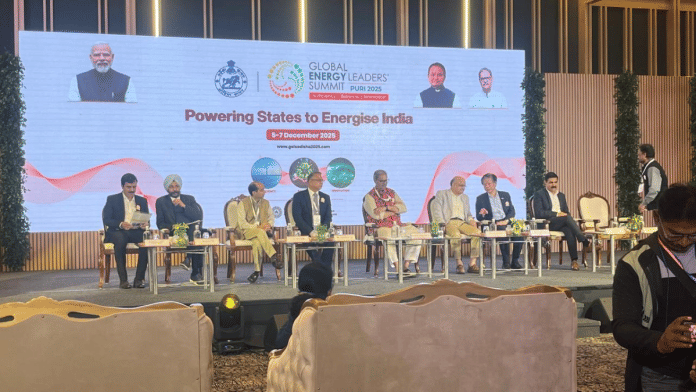



New Delhi: India needs to plan aggressively as it transitions to clean energy or risk being overwhelmed by an unprecedented surge in electricity demand from electric vehicles, AI-driven data centres and the need for cooling systems owing to climate change, NITI Aayog CEO B.V.R. Subrahmanyam has cautioned.
Addressing the Global Energy Leaders’ Summit in Puri, Odisha, he said the coming decade will force India to rethink everything from grid design to technology supply chains, adding that clean energy was “no longer the sideshow, it is the show”.
As mobility, cooling and heating all go electric, the load on India’s power system will skyrocket. “If every household becomes fully electric, then the transformer or the junction box will blow up,” he said Sunday.
Legacy grid systems, designed when coal was in the east and industry sat in the west, do not have the capacity to handle the surge in demand, he added.
Owing to the energy transition, Subrahmanyam said that a renewable energy-driven grid supported by solar plants will be from north to south owing to the landscape.
Several states have begun preparing long-term energy-consumption and transmission plans for renewable energy, he said. Maharashtra has already outlined nearly Rs 2 lakh crore worth of investments over the next five years.
“This has to happen on a massive scale. Transmission, distribution, storage and grid automation — all of it will require new technology and big capital,” he said.
Organised by the Odisha government in partnership with the Tony Blair Institute for Global Change, the Global Energy Leaders’ Summit 2025 brought together India’s policymakers, global energy leaders, technology experts, and industry stakeholders to collectively provide a direction towards clean energy transition.
A Puri Declaration 2025 was supposed to be rolled out after the summit, but with some states yet to provide their inputs, it has been put on hold as of now.
“We plan to release the official Puri Declaration 2025 in the next one month, once we have received inputs from all the states,” Odisha Deputy Chief Minister Kanak Vardhan Singh Deo said at a press conference Sunday.
India needs to be a leader
According to Subrahmanyam, India cannot afford to be a passive participant in the global clean energy transition.
“We are the fourth-largest economy, and soon to be the third. We have no choice but to lead from the front,” he said.
Technological disruption, he noted, often allows new countries to leapfrog incumbents as Japan did with efficient cars after the 1973 oil shock. The clean energy transition, he said, presents India with a similar opportunity.
“It is no longer about securing oil or coal. Energy security is now about technology, supply chains and clean energy sources,” he said, adding that countries that fail to lead in innovation will inevitably be shaped by others’ decisions.
Data centres to drive future energy demand
According to Subrahmanyam, future energy demand will be driven by data centres needed by artificial intelligence. As AI-powered data centres multiply, they will become huge consumers of electricity, already influencing global energy patterns.
Subrahmanyam noted that half of India’s data centres are clustered in Mumbai because it is the only city offering uninterrupted and stable power supply, a factor now dictating billions of dollars worth of investment flows.
He pointed to the US, where the revival of a nuclear power plant is being driven not by the government but by technology giants.
A nuclear plant at Three Mile Island, which was shut down due to an accident in 1979, is now being revived by Constellation Energy for Microsoft data centres he said, calling it a sign of where global demand is headed.
(Edited by Sugita Katyal)