





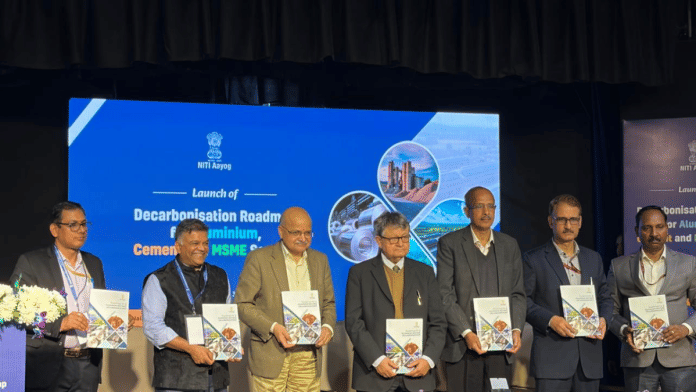



New Delhi: India’s 69 million Micro Small and Medium Enterprises (MSMEs) must transition to cleaner energy and more efficient production systems, not just for environmental reasons but to remain economically competitive, said a NITI Aayog report released Wednesday.
The report ‘Roadmap for Green Transition of MSMEs’ argued that while the MSME sector contributes nearly 30 percent to India’s Gross Domestic Product (GDP), 46 percent to exports and employs around 25 crore people, it is also a big contributor of carbon emissions.
“MSMEs rely heavily on fossil fuels to meet their energy and process requirements, resulting in approximately 135 million tonnes of carbon emissions (MtCO2e) in 2022 alone,” the report read.
Unlike large industries, the report highlights that MSMEs operate on thin margins and face multiple challenges including lack of awareness about green energy and lack of finance for energy transition.
“MSMEs face a range of challenges in terms of capacity to undertake green projects, access to reliable finance for the energy transition, lack of awareness on policies and schemes, absence of scalable models, and niche market dynamics that create uncertainty in investment decisions,” the report said.
Speaking at the launch, NITI Aayog vice-chairman Suman Bery said MSMEs are important members of domestic and international supply chains. “If we load them up with a high cost of inputs, including electrical inputs, then they’re not going to be able to expand.”
The government think tank report also highlighted the need for MSMEs to transition to clean energy, given the international implications.
One of the upcoming challenges is the European Union’s (EU’s) Carbon Border Adjustment Mechanism (CBAM), which will impose carbon-linked costs on imports from 2026. Indian MSMEs dominate exports in sectors like textiles, steel and engineered goods and without credible emission reductions, many companies could find themselves priced out of a key market.
“MSMEs will face increased costs for EU exports due to CBAM purchase certificates tied to product carbon emissions,” the report said.
It added that an increase in the administrative burden can be expected as CBAM involves monitoring, reporting, and verifying emissions, which can be particularly challenging for smaller businesses like MSMEs.
The report highlighted India’s climate goals of net zero emissions by 2070 and a 45 percent reduction by 2030, which it said cannot be achieved without the MSME sector transitioning to green energy. More importantly, it warned that MSMEs may not survive this transition unless the government steps in with targeted support.
NITI Aayog CEO BVR Subrahmanyam also called for “a national programme for decarbonising MSMEs within the ministry” that could work in a systematic way in helping MSME reduce emissions.
Also Read: NITI Aayog flags what India needs for its ‘$30 tn by 2047’ goal—‘a developed corporate bond market’
NITI’s recommendations
To tackle greenhouse gas emissions, NITI Aayog’s report proposes a national, decade-long programme built around three key levers: energy efficiency, green electricity and alternative fuels.
Under energy efficiency, the think tank recommends retrofitting old equipment through Energy Service Companies (ESCOs) using “pay-as-you-save” models that would allow MSMEs to upgrade without upfront costs. If implemented at scale, energy efficiency alone could cut 36 million tonnes of emissions over 10 years.
“The new energy efficient equipment will lead to savings from lower electricity/fuel usage, reducing the operational costs for MSMEs. These savings can be used to repay ESCOs over time,” the report said.
The second recommendation is the rapid adoption of green electricity across MSMEs, mainly rooftop solar systems under the Renewable Energy Service Company model, which eliminates the need for any upfront installation cost for customers and allows MSMEs to pay only for electricity consumed.
For micro enterprises, the think tank recommends extending the PM Surya Ghar Muft Bijli Yojana with a capital subsidy up to 3 kilo watt for roof top solar systems. The report states, “Under this approach, a sum of Rs 7,000 crore can be allocated for a period of 5 years with a target of covering around 1-1.5 million micro units.”
MSMEs transition to green electricity could reduce emissions by 30-35 million tonnes over next 10 years, it added.
Thirdly, NITI aayog has recommended that MSMEs, which rely heavily on coal, pet coke, furnace oil among others should gradually shift to cleaner fuels like natural gas, biogas and biomass, that could potentially cut another 9–16 million tonnes of emissions.
Together, these three measures could reduce emissions by 75–87 million tonnes, mobilise over Rs 2 lakh crore in private investment, and create more than 55,000 green jobs, said the report.
Alongside the green transition roadmap for MSMEs, the NITI Aayog Wednesday also released reports for decarbonisation for India’s cement and aluminium sectors.
(Edited by Gitanjali Das)
Also Read:Overlap in Centre’s MSME schemes affecting outcomes—NITI Aayog; offers course-correction roadmap