








New Delhi: The inflation trend in India for the last three months marks a turning point from the inflationary scare of earlier years. Retail inflation in November rose marginally to 0.7 percent, after hitting a record low for two consecutive months, September and October.
The periodic improvement in inflation data also prompted the Reserve Bank of India (RBI) to cut the repo rate to 5.25 percent during its latest Monetary Policy Committee (MPC) meeting held on 5 December. Though it would be premature to call it a structural correction, much of the fall can be explained by temporary and policy-driven factors.
The central bank released the latest figures for inflation data last week. Based on the figures for the last three months, RBI is expected to look for confirmatory evidence that can mark the beginning of a sustained decline in core inflation.
But a more detailed analysis suggests caution.
ThePrint looks at the data from the past three months to break down what resulted in the steep fall, how much of it is structural versus temporary, and the policy trade-offs that India now faces in terms of monetary and fiscal policy.
Also read: Steady growth rooted in ‘Dravidian model’. How Tamil Nadu more than doubled its GSDP in 10 yrs
Anatomy of inflation tapering
According to RBI’s release, retail inflation rose marginally to 0.71 percent in November 2025. India’s retail inflation tumbled to 0.25 percent year-on-year in October 2025, after a 1.54 percent surprise in September, the lowest consecutive months in nearly a decade.
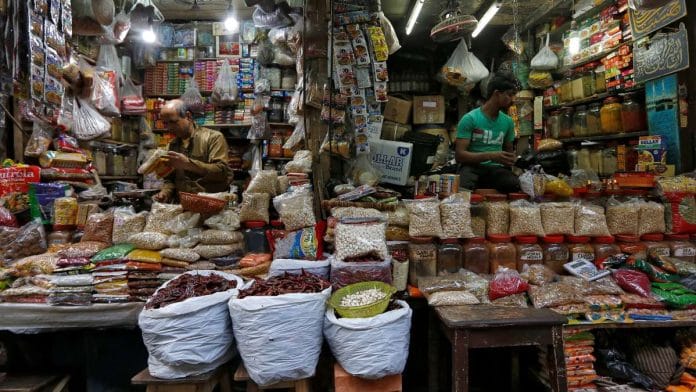
Food prices, the most volatile and weighty component of the Consumer Price Index (CPI), slipped into outright deflation: 3.91 percent in November, and 5.02 percent in October.
Three possible factors explain the magnitude of the steep fall in inflation over the last three months, namely the correction of food prices, Goods and Services Tax (GST) rationalisation, and the benefits of favourable base effects.
As food weightage is highest in the share of household consumption, even modest declines in food prices can strongly affect headline inflation. Bumper harvests in core producing regions, eased distribution networks, and a moderation in global commodity pressures resulted in a decline in market prices.
In late September, the government eased GST rates on a number of consumer items. Rate cuts and rationalisations directly lower retail prices and are reflected immediately in CPI aggregates. This tax channel, therefore, accounts for a material share of the October disinflation and explains part of the sharp downside surprise.
The food prices in November and October 2024 were elevated, and statistical base effects amplified the fall. Food prices for the same period this year showed deflation. A return to typical post-harvest levels produces a pronounced year-on-year decline even if current prices are not unusually low in absolute terms. The marginal increase in November is a testament to that.
Also read: Inflation plunges to a 10-yr low of 0.25% in October. Here’s why
Is this sustainable?
If low inflation was due to weak demand across the economy, the RBI could more confidently begin cutting the policy repo rate. However, in the instant case, core inflation (CPI excluding food and fuel) has shown limited easing through 2025, underscoring persistent price pressures outside volatile categories.
Services-price growth, housing rents, and health, education remained higher, indicating persistent price-setting power in parts of the economy. So, headline inflation fell largely because the most volatile component, food, was corrected and because of one-off tax policy changes. The RBI, therefore, may frame the monetary policy keeping in mind the longevity of the reduced inflation numbers, to offset the risks of premature cuts.
Tax relief due to the GST revision has immediate consumer benefits, but it also reduces indirect tax revenue. If the government sustains or expands such relief without compensating measures, fiscal pressures could rise, which would also be inflationary.
Politically, GST rationalisation represents a policy tool that can buy short-term relief. But it is not a structural fix. Longer-term price stability depends on stable agricultural supply chains, improved storage and cold-chain infrastructure, competitive food markets, and productivity gains. All these changes are structural and require a high investment.
Key risks to downward trend
Weather-related uncertainties, local crop failures, pest attacks, or export-led shortages remain a key risk to food prices, and any sharp reversal here could quickly increase headline inflation given the weightage of food in inflation.
At the same time, non-food inflation continues to pose challenges. If price pressures in services and administered categories such as health, education, or utilities fail to ease, overall inflation could remain volatile even if food prices stay benign.
External factors add another layer of vulnerability. Increases in global oil prices, renewed supply-chain disruptions, or a sudden depreciation of the rupee could translate into higher domestic inflation, with limited room for policymakers to offset these shocks in the short term.
Households see immediate relief in grocery bills, which is most meaningful for lower-income families. Markets see the inflation numbers initiating expectations of near-term rate hikes and opening room for potential rate cuts. The markets have priced in some possibility of easing. One way to sustain a rate cut is to weigh short-term relief against longer-term fiscal sustainability and invest in structural fixes.
Banudas Athreya is an alum of ThePrint School of Journalism currently interning with ThePrint
(Edited by Sampurna Panigrahi)
Also read: How startups are falling into lenders’ debt traps