





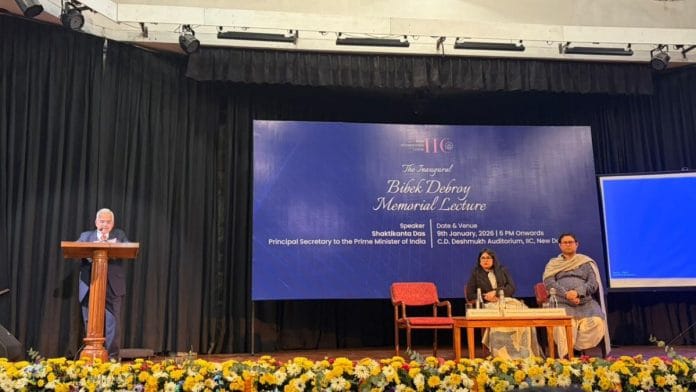



New Delhi: India’s economy has emerged as one of the most resilient in the world despite a pandemic, wars and global fragmentation, and is now expected to remain the fastest-growing major economy, Principal Secretary-2 to the Prime Minister and former RBI governor Shaktikanta Das said Friday.
Delivering the inaugural Bibek Debroy Memorial Lecture at the India International Centre, Delhi, Shaktikanta Das said India today stands at an inflection point where shifting geopolitical winds and trade policies are reshaping the global economic order.
“Trade and supply chains are increasingly used as tools of disruption and dominance,” Das said, warning that emerging markets, particularly the Global South, are most vulnerable to slowing trade, fragmented supply chains and shrinking opportunities for economic convergence.
Against this backdrop, Das said India has adopted Atmanirbhar Bharat not as an isolationist doctrine but as a strategy to build resilience, domestic capacity and geopolitical autonomy. “A self-reliant economy with strong domestic capabilities gives us the strength to sustain growth and pursue an autonomous foreign policy in our national interest,” he said.
Addressing a packed auditorium of economists, scholars and policymakers, Shaktikanta Das highlighted India’s economic recovery after the Covid-19 shock, noting that the country posted average growth of 8.2 per cent between 2021-22 and 2024-25, driven largely by private consumption and investment.
“What distinguishes India is not just that we expanded fiscally and monetarily during the pandemic, but that we rolled it back in time,” Das said, arguing that few countries managed this transition as effectively.
Turning to the present, Das said the Indian economy remains resilient and is expected to be the fastest-growing major economy globally despite ongoing disruptions. Citing recent National Statistics Office data, he said India is projected to grow at 7.4 per cent in 2025-26, contributing nearly 18 per cent to global GDP growth.
He also pointed to easing inflationary pressures. “In October 2025, headline CPI inflation fell to a record low of 0.25 per cent, remaining below the RBI’s target band for three consecutive months,” Shaktikanta Das said, adding that this has provided relief to consumers and reinforced macroeconomic stability.
Atmanirbhar Bharat & three-pillared strategy
According to Das, India’s approach to self-reliance rests on a three-legged strategy: Stability, structural reforms and strategic government schemes.
Stability, the first pillar, is the “bedrock on which India’s growth story is built”, he said. A decade of disciplined fiscal management and credible monetary policy has helped insulate India from global shocks such as the Russia-Ukraine war and supply chain disruptions.
Structural reforms form the second pillar. Das described reforms like the Goods and Services Tax as a “game changer” that unified India into a single market, improved compliance and boosted consumption. The Insolvency and Bankruptcy Code, he said, transformed India’s credit culture by replacing endless litigation with time-bound resolution and empowering creditors.
The third pillar comprises targeted government schemes aimed at addressing structural gaps. Flagship initiatives such as Production-Linked Incentive (PLI) schemes, Gati Shakti, Digital India, Start-up India, Bharatmala and Sagarmala have strengthened manufacturing, logistics, infrastructure and innovation ecosystems.
As a result, Das said, India is now the world’s third-largest startup ecosystem, has doubled its port capacity, increased inland waterways cargo seven-fold, and expanded regional connectivity through 88 new airports under the UDAN scheme.
Tribute to Bibek Debroy
Das began his address by paying tribute to Bibek Debroy, former chairman of the Prime Minister’s Economic Advisory Council, describing him as an “astute reformer” who shaped India’s transition from a planned to a market economy, while also translating the Ramayana, Mahabharata and Bhagavad Gita for global audiences.
The memorial lecture, Das said, reflected the values Debroy stood for—faith in reforms, intellectual rigour and confidence in India’s long-term economic future.
Bibek Debroy (1955–2024) was a distinguished economist, public policy expert and scholar. He was awarded the Padma Shri in 2015 and was posthumously conferred the Padma Bhushan in 2025 for his contributions to literature and education.
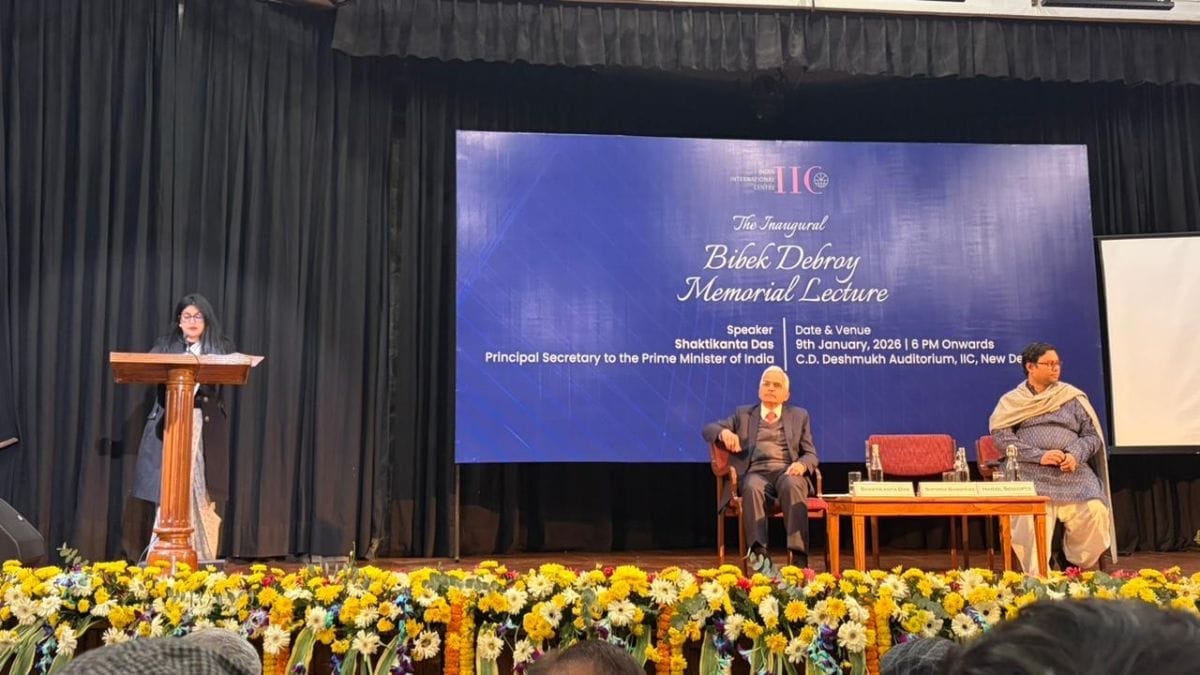
In an emotional address, Debroy’s wife, Suparna Banerjee, described him not only as a towering public intellectual but also as a deeply attentive partner and a lifelong seeker. Despite his demanding public life, she said, he always made time for shared moments, never missing birthdays or anniversaries.
Beyond his work as an economist and translator, Banerjee said, Debroy was constantly engaged with questions of meaning, faith and responsibility. The memorial lecture, she added, was conceived not merely as a tribute but as a living conversation about ideas, institutions and the discipline of thought in an increasingly noisy world.
(Edited by Viny Mishra)
Also read: India’s inflation figures tell a growth story, a cautiously optimistic one