









New Delhi: The Prime Minister Internship Scheme funds, as allocated under the Modi government’s flagship initiative to enhance the employability of India’s youth, have been severely under-utilised, after drawing a poor response in the first two pilot rounds, according to a parliamentary committee report tabled Thursday.
The Standing Committee on Finance, in its report on Demands for Grants (2026-27), as tabled in the Lok Sabha Thursday, highlighted that the scheme’s allocation in FY 2025–26 was drastically scaled down after it failed to take off. And, even from this reduced allocation, actual spending was negligible.
The scheme was launched in October 2024.
Initially, in the FY2025-26 Budget estimates, Rs 10,831 crore was allocated for the scheme. However, the amount was cut to Rs 526 crore in the revised estimates, corresponding to a nearly 95 percent dip. From these reduced funds, only Rs 64.91 crore had been utilised as of 31 December—0.6 percent of the original Budget estimates.
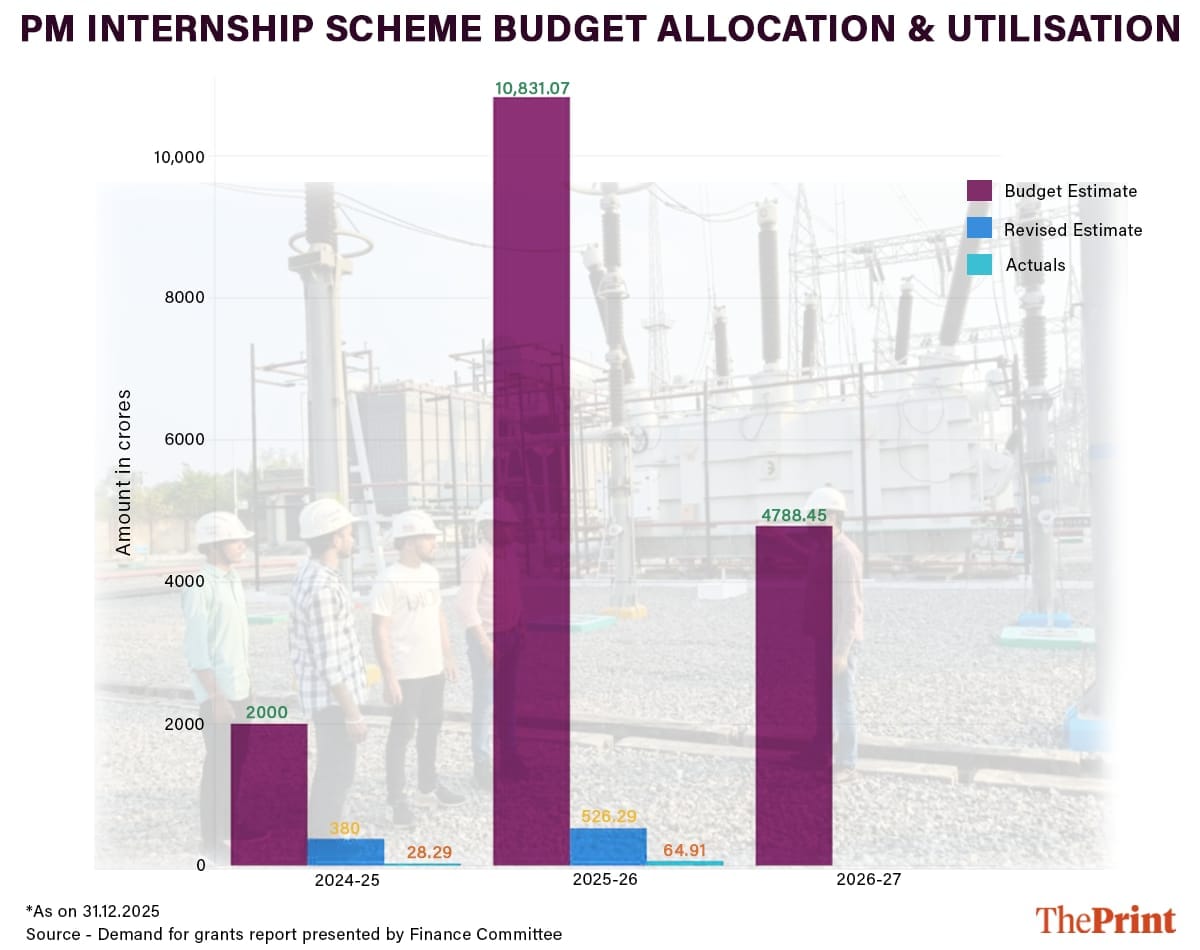
According to the Ministry of Corporate Affairs (MCA), the large initial allocation was meant for the full-scale rollout of the scheme. However, the main scheme could not commence due to low participation. And, hence, the ministry continued with pilot rounds.
In FY2026–27, the government allocated Rs 4,788 crore for the scheme.
Interns under the scheme, announced during Budget 2024-25, work for 12 months and receive a one-time grant of Rs 6,000 from the Centre. They are also paid a monthly stipend of Rs 5,000—Rs 4,500 from the government and Rs 500 from the employers from corporate social responsibility funds.
The scheme is currently open to candidates aged 21 to 24 years with a Class 10 or Class 12 qualification, an ITI certification, a polytechnic diploma, or a graduation degree.
Poor intake, high attrition
The underutilisation of the funds reflected a weak response to the scheme amid a high dropout rate.
During the first pilot round, which began in October 2024, companies made 60,866 internship offers. Of these, 28,144 candidates accepted the offers, with only 8,760 eventually joining.
Attrition was also high—4,702 candidates, or 53.6 percent of the total candidates, had exited the programme midway through the 12-month tenure.
Ultimately, only 3,417 candidates from the first pilot round completed the entire internship.
Launched in April 2025, the second pilot round also saw muted participation. More than 300 companies made 71,195 offers, but only 24,638 candidates accepted those.
Of these, 7,300 candidates physically joined their companies, and 2,464 candidates (33.7 percent) dropped out before completing the full internship period.
The data on candidates completing the second round is not yet available, as those internships are scheduled to conclude on or after April this year.
Why the scheme struggled
In its written submission to the parliamentary panel, the Ministry of Corporate Affairs (MCA) cited multiple factors behind the scheme’s poor response.
These included location constraints, low awareness among youth about internships, a monthly allowance of Rs 5,000 being perceived as inadequate, and the ministry’s limited on-ground presence across states.
Another major concern flagged by candidates was the absence of guaranteed employment after the competition of the internship.
“The scheme is not designed to provide placement offers,” the ministry said in a written reply.
However, it is now considering key modifications to the scheme in a bid to improve participation.
It plans to launch another pilot phase with key changes, including shorter internship durations, relaxed age criteria, and higher stipend amounts.
“The MCA is in the process of seeking approval to extend the pilot project with the changes in the eligibility criteria for both the companies and youths, and changes in the internship, such as its duration, age limit, qualifications, & monthly assistance to interns, among others,” the ministry said in a written reply to the committee.
(Edited by Madhurita Goswami)
Give that money as subsidy to MSMEs on a per job basis. That will do more wonders than such internship schemes.