





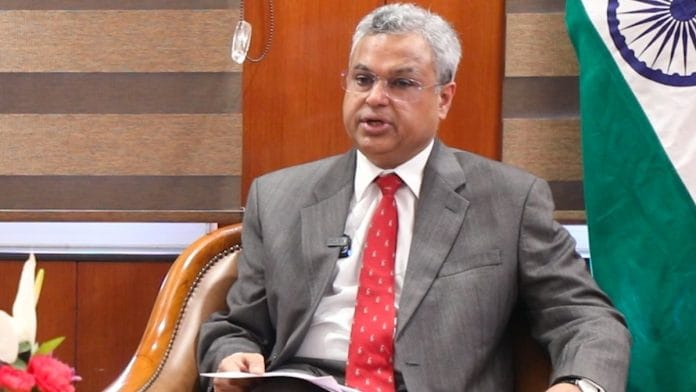



New Delhi: The Ministry of Statistics and Programme Implementation (MoSPI) is set to release updated Consumer Price Index (CPI) and Gross Domestic Product (GDP) numbers in February 2026, following a base year revision exercise after more than a decade, though MoSPI Secretary Saurabh Garg has said the new numbers are unlikely to lead to dramatic changes in inflation and growth trends.
In an exclusive interview with ThePrint, Garg said the base year revision is aimed at ensuring India’s key macroeconomic indicators remain relevant, representative and aligned with current economic realities.
“These macroeconomic aggregates, CPI and GDP, are very important to understand the status and health of the economy,” Garg told ThePrint. Over the past ten years, he said, consumption patterns have shifted, new data sources have emerged and statistical methodologies have evolved, therefore requiring a reset.
“We are using this base revision not just as a base revision, but a comprehensive exercise to ensure these macroeconomic aggregates that we are producing remain relevant in the years to come also,” the MoSPI Secretary said.
Going forward, MoSPI aims to revise the base year every five years in line with international norms. “That is when you expect some changes in the consumption patterns also,” Garg said, signalling a shift toward more responsive and up-to-date economic measurement.
CPI—new basket and new markets
The CPI revision, with 2024 as the new base year, reflects major changes in India’s consumption patterns. A key driver is the updated consumption basket, based on two household consumer expenditure surveys conducted in 2022–23 and 2023–24, replacing survey data that was more than a decade old.
“There are new items which have come in because new products have been introduced over the past decade and some of the old items have also been removed, keeping in view that they have become obsolete,” MoSPI Secretary Garg said.
The new series, Garg added, also draws from significantly expanded data sources. With the growth of digital platforms, MoSPI is now incorporating online price data, treating e-commerce platforms as separate markets.
Data on airfares, telecom service providers, television services, and petrol pumps—capturing state-wise variations—are also being directly used. “We are looking at end prices, not what are the quoted prices,” MoSPI Secretary Garg explained.
Geographical coverage has also expanded sharply. The number of markets tracked will rise from around 2,300 to 2,860, with rural markets increasing to 1,465 and urban markets to 1,395. Town coverage has gone up 40 per cent, from 310 to 434. The number of goods tracked has increased from 259 to 308, while services have risen from 40 to 50.
Methodologically, the CPI will now follow the 2018 Classification of Individual Consumption According to Purpose (COICOP), doubling the number of consumption groups from six to 12. Garg said this shift would reduce the large “miscellaneous” category seen earlier and offer greater granularity for policy decisions.
One of the most discussed changes is the fall in the food group’s weight—from about 45.8 per cent in the old series with base year 2012 to around 36.8 per cent in the new series.
However, Garg clarified that this is not a simple like-for-like comparison. Activities such as eating out were earlier included under the food and beverages category, but have now been moved to a separate category of restaurant and accommodation services. Taking this into account, he said the effective reduction is more modest and also reflects genuine changes in consumption patterns.
Among other major changes, Garg highlighted that housing has also been redefined to include utilities such as fuel and light, while rural rents have been brought into the index for the first time. However, he stated that employer-provided housing has been excluded, in line with international practice, as such rents often do not reflect market rates.
To ensure comparison and continuity of series, MoSPI will release linking factors allowing comparisons with the old CPI series going back to 2013. “It is necessary for researchers and other academics in order to be able to draw conclusions that they have a comparison at least initially until they get used to the new data,” Garg said.
GDP to have more accurate indicators
In the interview, Garg also touched upon the new data sources and changes to GDP estimates that will shift to a 2022–23 base year from 2011-12 earlier.
According to Garg, the new series will incorporate a wider set of administrative and digital data including GST data, the e-Vahan data, payments data, and expanded ministry-level datasets.
Apart from this, he added that monthly Periodic Labour Force Survey (PLFS) data, the Annual Survey of Unincorporated Sector Enterprises (ASUSE), and all-India debt and investment surveys will also now feed into GDP calculations.
Garg said these sources will improve coverage of the informal and unincorporated sectors, where earlier estimates relied more on proxies.
While the revision may refine growth estimates, Garg downplayed the likelihood of sharp changes. “We do not expect significant changes,” he said, adding that earlier methods were not “that off from the actual data” but will now be backed by more accurate indicators.
On India’s GDP framework receiving ‘C’ rating by the IMF in 2024 and 2025, Garg noted that this was solely due to the outdated 2011-12 base year, not concerns about data quality. With the revision, he expects that issue to be addressed.
(Edited by Viny Mishra)
Also read: Congress calls India’s GDP numbers ‘suspect’, alleges manipulation by Modi govt