








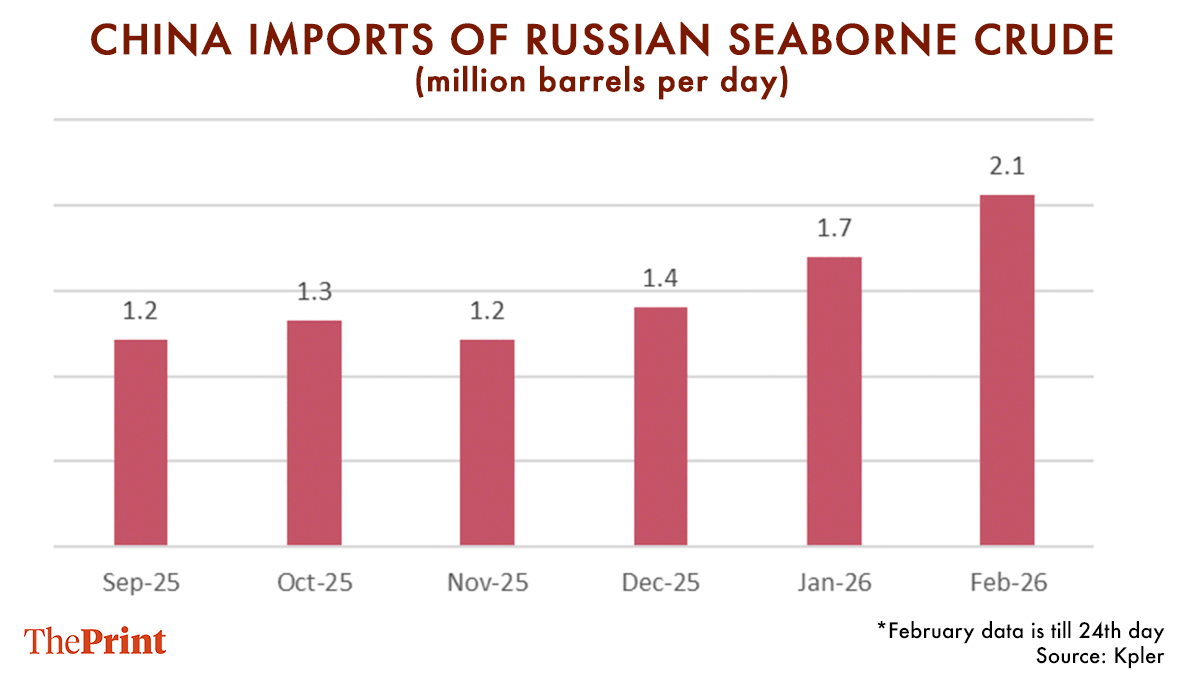
New Delhi: As Indian refiners recalibrate their crude oil sourcing strategy, Russian crude is increasingly finding its way to China rather than India. China’s imports of Russian seaborne crude climbed to an all-time high of around 2.1 million barrels per day (mbpd) in February 2026 (till the 24th day), underscoring a sharp divergence in buying patterns between the two Asian countries.
As India trims volumes, China has stepped up purchases, reshaping trade routes and helping Russia to sustain crude flows despite ongoing sanctions and logistical challenges. In January 2026, China’s seaborne crude imports from Russia stood at 1.7 mbpd and 1.4 mbpd in December 2025, indicating consistent month-on-month growth.
“While Chinese state refiners have occasionally adjusted purchases in response to compliance and pricing considerations, overall flows into China have remained resilient or in fact has increased to an all-time high of around 2.1 million b/d in Feb 2026,” Sumit Ritolia, the lead analyst for refining and modelling at global trade intelligence firm Kpler told ThePrint.
He adds that higher purchases have been aided by steep discounts offered by traders, making Russian barrels commercially attractive.
Notably, the 2.1 mbpd figure reflects only seaborne crude imports. In addition, China continues to import Russian crude via pipeline, estimated at around 700–800 thousand barrels per day (kbpd), cites Ritolia.
Russian crude and product volumes currently at sea are estimated at around 152 million barrels. This elevated level reflects “a combination of longer voyage times, sanctions-related trade rerouting and some degree of floating storage,” Ritolia said.
India pivoting to Middle East crudes
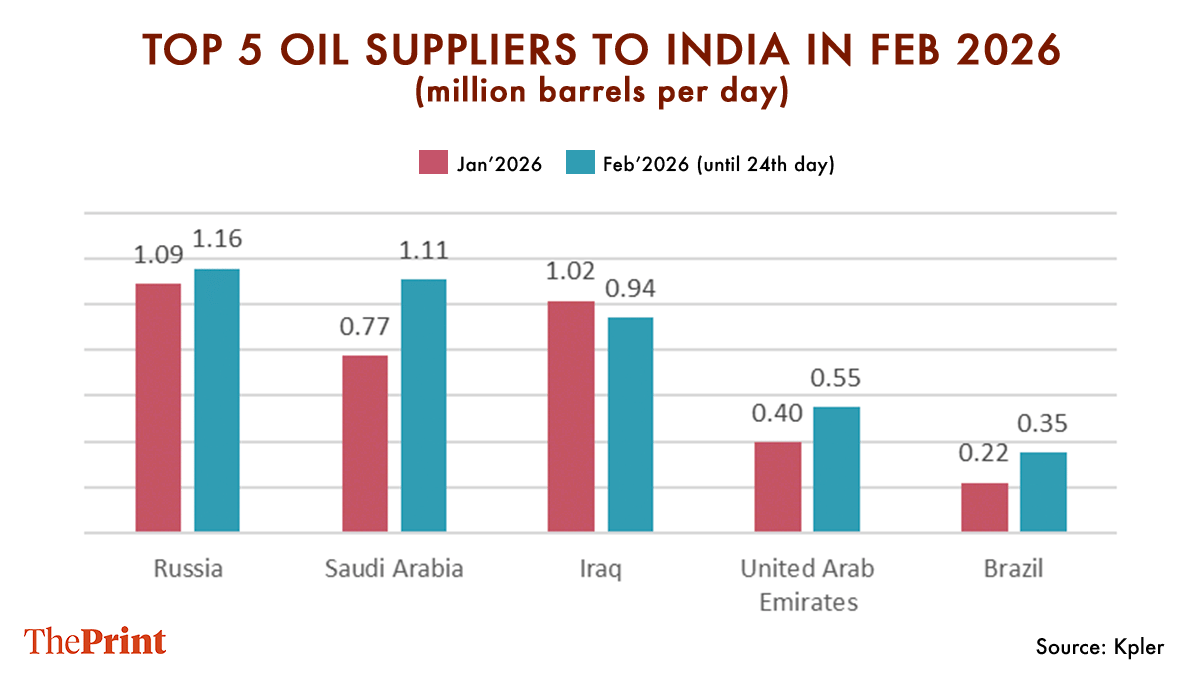
India’s own crude basket is shifting. Russian crude imports into India are estimated at around 1.16 mbpd till 24 February 2026, marking a decline from the elevated levels seen after 2022 when discounted Russian oil became a mainstay of India’s import mix.
As Russian volumes have declined, the primary beneficiaries have been Middle Eastern producers—notably Saudi Arabia, the United Arab Emirates and Qatar—along with Atlantic Basin suppliers such as Brazil and Colombia.
India’s crude oil supplies from Middle-Eastern countries are expected to surpass 3 mbpd in February 2026, a first time in more than a year.
With 1.11 mbpd crude oil supplied to India in February 2026, Saudi Arabia is emerging as a leading supplier. It is followed by Iraq with 0.94 mbpd and the UAE with 0.55 mbpd during the same period.
“The Middle East remains the dominant supplier given geographic proximity, established term contracts and scale advantages, and is likely to retain its position as India’s leading sourcing region through 2026 as refiners continue to rebalance their crude slate,” Ritolia said.
At the same time, Indian refiners are also exploring diversification. Ritolia confirmed that some refiners have made forward purchases of Venezuelan crude, which is expected to arrive in April. “Most of the refiners are looking to secure Venezuelan barrels, according to market sources,” he said.
Based on latest indications, Venezuelan crude is being offered at a landed discount of roughly $5-7 per barrel to ICE Brent, compared with Russian crude currently landing at a deeper discount of $8-10 per barrel, cites Ritolia.
Despite the narrower discount, Indian refiners are likely to consider additional Venezuelan volumes in subsequent months as part of a broader strategy to diversify sourcing and manage geopolitical risk, said Ritolia.
How Indian refineries fare
In February, state-run Indian Oil Corporation Limited (IOCL) emerged as the largest buyer of Russian crude among Indian refiners, importing about 434 kbpd, Kpler data showed.
Other refiners continuing to lift Russian barrels during the month included Nayara Energy at 382 kbpd, Reliance Industries at 179 kbpd, and Bharat Petroleum Corporation Limited (BPCL) at 157 kbpd.
Reliance Industries, which had not purchased any Russian crude in January 2026—the first such pause in more than two years—resumed buying in February. However, its latest purchases remain at lower volumes compared to its intake levels last year.
Meanwhile, Russia’s Rosneft-owned Nayara Energy—which has been sanctioned by the United States and the European Union—is moving ahead with plans to expand its fuel retail footprint in India, Ritolia said.
By adding more outlets, the company aims to serve what Ritolia described as “the world’s fastest-growing demand centre—India,” particularly when EU-related constraints have made exporting refined products more challenging.
(Edited by Amrtansh Arora)
Also Read: Venezuela crude returns to India’s oil basket. But only as ‘supplementary’ supply