





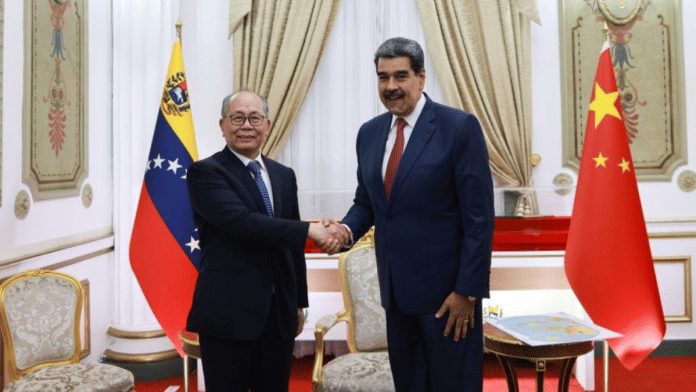



New Delhi: Hours before the US launched its military operation and “captured” Nicolas Maduro, the Venezuelan President was meeting with China’s Special Representative on Latin American Affairs, Qiu Xiaoqi. For Beijing, a lot is at stake in Venezuela, roughly $105.6 billion worth of loans and other financial assistance.
Beijing condemned the Saturday operation. In a statement, the Chinese Ministry of Foreign Affairs asserted that such “hegemonic acts of the US seriously violate international law and Venezuela’s sovereignty.” “We call on the US to abide by international law and the purposes and principles of the UN Charter, and stop violating other countries’ sovereignty and security,” the statement added.
Long before Donald Trump arrived on the political scene, Caracas opened its doors to China, leading to billions in infrastructure funding as Venezuela prospered under former President Hugo Chávez’s petro-socialism. The loans combined with new markets in Latin America and the Caribbean made Venezuela a key partner to China’s outreach to a region long considered to be the US’ key “sphere of influence.”
Countries in the region have all received billions of dollars in aid from China, as Beijing stepped up its efforts to expand its influence in Latin America. From energy projects, to infrastructure, to high-technological sectors such as space, Beijing has been a key partner for countries like Brazil, Chile and Venezuela.
In May last year, Chinese President Xi Jinping pledged $9.2 billion in credit lines for the Community of Latin American and Caribbean States (CELAC) as a part of the efforts to compete with the US’ long reach in the region. CELAC is an organisation that consists of 33 member states from the region.
Delegates from around 30 countries from the Latin America and Caribbean (LAC) region made for the fourth ministerial meeting of the China-CELAC Forum.
As a part of its vision, China has pushed its Belt and Road Initiative (BRI) into South America to help construct airports, ports, and other infrastructure projects. The BRI has been touted as the “project of the century” by President Xi and in the decade since its inception has lent over $1 trillion across the globe.
Between 2002 and 2021, China’s total trade with the LAC countries grew from $18 billion to nearly $449 billion, according to estimates published by the US Congressional Research Service. The exports from Latin America consisted primarily of natural resources (42 percent) and soybeans (16 percent) for example, while Beijing exported electric machinery and appliances.
China overtook the US as Brazil’s largest trading partner in 2009. A part of its goal in the region is to also isolate Taiwan as a majority of the 12 countries that still recognise the self-governing territory are from South America and the Caribbean. Furthermore, it has been key to propping the Cuban and Venezuelan regime.
Also Read: As Trump seeks regime change, the long arm of anti-Americanism in Venezuela—from Chavez to Maduro
The Venezuela gamble
Key to Beijing’s outreach is Venezuela. In 2006, while President Hugo Chávez still controlled Venezuela, Caracas signed a number of trade agreements with China and declared that Beijing was a “Great Wall” against American hegemony.
Venezuela agreed to export one million barrels of oil per day to China, while Beijing at the time promised to back Caracas’ bid at the time for a non-permanent member seat in the United Nations Security Council, according to media reports.
Caracas stepped in at a time to offer oil to Beijing just as China’s economy was evolving and becoming the lynchpin of global manufacturing. From being a net exporter of oil in the early 1990s, China became a net importer of oil in 1993 and by 2008, depended on half of its oil needs from imports.
The partnership between China and Chávez saw Beijing extend billions of dollars of loans to Venezuela. In 2006, China extended $2 billion in loans to Venezuela, which grew to $7 billion the following year, according to AidData, a research lab at the College of William and Mary, the US.
In 2009, China extended a further $8 billion in loans and the following year lent roughly $27 billion to the country, according to AidData. Beijing’s largesse kept investments flowing into Venezuela with the collateral being the South American country’s oil.
In 2007, China and Venezuela set up a joint fund worth $6 billion–$4 billion loan from the China Development Bank (CDB) and $2 billion from El Fondo De Desarrollo Nacional S.A. (FONDEN) set up by Caracas. The collateral for the repayment of the loan was collateralised through the shipment of oil from PDVSA–the Venezuelan state oil producer–to China for the terms of the loan or until the loan was fully repaid.
Two years later, the two governments agreed to double the money available in this fund to $12 billion through an additional $4 billion loan from the CDB and the same amount as the earlier agreement from FONDEN.
Under the agreement of the joint fund, there was one—petroleum sales agreement—that promised the sale of at least 100,000 barrels of oil a day by PDVSA to CHINAOIL at a pre-agreed price. Such agreements were commonplace as China stepped in to invest in Venezuela’s economy.
Other deals include a $1 billion line of credit to PDVSA for multiple projects in 2014 and a further $1.5 billion loan to state oil manufacturers that same year for working capital purposes, all of which have been documented by AidData. As oil prices collapsed in 2014, so did the Venezuelan economy led by President Maduro.
To offset the situation, China extended a loan worth $10 billion to ensure support for the government’s balance of payments, once again backed by oil sales from PDVSA. Realising the state of the economy, China further eased the terms of repayment of nearly $50 billion worth of loans granted to Caracas in 2015.
The USD loans were first granted in 2007. The restructuring eased the number of barrels per day that Caracas had to send to China, which stood at 330,000 and further allowed repayments in local currencies.
Since 2016, however, China’s loans petered off, while Beijing and Caracas focussed on restructuring the existing financial commitments. For China, Venezuela remains one of its largest debtors, and any change in administration in Caracas has large financial implications for Beijing.
(Edited by Tony Rai)
Also Read: State of emergency in Venezuela as Trump claims to have ‘captured’ Maduro, wife after US airstrikes
Going by Trumps new found love for 2+2 , he will be played by the Chinese in Venezuela too. The Americans keep making the mistake of playing too smart.