






New Delhi: The US-Pakistan thaw under President Donald Trump and growing ties may temper India’s “muscular” counter-terrorism response in future, according to former US ambassador to India Kenneth Juster.
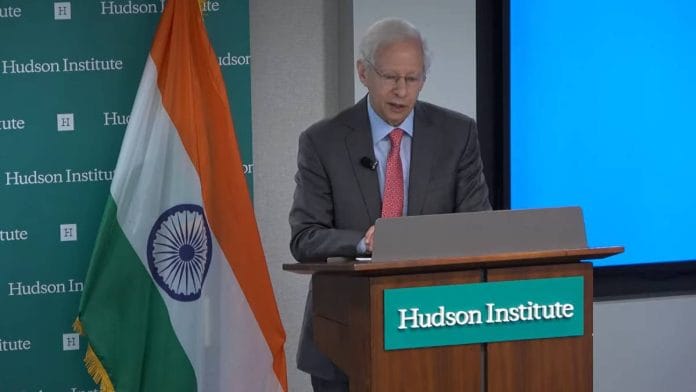
Juster, who served as ambassador from 2017 to 2021, made the comments Thursday at ‘The New India Conference’ at American conservative think tank Hudson Institute.
The shift, he said, could have tangible consequences in case of future crises.
“Pakistan’s warm relations with the United States may cause India to limit its response to the next significant cross-border terrorist incident. At the very least, unlike other previous incidents, and I was an ambassador when we had the Pulwama and Balakot incidents, India may have doubts as to whether the United States will support a muscular response to Pakistani-based terrorist groups,” he explained.
The comments come two weeks ahead of the anniversary of Operation Sindoor, India’s retaliatory strikes against terrorist infrastructure in Pakistan after the 22 April, 2025, Pahalgam attack in Jammu & Kashmir in which 26 people were killed.
In his address, Juster also claimed that the growing US-Pakistan relationship had “come as a surprise” to many.
“On Pakistan’s successful courting of the Trump administration, which now extends to being an intermediary in the US-Iran talks, obviously, on multiple levels and for many reasons, this is an irritant to India and a surprise to many of us,” he said.
Also Read: Countries need to work out a way to deal with China’s rising power — US envoy Kenneth Juster
‘China biggest threat to India’
According to the diplomat, for India, apart from geopolitical shifts, it is China that remains the biggest threat.
“China remains India’s biggest threat in the region,” Juster said, citing Beijing’s close partnership with Islamabad as “a cause of great concern to Delhi”. Even so, India continues to seek a cautious stabilisation of ties with China—“even though it will never be a relationship (of) trust”.
India’s commitment to a multipolar world also explains its enduring ties with Russia. These, Juster said, serve multiple purposes: securing defence supplies, accessing energy and preventing Moscow from drifting too close to Beijing.
At the same time, he noted a growing recognition in New Delhi that “Moscow (is) a declining power” and that excessive alignment with Russia could jeopardise ties with the West.
Beyond great power politics, India has broadened its diplomatic footprint across West Asia, Africa, Latin America and Southeast Asia, while participating in a growing number of multilateral and “minilateral” groupings, according to the envoy.
Prime Minister Narendra Modi has also cultivated the Indian diaspora through large-scale events abroad, he noted.
“This is part of an effort to make people proud of their Indian heritage,” Juster said, adding that it “can have a positive impact on the policies of the host countries towards India and it’s been, in my opinion, hugely successful”.
Much of his remarks traced the evolution of India’s foreign policy under Modi, which he characterised as increasingly assertive and expansive.
“Modi has increasingly projected greater self-confidence in reaching out to a wide swathe of countries throughout the world, expanding the scope of India’s foreign policy and its sense of purpose in engaging others,” Juster said.
He maintained that India’s rise remains one of the defining stories of the century.
“Given India’s large population, its market size, its technological talent, and its growing military, its rise will be one of the most significant geopolitical stories of this century,” he said, adding: “It’s in the interests of both the United States and India for America to be a positive part of that story.”
India, Juster said, now sees itself “as a civilisational power that wants to play an increasingly significant role in world affairs”. Its ambitions are concrete: becoming a developed nation by 2047 and serving as a leading voice for the Global South, he added.
Yet Juster spoke of tensions within India’s economic strategy. Despite its global ambitions, New Delhi has hesitated to join major trade frameworks, he said.
“To date… this has not meant that India has been willing to join a regional free trade agreement,” he asserted, pointing to its withdrawal from the Regional Comprehensive Economic Partnership (RCEP) and lack of interest in the Comprehensive and Progressive Agreement for Trans-Pacific Partnership.
“If India stays outside of these regional frameworks, it will not be able to fully meet its aspiration of being a global supply chain hub,” he warned.
India withdrew in 2019 from negotiations for the RCEP, a free trade agreement with 15 nations, on account of the possible adverse impact it would have on the country with regards to trade balance and impact on dairy sector, as well as threat from China.
(Edited by Nida Fatima Siddiqui)
Also Read: ‘Frictions & frustrations’ limit full potential of US-India trade ties — envoy Kenneth Juster
We are more motivated when the US stands against us lol. Don’t conveniently forget 1971.