







New Delhi: The talks between Iran and the US planned in Switzerland Friday have been postponed as Israel continued strikes on southern Lebanon. The delay comes after both the US and Iran digitally signed a memorandum of understanding that entails Washington dropping its naval blockade of the West Asian nation.
US Vice President J. D. Vance was scheduled to travel to Switzerland to hold the next round of discussions with the Iranian delegation. However as late as Thursday, Vance, in an interaction with the media, had said he was not sure he was travelling to Switzerland to handle the next round of negotiation. Vance was initially expected to handle the signing ceremony of the deal.
“The planned talks between the US, Iran, Qatar and Pakistan have been postponed. Switzerland remains ready to facilitate these talks. The relevant preparatory work at Bürgenstock is continuing. No further information can be provided at present,” the Swiss Foreign Ministry said in a statement Friday.
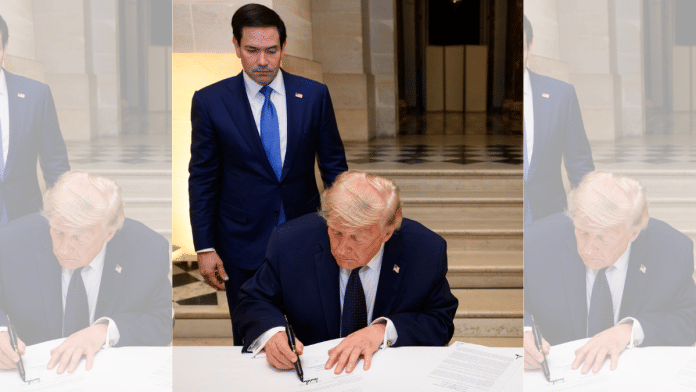
The memorandum of understanding mediated by Pakistan and a number of West Asian nations was originally scheduled to be signed Friday in Switzerland. However, Iranian President Masoud Pezeshkian digitally signed the agreement. US President Donald J. Trump also digitally signed the agreement Wednesday night in Versailles while seated next to French President Emmanuel Macron.
Iranian sources had informed domestic media Thursday that the planned trip to Switzerland was off due to the continued Israeli strikes on Southern Lebanon. The MoU made it clear that the US, Iran and all allies “declare the immediate and permanent termination of military operations on all fronts, including Lebanon”.
The White House in its own statement on the postponement of talks said that the US looked forward to “beginning technical talks as soon as possible”. The discussions were focused on the implementation of the MoU as well as the next step of negotiations to achieve a final deal within the 60-day time limit envisaged by the agreement.
The 14-point MoU focuses on the removal of the US naval blockade against Iran—first imposed on 13 April—the reopening of the Strait of Hormuz, along with at least creating a plan worth $300 billion for the reconstruction of the West Asian nation. In exchange, Iran commits not to develop or procure a nuclear weapon, while the US will begin the process of easing sanctions on the Iranian economy.
The 60-day time period to negotiate a final deal can be extended by mutual consent. Iran’s Supreme Leader Mojtaba Khamenei in a statement Thursday said that he agreed to the deal despite having a “different view”.
“Out of the commitment that the esteemed President—as the head of the Supreme National Council—gave to me on his own behalf and on behalf of the other members regarding safeguarding of the rights of the Iranian nation, and the Resistance Front, and his explicit acceptance of that responsibility, I granted my permission,” the Iranian Supreme leader said in a statement.
Khamenei acknowledged that in-person negotiations will be held in the future, but that does not mean the “acceptance of the enemy’s position”. While Iran and the US seem to indicate acceptance of moving the deal forward, Israel, which is not a party to the deal, but included by the US, has moved forward with maintaining its security zone within Southern Lebanon.
The Israeli Defence Forces (IDF) in a statement Friday said that four of its soldiers were killed “last night” by the Hezbollah, while another drone attack by the Shi’ite militia Friday morning severely injured an IDF reserve officer, while “lightly injuring” three reservist non-commissioned officers and one non-commissioned officer.
Tel Aviv has maintained that it will continue taking action against Hezbollah, despite the US-Iran agreement. Trump has hit out against Israeli Prime Minister Benjamin Netanyahu in recent days. Trump called on the Israeli Prime Minister to “be more responsible with respect to Lebanon” Tuesday in comments to the media.
Vance in his own interaction with American media Thursday hit out at Israeli politicians criticising Trump. The deal and the resulting exchanges between US and Israel have galvanised the Israeli opposition, with Yair Lapid, the Leader of the Opposition, warning that the Netanyahu government is “wiping out” Israel’s foreign affairs.
(Edited by Viny Mishra)
Also read: Iran-US MoU is an opportunity for India. Or forget the $5-trillion economy