





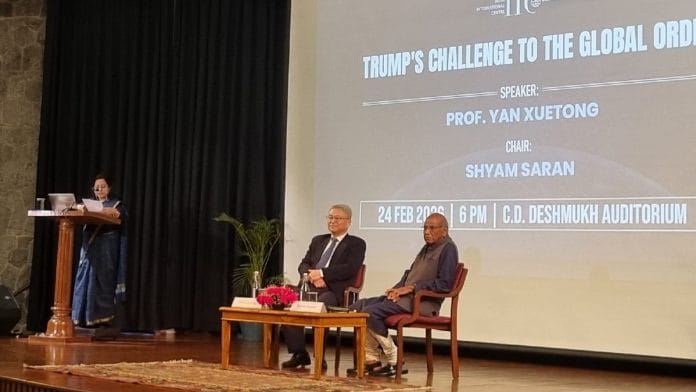



New Delhi: Beijing and Washington can never form a unit called “G2” to provide global leadership because of consistent competition rather than cooperation, said Chinese political scientist Yan Xuetong during a discussion at the India International Centre here Tuesday.
Xuetong, the distinguished Professor from Beijing’s state-run Tsinghua University, delivered the lecture on ‘Trump’s Challenge to the Global Order’.
The discussion, moderated by former foreign secretary Shyam Saran, explored how the post-Cold War era of undisputed US hegemony has dissolved into a complex concept of ‘G-0’, a state defined by a total lack of global leadership.
While the concept of a “G2” technically implies a bipolar world, the consensus drawn from the presentation by Yan was that the primary contenders are currently too engaged in rivalry to provide global direction. This has prompted middle powers like India and Russia to seek multilateral alternatives.
Professor Yan talked about how “Trump reversed the global order,” noting that the US president appears not to grasp that the era of undisputed leadership ended after the post-Cold War period. He also said that the US was once the only superpower because of its strong economy. But in today’s divided and fragmented world, that is no longer true.
“The current order is based on populism and not on nationalism,” Yan added, urging the observers to distinguish between the two. He explained that while nationalism can encourage a nation to ‘catch up’ with others, populism leads to a ‘complete cutoff’ of economic and cultural exchanges, which leads to an increase in xenophobia.
He suggested that while many focus on the international fallout of Trump’s actions, his “challenge to the global order is nothing compared to the damage he has done to American society”.
This trend, he argued, undermines ‘comprehensive national capabilities,’ specifically in the US, where restrictive immigration policies threaten the very talent-attraction model that built American strength.
Also Read: A secret nuclear test by China? It’s a Hollywood-style conspiracy, Chinese say
AI & Cyberspace Competition
The discussion also delved into how AI and digital technology are fundamentally altering international relations, creating a new ‘cyber space’ where military power is increasingly bolstered by cyber capabilities.
Yan cited the Russia-Ukraine conflict as a prime example of this shift, as despite being unequal in conventional military power, the help Ukraine receives from the EU in cyberspace has acted as a ‘counter-balancing act’ in the situation.
This technological rivalry has widened the cracks between the global trading systems, which he called ‘counter-globalization’. With the WTO being ‘ripped apart’ as countries move away from global integration, the world is shifting toward a fragmented globe characterised by extreme polarization and a widening gap between the rich and poor.
Responding to these shifts, Yan noted that a new benchmark for national security has emerged called ‘economic security’.
Before Trump, this was largely an academic concept, but now, it dictates policy as countries limit external purchases to reduce economic interdependence, he said.
He suggested that this trend of reducing dependence is expected to become ‘wider and more persistent’ as the global center of gravity shifts decisively from Europe to East-Asia.
The presentation concluded with the observation that, unlike the Cold War, which was a quarrel over ideology, the current global conflict is strictly based on technology and cyberspace,and that the shift toward a world defined by cyberspace competition is now an inescapable reality.
(Edited by Varnika Dhawan)