


New Delhi: The US criticised India’s Atmanirbhar Bharat (Self-Reliant India) strategy and Production-Linked Incentive (PLI) schemes, citing market distortions, and proposed a 25 percent tariff rate on Wednesday.
The United States Trade Representative (USTR) Jamieson Greer determined that under Section 301 of the Trade Act of 1974, India has made several “unreasonable acts” including industrial plans to expand manufacturing; inadequate labour protections; financial repression policies; sustained market access barriers; and failed to address global excess capacity and production, including through imports and foreign direct investment from non-market economies.
“These acts, policies, and practices burden or restrict U.S. commerce by (1) reducing commercial opportunities for U.S. producers and exporters in India and third-country markets…This is especially true in sectors like health (pharmaceuticals and medical devices), steel, solar, and information and communications technology (ICT),” the USTR said in its statement.
As a result of these investigations, the USTR proposed a 25 percent tariff rate on Indian imports, which could be reduced to 17 percent, in the event that a trade deal is signed, according to Reuters.
“The Trade Representative proposes that appropriate action to obtain the elimination of the acts, policies, and practices would include applying tariffs of up to 25 percent on all goods of India, net of existing Section 301 tariffs, with exemptions for certain goods,” the USTR statement said.
The Section 301 investigation was launched in March 2026, after the US Supreme Court on 20 February struck down the previous tariff architecture put into place by the administration of President Donald Trump under the International Emergency Economic Powers Act (IEEPA).
The Trump administration had imposed a 25 percent tariff on Indian goods, accusing New Delhi of engaging in unfair trade practices that hurt American companies. After the IEEPA tariffs were deemed invalid, the White House moved to launch investigations under the Trade Act of 1974 against 16 economies over “excess capacity” and several other countries over their failure to prevent forced labour in supply chains.
The investigations into forced labour protections were completed a few months earlier, with the US imposing a 10 percent tariff rate on India. The new proposed tariff rate is unlikely to come into effect until January 2026.
If the first tranche of the India-US bilateral trade agreement is signed, the proposed tariff rate will be reduced to 17 percent. The new tariffs will not be levied over and above the existing 10 percent rate. Instead, they will replace it, becoming the final tariff rate applicable to Indian goods.
The lower proposed tariff rate on Indian merchandise is a result of the ongoing negotiations between New Delhi and Washington, D.C. Last week, ThePrint reported that the US had “assured” India of a comparative tariff advantage to its competitors. A total of 13 countries and the European Union (EU) face new proposed tariffs, while Mexico and Norway are currently outside the proposed levies, despite ongoing investigations.
The proposed rate of 17 percent in case of the trade deal is lower than several of India’s competitors, including Vietnam, which faces a proposed rate of 35 percent (or 20 percent tariff rate if they sign a trade deal with the US) and other countries including Thailand, Bangladesh, Myanmar, Indonesia, Malaysia and Cambodia, all of which face an 18 per cent rate, according to reports.
For India, the latest proposed 17 percent rate is lower than the 18 percent that was announced in February. The two governments had announced a joint framework for the trade deal in February, just about two weeks before the US Supreme Court struck down the IEEPA tariffs.
The first tranche of the bilateral trade deal has yet to be finalised and signed as New Delhi was waiting on the completion of the Section 301 investigations. Now that the US administration has completed the investigations and is set to carry forward the processes under law, which will take at least a couple of months, there remains a brief window for the two sides to potentially finalise the deal.
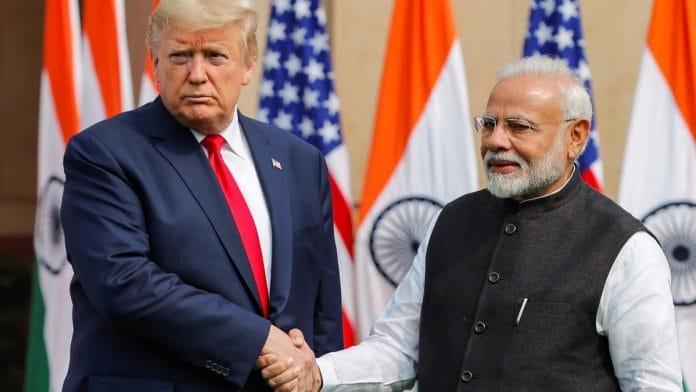
Prime Minister Modi is expected to travel to the US on 13 December to attend the G20 Leaders’ Summit, being hosted in Miami. Given that the US is hosting the summit, PM Modi is likely to have a bilateral meeting with President Trump, as is the norm when the Indian leader attends multilateral summits.
(Edited by Anupama Yadav)
Also Read: US ‘assures’ India of ‘comparative tariff advantage’ as trade talks continue