



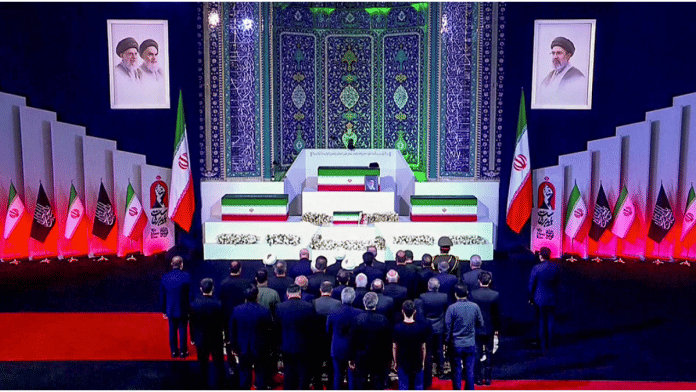
New Delhi: A Saudi delegation led by the country’s deputy foreign minister Waleed el Khereiji, made an unexpected appearance in Tehran at the funeral of former Iranian supreme leader Ali Khamanei.
Saudi Arabia had not been listed among the foreign delegations expected to attend the funeral, according to Iranian media. Officials from Oman and Qatar had been publicly identified ahead of the event, making Riyadh’s participation a notable diplomatic gesture.
The funeral ceremonies began Friday in Tehran where Khamenei’s body was displayed at the Grand Mosalla. His body will be paraded through Tehran before being moved to the Shiite seminary city of Qom Tuesday.
The Saudi deputy FM later also wrote a condolence letter for Khamanei, Iranian media reported. The attendance at the funeral comes amid strained ties and cautious diplomacy between both countries amid the West Asia war.
According to a May 2026 Financial Times report, Saudi promoted the idea of a regional non-aggression framework involving Iran and Gulf Arab states post the fragile ceasefire.
Saudi policymakers have expressed concern that any future regional security arrangement should address Iran’s ballistic missile and drone capabilities while reducing the risk of another major military confrontation in the Gulf, the report added.
Shifting regional dynamics
The proposal reflects a broader reassessment of security priorities across the Gulf, where governments are weighing how to maintain stability amid uncertainty amid the West Asia war.
The report also described a growing difference among Gulf states over how to respond to shifting regional dynamics. While Saudi Arabia has stressed on diplomacy and de-escalation, the United Arab Emirates has maintained close security cooperation with the United States and Israel.
Media reports also mentioned that Saudi Arabia earlier in May resisted a proposed US-led maritime security operation in the Strait of Hormuz by withholding access to American military facilities. The Wall Street Journal reported discussions surrounding maritime security operations in the Gulf, though the details and extent of any disagreement between Washington and Riyadh remain disputed, and neither government has publicly confirmed the claims.
Gulf governments, in essence, are increasingly seeking diplomatic methods that reduce the likelihood of future conflicts while preserving security partnerships with Western allies.
Two weeks ago, the Saudi foreign minister Prince Faisal bin Farhan welcomed the MoU between the United States and Iran as an important opportunity to reduce tensions, while cautioning that any lasting agreement must include strong verification measures and address broader regional security concerns.
“The details will matter,” he said. “How we will have a long-term sustainable verification regime is what will matter the most.”
Rejecting proposals for new arrangements governing navigation through Hormuz, he further said the existing framework had functioned effectively before the West Asia war.
“The management of the strait was working fine before the conflict,” he said. “Ships were navigating freely. Why should we now, as a result of a conflict, accept some novel arrangement that is going to be imposed on it?”
Addressing Saudi Arabia’s relationship with Iran, Faisal acknowledged that recent hostilities had significantly eroded the trust that had begun to emerge following the Beijing-brokered restoration of diplomatic relations between the two countries in 2023. According to reports, Saudi had also launched secret retaliatory strikes on Iran after the West Asia war began in February, but has struck a more conciliatory note since then.
While Riyadh had cautiously explored renewed dialogue and economic cooperation with Tehran, he said those efforts have effectively been placed on hold.
The foreign minister also said Saudi Arabia had supported diplomatic efforts behind the scenes but had not served as a formal mediator.
“We were supporters and we were helpful behind the scenes in trying to encourage both parties to give primary focus to the diplomatic track,” he added.
(Edited by Viny Mishra)
Also read: US believed Israel was planning to assassinate top Iranian negotiators as talks underway: NYT
Iran has held its head high since 28th February. Its newly demonstrated control over the Strait of Hormuz gives it leverage over the global economy. Gulf states would be wise to accept a new order in the region where Iran, with the world’s second largest reserves of natural gas and fourth largest of oil, develops as a modern, prosperous society. 2. India too might wish to tot up the hits and misses of I2U2.