





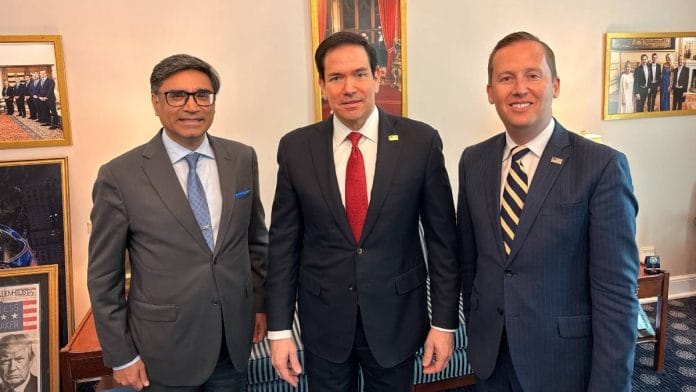


New Delhi: Marco Rubio is expected to make his first visit to India next month in his capacity as US Secretary of State. The visit would come in the immediate aftermath of the West Asia conflict, which has negatively impacted energy supply globally, and a few months after the two countries announced a trade deal, which remains in limbo at the moment.
The announcement on Rubio’s impending visit made by US ambassador Sergio Gor comes as Indian Foreign Secretary Vikram Misri finishes his three-day visit to the US, where he met with a number of senior American officials.
“Welcome to the White House @VikramMisri! Productive meeting with @SecRubio that focused on our bilateral relationship, especially trade, critical minerals, defense and the Quad. Secretary Rubio looks forward to visiting India next month!” Gor said in a statement on X.
Gor had announced that India and the US are working on a series of high-level bilateral exchanges during his speech in January, before officially taking over as the US’ top diplomat in New Delhi.
Since then, a series of American officials, including Christopher Landau, Deputy Secretary of State, and Elbridge Colby, Under Secretary of Defence, have all travelled to India.
Misri undertook the US visit as the two countries look to build on the successful announcement of the trade deal in February. India-US ties have seen challenges in the last year due to the US imposing 50% tariff on Indian goods and the lack of a trade deal.
However, the trade deal papered over the cracks in ties, and has seen an uptick in high-level exchanges and meetings. Misri, in his three-day visit to the US, met with Rubio, as well as Federal Bureau of Investigation Director Kash Patel, and other officials such as Colby and Landau.
Rubio’s visit to India next month would come at the end of the two-week ceasefire announced between the US and Iran. However, both nations have sent delegations to Islamabad to start direct negotiations for a long-term solution, with discussions set to begin Friday.
India’s energy security, particularly flow of liquefied natural gas, has been impacted due to the Israel-US war with Iran. Tehran’s retaliation took aim at the Gulf Cooperation Council countries, including Saudi Arabia, Bahrain, Kuwait, Oman, UAE and Qatar.
New Delhi has called on all three parties involved in the West Asian conflict to negotiate an end to the war, welcoming the ceasefire announcement.
India also officially joined the US-led Pax Silica initiative in February, during a visit by Minister for Railways, Information and Broadcasting and Electronics and Information Technology Ashwani Vaishnaw to the US. External Affairs Minister S. Jaishankar also travelled to the US in early February to attend the Critical Minerals Ministerial dialogue.
Ties between India and the US for most of last year remained challenging given the US pressure placed on New Delhi to curtail Russian oil purchases. The relationship was further impacted by a heated call between Prime Minister Narendra Modi and US President Donald Trump last June over the role the US played in ceasing hostilities between India and Pakistan following Operation Sindoor.
While India maintained that the 87-hour conflict with Pakistan was concluded through bilateral discussions, Trump took credit for the cessation of hostilities, claiming that the US had threatened to impose high tariffs if both countries did not end the conflict.
The two leaders did not speak for the next three months. However, the biggest challenge remained the India-US trade deal. Negotiations between the two sides went on for the better part of a year.
In February, following a call between Modi and Trump, the two countries announced the conclusion of negotiations for the first tranche of the trade deal, which was soon followed by a joint framework agreement.
The deal, however, remains in limbo currently as the US Supreme Court struck down Trump’s ability to impose tariffs using the International Emergency Economic Powers Act (IEEPA). The US has since used a different legislation to impose 10% tariffs globally.
New Delhi is waiting to see how the Trump administration will impose its global tariff architecture before signing the trade deal.
(Edited by Nida Fatima Siddiqui)
Also Read: Trump’s fanboys in BJP are now proved wrong. Lesson here is to never personalise diplomacy