





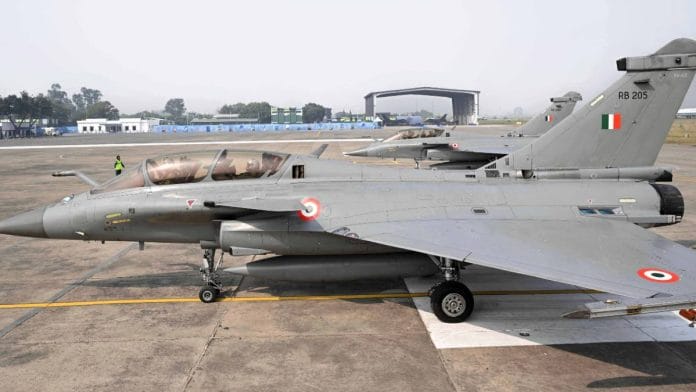



New Delhi: In the last few weeks, a new wave of disinformation, emanating from Pakistan, has been launched against Dassault Aviation, maker of the Rafale aircraft, on social media platforms. Earlier this month, a fake letter was in circulation, purportedly written by External Affairs Minister S. Jaishankar to France’s ambassador to India Thierry Mathou regarding aircraft purchase by the Indian Navy.
“Once again, the Rafale fighter jet finds itself in the crosshairs of a foreign power… Dassault Aviation was the target of a disinformation campaign on social media launched on 25 November. This operation was allegedly carried out by a self-proclaimed Pakistani digital communications specialist,” French weekly newspaper Le Journal du Dimanche said Wednesday, citing a report by Viginum, France’s agency for vigilance against foreign digital interference, put out by weekly Le Canard enchaîné.
It pointed out that there have been at least three instances of fake letters shared since 25 November, two purportedly from Éric Trappier, CEO of Dassault Aviation, and one from Jaishankar.
The first of the fake letters from Trappier “leaked” on 25 November had the Dassault CEO inform the Indian Ministry of Defence that the delivery of 26 Rafale Marine (M) aircraft would not be possible without prior training of pilots for 10 weeks, according to the French newspaper. The second fake letter circulated a day later had Trappier urging Indian authorities to open an investigation in the wake of the first letter.
Jaishankar’s letter to Mathou first circulated on social media on 8 December was swiftly labelled as “fake” by the Ministry of External Affairs’ FactCheck unit on 11 December. The ministry also urged individuals to be “alert against such disinformation”.
The Rafale jet has been the subject of disinformation in the aftermath of Operation Sindoor. The 87-hour conflict between India and Pakistan in May saw the aircraft used in operations by the Indian Air Force (IAF).
Last month, the US Congress was informed that the Rafale in particular had been the centre of a disinformation campaign initiated by China to hinder the sales of the fighter jet. The report by the US-China Economic and Security Review Commission highlighted that the campaign launched against the aircraft was focused on the alleged downing of a Rafale by Pakistan’s Air Force during Operation Sindoor using Chinese weaponry.
India has not released information regarding the loss of equipment during Operation Sindoor, while conceding that there were a few losses. India rejected the loss of six jets as claimed by Islamabad. Pakistan has repeatedly claimed that one of its J-10C jet’s shot down at least one Rafale.
China has become the primary arms supplier for Pakistan and has sought to leverage the alleged successes of its equipment during Operation Sindoor with larger sales of defence platforms across the globe.
In the aftermath of Operation Sindoor, reports indicated that Indonesia, another South East Asian nation with a standing order of Rafale fighters, was now “reconsidering” its purchase and looking at Chinese equipment instead. However, the first three Dassault Rafale B aircraft for Indonesia’s Air Force are set to be delivered at the end of January 2026. Indonesia has ordered a total of 42 Rafales so far.
(Edited by Nida Fatima Siddiqui)
Also Read: France’s Dassault Aviation ties up with Tata for Rafale fuselage manufacturing in India