





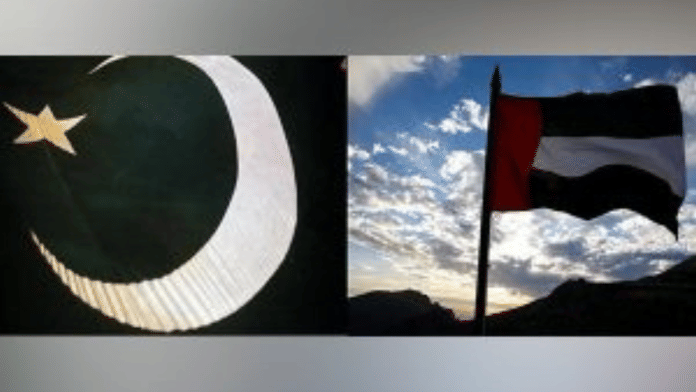



New Delhi: After the UAE asked Pakistan to immediately pay back a $3.5 billion loan, a senior Pakistani cabinet minister announced the repayment this month to its “brotherly country”, adding, “national dignity could not be compromised for financial considerations”.
While the cabinet minister confirmed that Pakistan would repay the UAE debt, senior officials said discussions were ongoing to convert part of it into investment. The escalating West Asia conflict is believed to have accelerated the repayment, as the UAE had previously been reluctant to roll over the loans, Express Tribune reported.
Earlier, the UAE rolled over two $1 billion loans in January for a month, despite Pakistan’s request for a two-year extension at a lower interest rate.
Under a $7 billion International Monetary Fund (IMF) programme, Pakistan is required to secure $12.5 billion in rollovers from three partners—China, Saudi Arabia, and the UAE—to meet external financing needs and maintain reserve levels. The programme concluded in September 2024.
The UAE first provided $2 billion in 2018, followed by $1 billion in 2023 for IMF support. While repayment had initially been deferred through monthly rollovers, the UAE has now requested full repayment.
Pakistan now claims it will return $450 million on April 11, $2 billion on April 17, and $1 billion on April 23, possibly using part of the central bank’s $16.4 billion reserves. Including a $1.3 billion Eurobond due April 8, total repayments this month will reach $4.8 billion. The country had requested the UAE to reduce the interest rate on the recent loans from 6.5 per cent to around 3 per cent, citing improved credit ratings and lower global borrowing costs but the UAE refused.
Of the total, $450 million traces back to a one-year loan taken in 1996–97, which Pakistan plans to repay next week after three decades.
The cabinet minister who made the announcement on condition of anonymity described the move as the cost the country was willing to bear to uphold “national dignity” even as it is set to significantly draw down foreign exchange reserves, Dawn reported.
According to the latest data, Pakistan’s central bank reserves are at about $16.3 billion. A payment of $3 billion from the reserves would sharply reduce these holdings by 18 per cent, significantly lowering the external buffer and import cover.
In September 2024, China, the UAE, and Saudi Arabia agreed to lend the country $7 billion to help secure an IMF loan that the lending body had approved in July. IMF deferred the loan due to an external financing gap which prompted Pakistan to ask its allies for help.
Each country lent a fixed amount, with the UAE lending $3.5 billion. Saudi Arabia gave $5 billion, while China gave $4 billion. Pakistan was supposed to pay it off on a rollover basis to the UAE, but it will now be paid entirely in April.
In September 2024, Pakistan PM Shehbaz Sharif publicly thanked all 3 countries for coming together to help secure external funds and even called the UAE ‘a brotherly state’. However, sentiments had changed by 2026.
In January, while addressing a group of exporters and businessmen in Islamabad, Sharif said “seeking foreign loans had forced Pakistan to “bow” its head and make compromises at the “cost of self-respect”.
“How should I describe the way we requested loans from friendly countries? The friendly countries didn’t disappoint us. But the one who goes to seek a loan has their head bowed. When you go seeking loans, you pay the price at the cost of your self-respect. You have to compromise… Sometimes, an undue demand may come up, and you have to implement it even when there is no reason to fulfil it,” he had said in January.
(Edited by Viny Mishra)
Also read: How Pakistan lost the plot in the Middle East—from security provider to security seeker