








New Delhi: Pakistan Thursday joined Arab-Islamic states in condemning Iran’s retaliatory strikes across the Gulf, calling on Tehran to “halt its attacks” and warning that the “future of bilateral relations would depend on respect for sovereignty and non-interference”.
The condemnation spotlights the growing alliance between Azerbaijan, Turkey and Pakistan against the backdrop of Pakistan’s Strategic Mutual Defence Agreement with Saudi Arabia, signed last September.
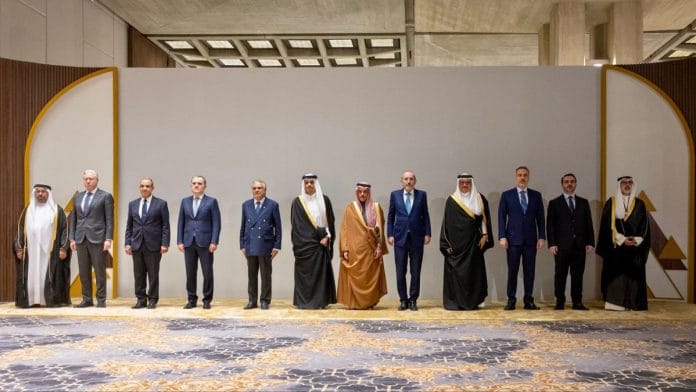
The joint statement, endorsed by the foreign ministers of Saudi Arabia, Qatar, the UAE, Egypt, Turkey and Azerbaijan, denounced Iran’s actions as “unjustifiable” and called for an immediate cessation of hostilities. It also warned of the threat Tehran’s actions posed to key maritime routes, particularly the Strait of Hormuz, critical to global energy supplies.
The bloc also accused Iran of launching ballistic missiles and drones that struck civilian infrastructure, including residential areas, oil facilities, desalination plants and airports. Such attacks, it said, could not be justified “under any pretext,” while affirming the right of member states to defend themselves under Article 51 of the United Nations Charter.
Joint Statement Issued by the Consultative Ministerial Meeting of the Foreign Ministers of a Group of Arab and Islamic Countries Regarding the Iranian Attacks
Riyadh | 19 March 2026
Their Highnesses and Excellencies the Ministers of Foreign Affairs of the State of Qatar, The… pic.twitter.com/Eik3eqtdlA
— Ministry of Foreign Affairs – Qatar (@MofaQatar_EN) March 19, 2026
Pakistan’s participation in the Riyadh bloc reflects a strategic balancing act, given its border with Iran and deepening ties with Saudi Arabia, its principal partner in the Gulf.
That tension is increasingly visible as Pakistan aligns itself more closely with a loose trilateral grouping alongside Turkey and Azerbaijan. The three countries have over the past few years strengthened cooperation around shared diplomatic and security concerns.
Their partnership took shape following the 2020 Karabakh war, after which the three nations explored a trilateral cooperation framework. In June 2021, Turkey and Azerbaijan signed the Shusha Declaration. Pakistan was the first nation to join this strategic alliance.
In July 2024, the heads of all three countries met on the sidelines of the 24th Meeting of Council of Heads of State of Shanghai Cooperation Organization (SCO) in Astana, Kazakhstan. The second trilateral meeting was held in May 2025 on Azerbaijan’s Independence Day, in Lachin, where they decided to expand regional cooperation and trade.
The third trilateral meeting was held in November 2025, in Baku, to commemorate the fifth anniversary of the Second Karabakh War and liberation of long-occupied Azeri territories.
The idea was to nurture a sense of “three states, one nation”.
For India, the emergence of such a bloc raises concerns that it could evolve into a more formal political or military axis, particularly as global alignments harden.
India has close ties with Gulf states and maintains pragmatic relations with Iran.
Also Read: US annual threat assessment focuses on Iran, Pakistan, China and Russia. What it says
Spillover of West Asia war
On 5 March, Azerbaijan accused Iran of launching drone strikes into its territory, including its exclave of Nakhchivan. Azeri officials said an airport terminal was damaged and civilians injured near a school, prompting the military to move to maximum combat readiness.
Tehran denied any role, suggesting the possibility of a false-flag operation by Israel.
However, Azerbaijan’s President Ilham Aliyev blamed Iran for the drone strikes, calling it “ugly, cowardly and disgusting”. He even made a pointed reference to expats living in Iran, saying that “independent Azerbaijan is a place of hope for Azeris living in Iran”.
This shift in rhetoric was new since Baku had so far avoided any comments on religious minorities, given regional sensitivities.
Both Iran and Azerbaijan are Shia-majority countries but their relationship deteriorated after the 2020 Karabakh war between Azerbaijan and Armenia.
Meanwhile, Turkey has sought to maintain a nuanced position. While condemning Iranian strikes on Gulf countries as “unacceptable, regardless of the reason,” Turkish President Recep Tayyip Erdogan also criticised US and Israeli strikes against Iran as “clear violation” of international law, warning further escalation could destabilise the entire region.
Turkish Interior Minister Mustafa Ciftci then held calls with counterparts in Azerbaijan and Iraq about strengthening cooperation, the Interior Ministry said in a post on X.
Pakistan’s stance reflects similar contradictions. Even as it joined the Riyadh statement condemning Iran’s actions, Foreign Minister Ishaq Dar had earlier separately denounced attacks on Iran as “unwarranted”, calling for an immediate return to negotiations.
(Edited by Amrtansh Arora)
Also Read: ‘Exercise caution’ when discussing country’s foreign policy on TV, Pakistan govt tells its media