





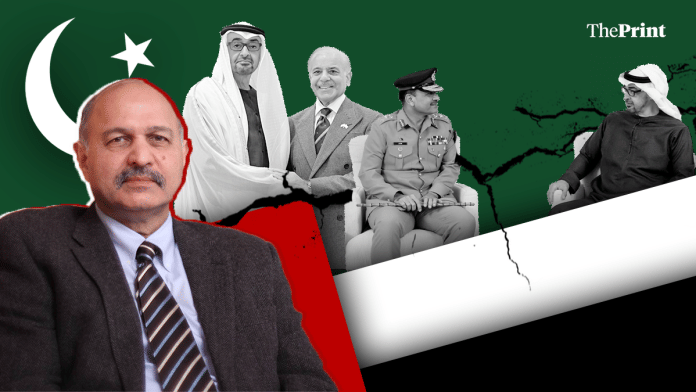



New Delhi: As both US and Iran affirmed Pakistan’s role in the ceasefire earlier this week, a Pakistani establishment figure’s public jibe at the UAE put the spotlight on fraying ties between Abu Dhabi and Islamabad—in the backdrop of the South Asian country’s balancing act in the Gulf amid the war.
On Tuesday, Pakistani Senator Mushahid Hussain described the UAE as a “helpless nation” after the Emirates asked Islamabad to repay a $3.5 billion loan, framing the repayment not as a financial obligation but as an act of “brotherly rescue” for a nation “in crisis” in the midst of the West Asia conflict.
In an interview to Dunya News, Hussain—a former information and broadcasting minister of Pakistan who once ran for president—framed the UAE’s financial pressures as stemming from regional conflicts, and claimed that Abu Dhabi “gave” $150 billion to US President Donald Trump, implying a depletion of its reserves.
The senator further pointed to longstanding ties between Pakistan and the UAE, asserting that Pakistan had “played an important role in building the UAE” and “trained their armed forces”, maintaining relations since Sheikh Zayed bin Sultan Al Nahyan’s era.
He also took a swipe at the UAE’s close relations with India, warning that the “friendly ties” could lead to India annexing the Arab country into “Akhand Bharat”, considering 45% of the UAE’s population is Indian.
“I will give some brotherly advice to my brothers in UAE that janaab, you have a population of 10 million, 4.5 million of them are Indians. Please be careful about your growing friendship with India. I hope you don’t become a target of India’s Akhand Bharat ideals. Because India’s condition is bad and India’s idea of Akhand Bharat is no longer limited to just Pakistan, Afghanistan or Bangladesh but the people of the Gulf can be included too.”
Hussain’s remarks lay bare the emergence of a vivid fault line between Pakistan and the UAE, two countries that have shared a long-standing strategic partnership. Though this strain in ties began before the war (with UAE withdrawing from a deal to operate the Islamabad international airport and tightening visa approvals for Pakistanis), it has intensified as Pakistan plays the role of messenger between US and Iran.
The UAE has been a primary target of Iran in the West Asia war even though it was initiated by America and Israel. According to UAE’s ambassador to the US Yousef Al Otaiba, Iran has launched over 2,180 missiles and drones at the Emirates. That’s more than many of the remaining five Gulf Cooperation Council (GCC) countries—Oman, Bahrain, Saudi Arabia, Qatar, and Kuwait—put together.
Iran and the UAE’s mutual dislike has been further evident in remarks by envoy Otaiba and former Iranian foreign minister Mohammad Javad Zarif. “Iranians don’t like us. Not only because we are so near, but because we are so different,” Otaiba wrote in an article for the Wall Street Journal on 25 March. Meanwhile, Zarif purportedly exchanged some messages on Telegram which got leaked where he said that the UAE is as much an enemy as Israel.
In this backdrop, Pakistan has, over the past few weeks, condemned both the US strikes on Iran and as well as Iran’s retaliatory strikes on its Gulf neighbours. And now it seeks to leverage its peacebroker role to both raise its status as a geopolitical player as well as solve the multi-fold domestic economic crisis that has emerged from the war, including the public backlash over a record fuel price hike.
The UAE’s growing closeness with India also comes into sharp focus in this context. In January, Emirati President Mohamed bin Zayed Al Nahyan—in a rare move—made a last-minute, two-hour whirlwind visit to New Delhi, where was received at the airport by Prime Minister Narendra Modi.
Days after senator Hussain’s remarks, Pakistan’s quiet strategic divergence from the UAE was once again highlighted in Prime Minister Shehbaz Sharif’s message of thanks on X Wednesday, hours after the ceasefire announcement. Posted before “proceeding to Islamabad talks”, he mentioned the US, China, Saudi Arabia, Turkey, Egypt and Qatar, but not the UAE.
Who is Mushahid Hussain?
Senator Hussain, who made the loaded jibe at the UAE, has an interesting background. A former journalist, he was the youngest editor of The Muslim, a Pakistani English daily that had a reputation for gutsy independent reportage, founded by Shia scholar Agha Murtaza Pooya, an Iranian who settled in Pakistan.
In 1988, Hussain lost his job as editor following the publication of an interview. According to retired Pakistani Brigadier General Feroz Khan’s book Eating Grass: The Making of the Pakistani Bomb, in January 1987, Dr Abdul Qadeer Khan, known as the father of Pakistan’s nuclear bomb, agreed to an interview with Hussain, who also brought along Indian journalist Kulip Nayar. In front of the two journalists “experienced in the art of extracting information”, Khan, according to the book, “confirmed the success of Pakistan’s nuclear capability” and even “boasted of Pakistan’s possession of a nuclear bomb”. Khan’s remarks were seen as “signaling” during Operation Brasstacks.
When the interview was published, in the uproar that it caused, Hussain lost his job.
Hussain briefly served in the Nawaz Sharif administration in the 1990s and is known for championing civilian control of the military. As I&B minister, he played a key role during Pakistan’s nuclear tests in 1998 and was imprisoned during General Pervez Musharraf’s coup in 1999 on treason charges.
In 2003, he supported Musharraf’s presidential campaign but remained sympathetic to the Pakistan Muslim League (N), eventually returning to the party in 2016. He has been a strong advocate for foreign relations with China and Central Asia, chairing the China-Pakistan Institute in Islamabad.
Known as a “war hawk,” he supported Sharif’s decision on nuclear tests, and defended Pakistan’s military actions during the Kargil war.
Pakistan’s sectarian politics
The remarks by Hussain, a Shia in the ruling PML-N, also show the sectarian politics at play within Pakistan, which has the highest population of Shias after Iran. Though a minority, the community is estimated to make up about 15 percent of the population.
Pakistan’s chief of defence forces Asim Munir—who along with PM Shehbaz Sharif got a special mention in US President Donald Trump’s ceasefire announcement—had told Shia clerics at an iftar gathering in Rawalpindi last month: “If you love Iran so much, then go to Iran.”
As Pakistan tilts towards a more Saudi-led orbit, Asim Munir’s remarks targeting Shias for their apparent support to Iran were described by Shia religious leaders as insulting and inflammatory.
They accused the Pakistani army of “working against Pakistan’s interests at the behest of the US and Israel” and “destroying the nation by toppling governments”. Shia Ulema Council Pakistan central vice president Allama Syed Sibtain Haider Sabzwari told Munir to “leave Pakistan if you love your masters, Israel and the US, so much”.
Earlier that month, another prominent Shia cleric, Shaikh Karamat Hussain Najafi, publicly asked PM Sharif and the PML-N to withdraw from the newly established Gaza Peace Board, alleging it was shaped by external interests.
(Edited by Gitanjali Das and Nida Fatima Siddiqui)
Also Read: How US ‘pushed Pakistan’ for ceasefire with Iran even as Trump escalated threats
Why do you lefties start drooling and rejoicing over any credibility that Pakistan gains in international forum. It’s China who pushed Iran on ceasefire, Pakistan is just reaping the benefits and acting as the admin guy
Seriously it’s such a shameless nation. Imagine a nation which survives on international aid and yet it is so delusional that it somehow thinks it’s better than the gulf nation.
Also no one in India wants Pakistan dude. I only see cons in taking over Pakistan. Also taking over gulf nations ? That’s your fantasy because you are desperate for that “oil” which you claim to have for decades but we have not seen any.
Pathetic nation. The only thing it is good at is ragebaiting on the internet.