



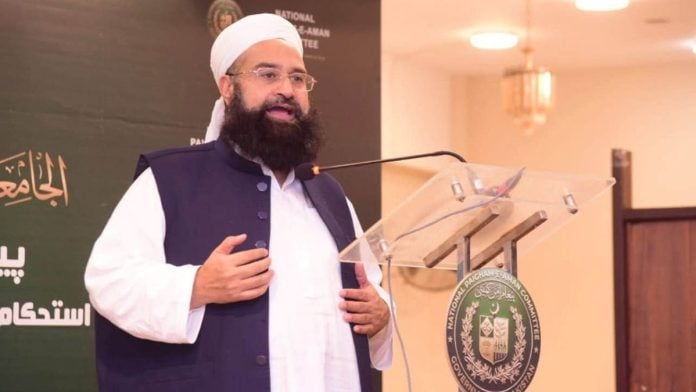
New Delhi: Pakistan’s Ulema Council head refuses to stop courting controversy. A week after he was stripped of a UK peace prize for interfaith harmony over his endorsement of Osama bin Laden as “a Muslim warrior”, Tahir Ashrafi has now said he doesn’t consider the Houthis Muslim enough.
Speaking at a conference in Saudi Arabia Sunday, Ashrafi described the Houthis as a “terrorist faction with no connection to Islam”, saying that the protection of the holy cities of Mecca and Medina was an “absolute red line”.
The Houthis belong to the Zaydi branch of Shia Islam. Pakistan’s 10 percent Shia population routinely faces sectarian violence.
He was perhaps echoing the Pakistani government’s position as it seeks to maintain close ties with Saudi Arabia, emphasising “brotherly unity” rather than activating the trilateral Mecca defence pact between the two countries and Turkey despite a Houthi offensive against Saudi Arabia.
Ashrafi said the conflict should not be viewed as a Shia-Sunni dispute or simply as a bilateral confrontation between Saudi Arabia and Yemen. He accused the Houthis of killing civilians in Yemen and argued that their invocation of Islam and the Palestinian cause was inconsistent with their actions.
“The sanctity of the land of the two holy mosques is an absolute red line,” Ashrafi said. He added that attacks on the security of Mecca and Medina were unacceptable to Muslims and that Saudi Arabia and Yemen had the right to take measures to protect their populations and territory.
The comments add another chapter to the controversy surrounding Ashrafi, chairman of the Pakistan Ulema Council.
Earlier this month, Archbishop Sarah Mullally presented Ashrafi with an interfaith award at Lambeth Palace in the UK, recognising what the Church of England described as his work in reconciliation and cooperation between faiths. The award was subsequently withdrawn after his earlier comments about bin Laden resurfaced.
In a 2007 interview with AFP, Ashrafi said the Pakistan Ulema Council was giving bin Laden the title “Saifullah”, or “Sword of Allah”, in response to Britain’s decision to knight author Salman Rushdie.
“We are pleased to award the title of Saifullah to Osama bin Laden,” Ashrafi said at the time, describing it as “the highest title for a Muslim warrior”.
The award controversy was particularly striking and ironic because the ceremony took place on the 25th anniversary of the 9/11 attacks.
A week later, The Telegraph ran an expose alleging that Ashrafi’s brother, Hassan Muawiya Ashrafi, ran Pakistan’s biggest blasphemy gang.
According to rights groups cited in the report, Hassan filed 26 blasphemy complaints over four years, reportedly the highest number attributed to an individual in Pakistan during that period.
Pakistan’s blasphemy laws carry severe penalties, including the death penalty, and accusations can trigger vigilante violence before a case reaches court.
The Ulema head has denied involvement in any such network and challenged anyone to provide evidence that he or his brother extorted money from alleged victims. He has also defended his brother publicly in Pakistani TV shows.
Ashrafi’s public record, meanwhile, has combined advocacy and extremism simultaneously. He has supported polio vaccination campaigns, condemned Islamic State and publicly backed the construction of a Hindu temple in Islamabad. He also played a prominent role in the 2012 case of Rimsha Masih, a Christian girl accused of blasphemy whose case was later found to involve false allegations.
He also received Malik Ishaq of the terrorist group Lashkar-e-Jhangvi (LeJ) with garlands, and later in 2020, thanked then-Prime Minister Imran Khan for excluding the Ahmadi, a minority Muslim sect that Pakistan’s constitution officially classifies as non-Muslim, from a government commission intended to protect minority rights. He was then Khan’s special Representative on religious harmony. LeJ is infamous for its attack on the Shia population in Pakistan.
Despite the controversy surrounding him, Ashrafi continues to occupy a prominent position in Pakistan’s religious and political landscape. He was also an advisor to the government during General Musharraf’s era, then in the Imran Khan government, and now he is now the religious coordinator for the Shehbaz Sharif government.
In Saudi Arabia, Ashrafi and the allegations about his family seemed to have little impact. He was instead presented an honorary shield by Sheikh Dr Saad bin Nasser Al-Shithri, adviser to the Custodian of the Two Holy Mosques, King Salman bin Abdulaziz, and a member of the Saudi Council of Senior Scholars, for participating in the conference.
(Edited by Sugita Katyal)
Also Read: Pakistan PM Shehbaz again brings up May 2025 conflict, thanks ‘Trump intervention’ in UNGA speech