








New Delhi: The sale of S-400 Triumf anti-air defence systems, small modular nuclear reactors and protecting the India-Russia trade from sanctions are all a part of Moscow’s agenda during the upcoming state visit of Russian President Vladimir V. Putin to New Delhi later this week. In particular, ways will be found to ensure that oil trade volumes do not go down due to the US sanctions, a Russian official said.
“S-400 is on the agenda. We will have certain members of the delegation that can discuss in detail. The only thing I will say is that our military industry is working pretty well. We have managed to enlarge the volumes of production,” Dmitry Peskov, spokesperson for the Russian President said Tuesday at an online interaction with the Indian press organised by the Sputnik News Agency.
He added: “Strategic interaction and cooperation in the defence industry, cooperation in these sensitive areas can be hardly overestimated… It is not only the BrahMos [missiles], but the exchange of high technologies, the exchange of knowhow which pave the way for a bright future in this cooperation.”
ThePrint was the first to report India’s interest in procuring five more regiments of the S-400 platform last week. India currently operates three of these platforms, with two more scheduled for delivery in the next year. The potential purchase of five more regiments could see India operate a total of 10 of these platforms. The S-400s performed exceptionally well during Operation Sindoor, keeping Pakistan’s air forces at bay.
The system scored its longest ever hit during Operation Sindoor earlier this year, and its ability to not only hit the targets but also its mobility came to the fore, leading to keener interest in acquiring more of these systems. The original deal in 2018 cost India $5 billion. Peskov has confirmed that the Russian delegation accompanying President Putin will involve specialists to discuss the finer details of any potential sale.
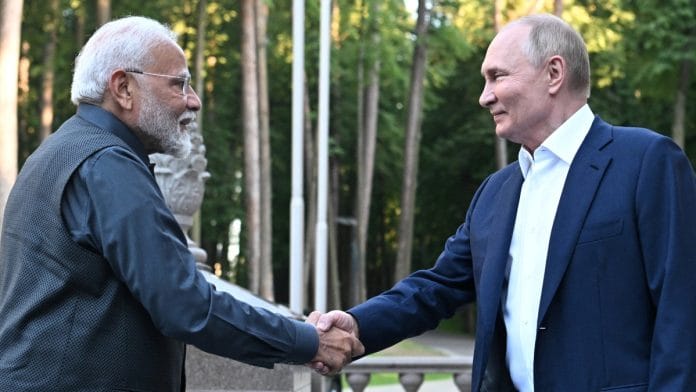
Putin is set to arrive in India Thursday for a two-day state visit and to participate in the annual India-Russia Summit before departing New Delhi late Friday evening. He is expected to be accompanied by a number of leading figures from the Russian government and business communities.
Peskov, spokesperson for Putin, also declared that the sale of Sukhoi Su-57 fighter jets is high on the agenda for Moscow. However, as reported by ThePrint, India is looking at all possibilities, but there has been no decision on the acquisition of two squadrons of the fighter jet. There have been no firm discussions between New Delhi and Moscow over the procurement of these aircraft.
The Su-57 has limited stealth capabilities, but is not considered a true fifth-generation fighter aircraft like the F-35 built by the US. However, the upgrade of the Sukhoi Su-30 MKI is being discussed between India and Russia. India operates a number of these aircraft.
Sanctions & oil
The economic engagement between India and Russia has deepened in the last three years, in particular after the war with Ukraine broke out in February 2022. India has been one of the largest purchasers of Russian oil, with imports touching $56 billion last year.
However, this year the economic engagement has taken a hit, especially after the US sanctioned Rosneft and Lukoil—two of the largest Russian oil firms—earlier this year. Rosneft had a number of contracts with Indian oil companies that have now been suspended due to the sanctions, according to media reports.
Peskov, spokesperson for Putin, decried the US sanctions as “illegal” stating that as per international law the only legal sanctions are those approved by the United Nations. India and Russia last year announced a goal to hit $100 billion in trade by 2030. However, this is now under threat due to the US sanctions. Furthermore, trade is highly skewed in favour of Russia, a fact that Peskov said will be on the agenda.
“There are some countries that would try to put obstacles in the way of the development of our trade, so let’s stick to our own interests. This is our approach… What concerns us is how we are going to continue and enlarge the volume of our bilateral business with India and this will definitely be discussed,” said Peskov.
He added: “We are finding ways to not let the volumes of trade down. For a brief time there could be an insignificant drop in oil trade… We do not accept these limitations… We have deep experience and technologies to get around these obstacles… We will do what we can to ensure greater sophistication of our technologies to continue trade (with India).”
The US sanctions any company trading with the sanctioned companies. Potential consequences for firms continuing to trade include secondary sanction which would impact its ability to conduct foreign trade and access banks abroad.
The US has taken aim at India’s oil trade with Russia, with President Donald J. Trump imposing 25 percent additional tariffs on India as a penalty. Peskov refused to comment on the tariffs, pointing out that it is a “bilateral issue” between India and the US.
The other sector to be high on the agenda is civil nuclear cooperation. Russia has aided in the construction of the Kudunkulam Nuclear Power Plant in Tamil Nadu, and Peskov is “hoping for the continuation of these projects”.
As part of the growing cooperation, Peskov announced Russia is willing to share its technology to build small modular reactors (SMRs) with India. Russia is a pioneer in the field, operating the only floating SMRs in the world and is constructing other land-based small reactors.
India has been keen on building such reactors, given that they are smaller in size (roughly 300MW capacity) which entails lower costs. Last year, New Delhi sought cooperation in this field with a number of countries, including France.
On Indians in Russian Army
A number of Indian citizens have been recruited into the Russian Army since the end of 2023. Currently, there are around 50 Indians that the Ministry of External Affairs is aware of who are part of the Russian armed forces. All of them are to be discharged soon, an official from the Ministry of External Affairs said Tuesday.
“Tentatively based on figures that we have there are around 50 Indians (in the Russian army), of which over a dozen have been released (in the recent past),” the official said. ThePrint had reported last month that there were 44 Indian citizens in the Russian military, despite repeated requests from New Delhi to prevent their recruitment.
However, Russian Ambassador to India Denis Alipov told ThePrint in October that Moscow had stopped recruiting Indian citizens since March 2025. He pointed to a number of cases of Indians who have since acquired Russian nationality and have accordingly joined the Russian Armed Forces.
There are still around 11 or 12 Indians who continue to be missing from 2024, when it was first reported that Russia was recruiting citizens of India to the armed forces. PM Modi requested President Putin at the last annual India-Russia summit in July 2024 to stop the recruitment of Indian citizens.
(Edited by Viny Mishra)
Also read: US sanctions Rosneft & Lukoil: What we know of 2 oil giants that produce half of Russia’s crude