





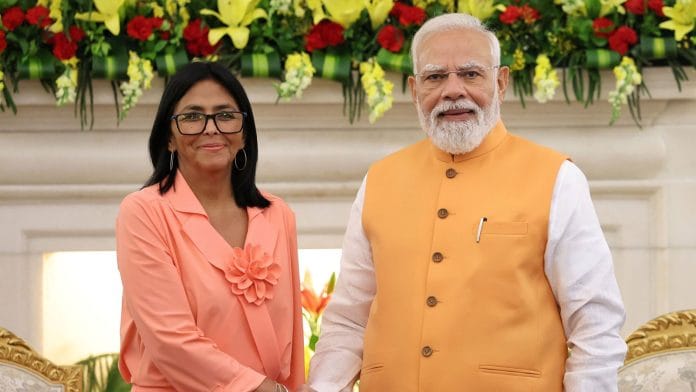


New Delhi: Oil and mining topped the agenda of the talks between Prime Minister Narendra Modi and Venezuela’s Acting President Delcy Rodriguez Thursday in the national capital. The discussions aimed to establish a political consensus indicating that Venezuela is ready to engage with Indian businesses.
“Venezuela possesses one of the largest oil reserves in the world. India is a large and growing consumer of oil. In the energy sector, we see perfect complementarity. In our spot purchases, Venezuela has emerged as our third largest supplier this month,” Rudrendra Tandon, Secretary (East) in India’s Ministry of External Affairs, said at a special briefing.
He added, “The Venezuelan energy sector is undergoing a fundamental transformation. They see India having a stable demand for many years to come…The discussions were very business-like, very substantive…There are no big-ticket announcements during this visit.”
Rodriguez landed in India Wednesday for her first working visit as the interim President of Venezuela. She has travelled to India at least six times previously in different roles. For India, the visit comes as New Delhi is seeking to diversify its energy purchases from West Asia, a region that has been facing a conflict between the US, Israel and Iran since the end of February.
The conflict has led to a surge in oil prices, following Tehran’s effective closure of the Strait of Hormuz. The international waterway accounts for a fifth of global energy exports. Venezuela possesses the largest proven oil reserves in the world.
However, Caracas has faced several sanctions imposed by US President Donald J. Trump during his first tenure in 2019. The sanctions led to Indian companies moving away from importing crude oil from the South American nation. Moreover, several Indian firms in various sectors, including ONGC Videsh Ltd. (OVL) and pharmaceutical companies, were hit by non-payments of dividends by Venezuela on their investments in the country.
The discussions over unpaid dues to Indian firms, which amount to roughly $500 million to OVL and at least $700 million to pharmaceutical companies, were discussed by Modi and Rodriguez, Tandon confirmed.
“The dividend issue did come up several times in discussions with Venezuela. They are very sensitive to the issue…Venezuela is in transition. Its government is aware of all these issues [payments owed to oil and pharmaceutical companies]. We have sensitised them to these issues. It will be a part of our discussions going forward,” said India’s Secretary (East).
However, despite the pending issues, discussions continued at the delegate level through a working lunch on energy and mining. India is keen to indicate its interest in participating in the Venezuelan economy at all levels.
The US has eased sanctions following its military raid on Caracas in January that led to the arrest of Venezuelan President Nicolas Maduro and his wife, Cilia Flores. Maduro and Flores are currently detained in an American prison awaiting progress in the judicial processes against them.
Rodriguez stepped up and pivoted Caracas’ foreign policy towards the US. Maduro had long been anti-US. The US has seized Venezuela’s oil industry. There remains little transparency in how Caracas’ oil revenues are currently being managed, with reports indicating that at least $8 billion worth of oil sales have taken place in the first four months of 2026. US Secretary of State Marco Rubio had announced Rodriguez’s visit to India ahead of his own visit to the national capital last week.
Tandon made it clear that private Indian companies interested in purchasing Venezuelan oil will have to follow payment arrangements that are currently in place. Indian companies “have to take into account the existing payment methods” when doing business in Venezuela, said the Secretary (East).
The two leaders discussed the political situation in Venezuela. In January, India expressed that the events following the US military raid were a “matter of deep concern.” New Delhi took approximately 24 hours to respond to the arrest of an international leader by American forces in a foreign country.
Tandon underlined that India is keen to work with the current administration in Venezuela, highlighting that it is “friendly” towards New Delhi.
The two leaders also discussed potential cooperation in the mining sector. The cooperation will be industry-led. India and Venezuela had a deep economic relationship until 2019, based on New Delhi’s imports of crude from Caracas.
Rodriguez will visit the industry centers in New Delhi and travel to Gujarat to gain firsthand insight into India’s growing oil refining industry. The Venezuelan Acting President is also expected to make a private visit to Puttaparthi, the birthplace of Sathya Sai Baba, whom Rodriguez has been known to follow.
(Edited By Harini TS)