








New Delhi: India’s negotiating team is expected to travel to Russia at the end of February after the Union Budget 2026 for the next round of negotiations for a Free Trade Agreement (FTA) with the Eurasian Economic Union (EAEU).
Government sources said the focus of the talks would be to reduce the current non-tariff measures imposed by Russia on Indian imports, as well as looking into simplifying the current overlap of standards for export of goods. Currently goods exported from India face a number of regulatory overlaps including EAEU requirements as well as Russian ones.
In this scenario, Indian exports to Russia have been impacted. For India, the negotiations with the EAEU are part of its strategy to diversify exports, especially as the US remains its largest merchandise export market. The US has hit India with 50 per cent tariffs since the end of August last year.
“Some products have European Union (EU) standards, some have EAEU standards and some have Russian standards. Our exporters do not have clarity on which standards apply on which products,” said a source familiar with the matter.
The source added there is a keen interest between India and Russia to deepen the economic engagement, with Moscow relaxing a number of non-tariff barriers on goods such as marine products.
Russia is a part of the EAEU Single Market that also includes Armenia, Belarus, Kazakhstan and Kyrgyzstan. The five-member trading organisation has similarities with the EU’s single-market without the use of a common currency.
India doubled down on trade with Russia last year, despite penalty tariffs imposed by the US on Indian goods. The US is India’s largest export market with merchandise exports crossing $50 billion in the first eight months of this financial year. The US currently has imposed 50 per cent tariffs on Indian merchandise in a number of sectors.
Russia is a major source of petroleum products, particularly crude oil, for India. However, Indian exports to Russia this financial year have yet to cross $3 billion in value.
According to the latest data published by the Ministry of Commerce and Industry, India’s total exports to Russia in the 2025-2026 stands at $2.6 billion, while it has imported merchandise worth $35.9 billion in the same period. India’s trade deficit this year with Russia is roughly $33 billion.
Indian exporters face a number of challenges exporting Russia including labelling requirements that require labels to be printed in the Russian language. Trade between India and Russia touched $60 billion in the last financial year primarily due to New Delhi’s import of Russian crude.
This year, the import of Russian crude has fallen, especially after the US imposed sanctions on Rosneft and Lukoil—two of Moscow’s largest petroleum companies.
However, India’s largest source of petroleum products remains Russia according to data published by the Ministry of Commerce and Industry.
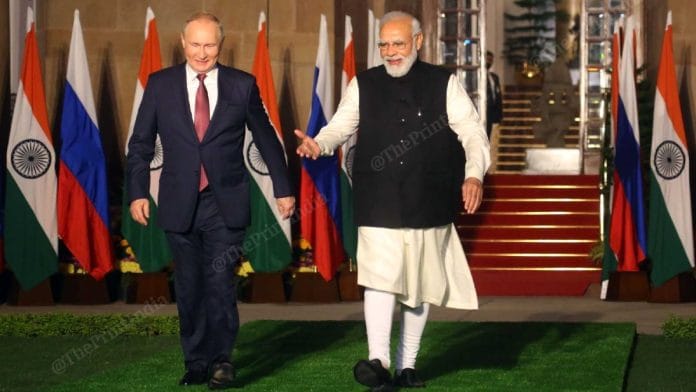
Trade was an important feature of discussion between Prime Minister Narendra Modi and Russian President Vladimir Putin during the India – Russia Annual Summit last month.
The two leaders unveiled an economic programme till 2030 on 5 December, during Putin’s visit to New Delhi. Russia offered to collaborate with India in a number of high technology areas including the construction of small modular nuclear reactors (SMRs). SMRs have a capacity to generate roughly 300 MW of energy.
The two leaders also concluded a number of agreements including on mobility, food standards, customs and healthcare.
India has been pushing Russia to invest its accumulated rupees through its sale of oil since the war with Ukraine began in the Indian market. The formal talks for the India – EAEU FTA began in August last year after the two sides signed the terms of reference for the trade deal.
(Edited by Ajeet Tiwari)