





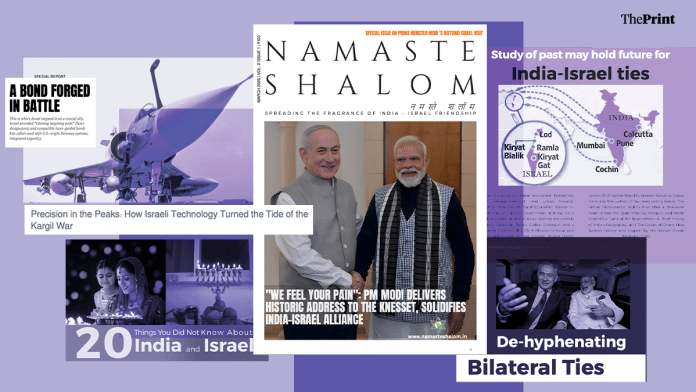



Mumbai: Eight years after its first launch, a magazine dedicated to India-Israel ties, the Bene Israeli community in India and Prime Minister Narendra Modi’s rapport with Israeli PM Benjamin Netanyahu is back in circulation.
Launched by Tarun Vijay, a former BJP Rajya Sabha member and a long-time Rashtriya Swayamsevak Sangh (RSS) worker, the magazine titled ‘Namaste Shalom’ was first introduced in 2018, when Netanyahu visited India.
Back then, however, the magazine could not sustain beyond an initial couple of issues.
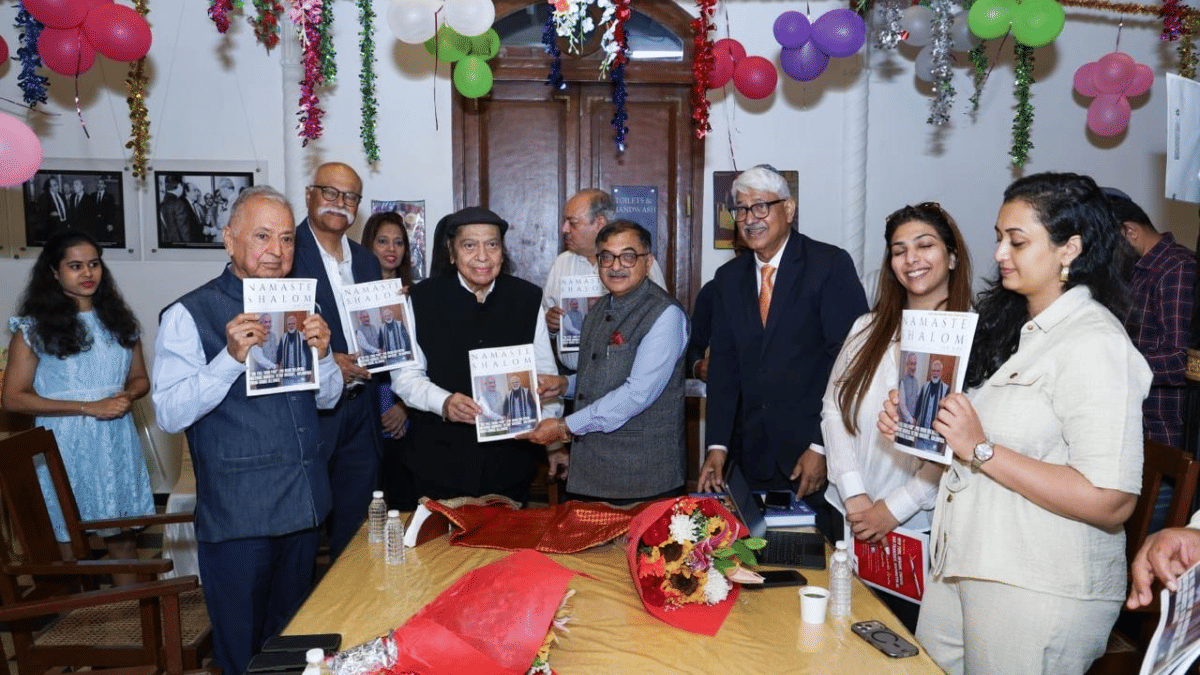
On Sunday, Vijay and his team re-launched ‘Namaste Shalom’ with a special issue on PM Modi’s Israel visit of February this year. They plan to bring out one issue a month, focusing on various aspects of India-Israel relations – the Jewish cuisine in India, the history of Bene Israeli jews in Maharashtra, Israeli students and the youth visiting India and vice versa, the bilateral relations with Israel under PM Modi and so on.
“The relationship of the Jewish community with India is something to celebrate, cherish and preserve. Every Jew in Maharashtra speaks Marathi. The Jews in Mumbai are called Bene Israeli, translating to the children of Israel. The idea behind the magazine is that it should work as a bridge between India and Israel,” Vijay told ThePrint.
“We started in 2018, but there were some issues related to finances. I also got busy. There were some unavoidable circumstances, but our team is in place now and we are back, and in the next 2-3 months we hope to ramp up our subscription to 5,000,” he added.
The magazine was relaunched Sunday at the Knesset Eliyahoo Synagogue at Kala Ghoda in Mumbai. With its re-launch, the ‘Namaste Shalom’ team has also renewed a demand to build a grand memorial at the site in Alibaug in the Raigad district where Jews first arrived in India over 2,000 years ago.
Other than Vijay as its editor, ‘Namaste Shalom’ includes BJP leaders such as Poonam Mahajan and Rajeev Chandrashekhar on its editorial advisory board.
The magazine, which had received encouragement from Modi himself at the time of its 2018 launch, strongly emphasises how India-Israel relations have been strengthened only under PM Modi’s leadership, while those aligned with the Congress or sharing the ideology of the socialists, communists and liberals were more concerned about appeasing Muslims in India and the Middle East.
Vijay, however, insists the magazine is not political. The magazine has also not weighed in on the ongoing Iran-Israel war.
“We have so far taken no political stands. We follow the Indian stand on every issue concerning Israel. We take our cues from the Ministry of External Affairs. The ministry’s stand is our stand,” Vijay said.
He added, ‘Namaste Shalom’ has so far not approached any Opposition leaders for any kind of contributions because the publication wants to stay out of politics.
“We want to stay out of any kind of unsavoury comments. We think that everyone belongs to us, and we are just going ahead with our mission of promoting amity,” Vijay said.
As per the 2001 census, there were 4,650 Jews in India with more than half of them—2,466—living in Maharashtra. There is no separate categorisation for Jews in the 2011 census.
Ralphy Jhirad, the President and Managing Trustee, Bene Israel Heritage Museum & Geneological Research, who is also on the editorial advisory board of ‘Namaste Shalom,’ told ThePrint that the Bene Israeli Jews have always been a very happy community in India, and Namaste Shalom is a voice of the two nations—India and Israel.
“My job is to give Namaste Shalom support from the Jewish community. We are actively participating in implementing the idea of establishing a memorial and a Bene Israel memorial in the area of Raigad,” Jhirad, a member of the Bene Israeli community, said.
Jhirad said that they are hoping to get two parcels of land from the state government—one five-acre parcel at Navagaon for a memorial and another five-acre Awas in the Raigad district for a museum.
Also Read: What India can learn from the US-Israel war on Iran
RSS training & ‘Namaste Shalom’
Vijay, who served as a Rajya Sabha MP from 2010 to 2016, has been associated with the RSS since his childhood. He has also served as the editor of RSS’ publication, ‘Panchajanya’.
The former MP said that his RSS roots helped him develop a keen interest in the life of India’s Bene Israeli Jewish community.
We have so far taken no political stands. We follow Indian stand on every issue concerning Israel. We take our cues from MEA. The ministry’s stand is our stand—Tarun Vijay, Editor, Namaste Shalom.
“Being a RSS swayamsevak since my childhood, we were always given the example of Jews for strong nationalism, love for their language Hebrew. We have a lot in common. They have also been persecuted a lot like Hindus,” Vijay said.
The inaugural issue of Namaste Shalom, published in February 2018, also had a piece by Prafulla Ketkar, editor of RSS mouthpiece ‘Organiser Weekly’ where he cited the common civilisational ethos, other than commitment to democracy, as a driver of bilateral relations between India and Israel.
“Words of Sanskrit origin appeared in the Hebrew Bible 3,000 years ago, while Jewish authors of Roman times, rabbis of the Talmud, and Jewish traders and philosophers in the middle ages spoke of India. Both Hinduism and Judaism do not practice religious conversion as a method of propagation and believe that the ‘supreme being’ is one and omnipresent,” he said.
RSS and BJP leaders have had a longstanding engagement with Israel. In December last year, Israeli diplomat Yaniv Revach, the consul general of Israel to midwest India, visited the RSS headquarters in Nagpur, paying tributes to RSS founder-leaders Dr K.B. Hedgewar and Dr. MS Golwalkar.
He was reportedly briefed on the organisational journey of the RSS and its social initiative over the years.
Speaking to PTI after the visit, Revach said, “It was important for me to visit the RSS and see the activities they organise here. These activities are very impressive as they are working with the young generation and connecting them to the roots, heritage, and history of India.”
Former BJP MP Poonam Mahajan told ThePrint about how a team of MLAs from Maharashtra had visited Israel in 1995-96, shortly after India established full diplomatic relations with the country in 1992.
“This was when the Shiv Sena-BJP government was in power. The delegation went to Israel to study drip irrigation. We might be the first ever government of a state in India who sent representatives to Israel for a study tour,” she said.
Modi, food, customs & history
In 2018, the inaugural issue of ‘Namaste Shalom’ was launched with great pomp in the gardens of Varsha, the chief minister’s official residence in the presence of the then consul general of Israel.
Amruta Fadnavis, CM Devendra Fadnavis’ wife, sang a song, and PM Modi, then President Ramnath Kovind, and the then Israeli Ambassador Daniel Carmon sent their wishes for the magazine that were published in the inaugural issue.
The February 2018 issue also had an interview with Fadnavis and one with economist Sanjeev Sanyal, other than pieces by economist Rupa Subramanya, and Jewish residents who have grown up in India.
Subramanya wrote, “While its true that India was one of the first countries to recognise the state of Israel in 1950, then prime minister Jawaharlal Nehru did not see fit to open formal diplomatic relations with Israel so as to avoid offending India’s Arab ‘friends’ and no doubt also not to offend the large Muslim minority in India, which was firmly behind the cause of Palestine and unsupportive of the newly created Jewish state.”
India established full diplomatic relations with Israel in 1992 under prime minister P.V. Narasimha Rao.
Subramanya wrote how it is the personal rapport between Netanyahu and Modi that have jumpstarted bilateral relations between India and Israel.
The articles and interviews carried in the editions published so far have touched upon the ideological kinship between Hinduism and Zionism, and how the proponents of Hindutva are sympathetic to the Jewish claim on the land of Israel.
They have talked about how the Bene Israeli community has adopted several Indian customs, speak the Marathi language, wear the local attire, and tie mangalsutra at weddings. They use coconut oil and camphor in synagogues and haldi and henna in their weddings.
Then there is a list of 20 things readers may not know about India and Israel, such as how India is a top gap year destination for young Israelis, how more than two lakh Indian farmers have been trained over the years as part of the India-Israel agricultural collaboration and so on.
Vijay said he had been reading and writing about Israel for a long time, and was amazed at how the Bene Israelis “totally became one with the local Hindu society”.
The March 2026 issue, the first after the relaunch, includes an essay on Israel’s help during the Kargil war, with Israeli technicians supposedly having helped Indian Air Force engineers upgrade ‘Mirage 200’ fighters.
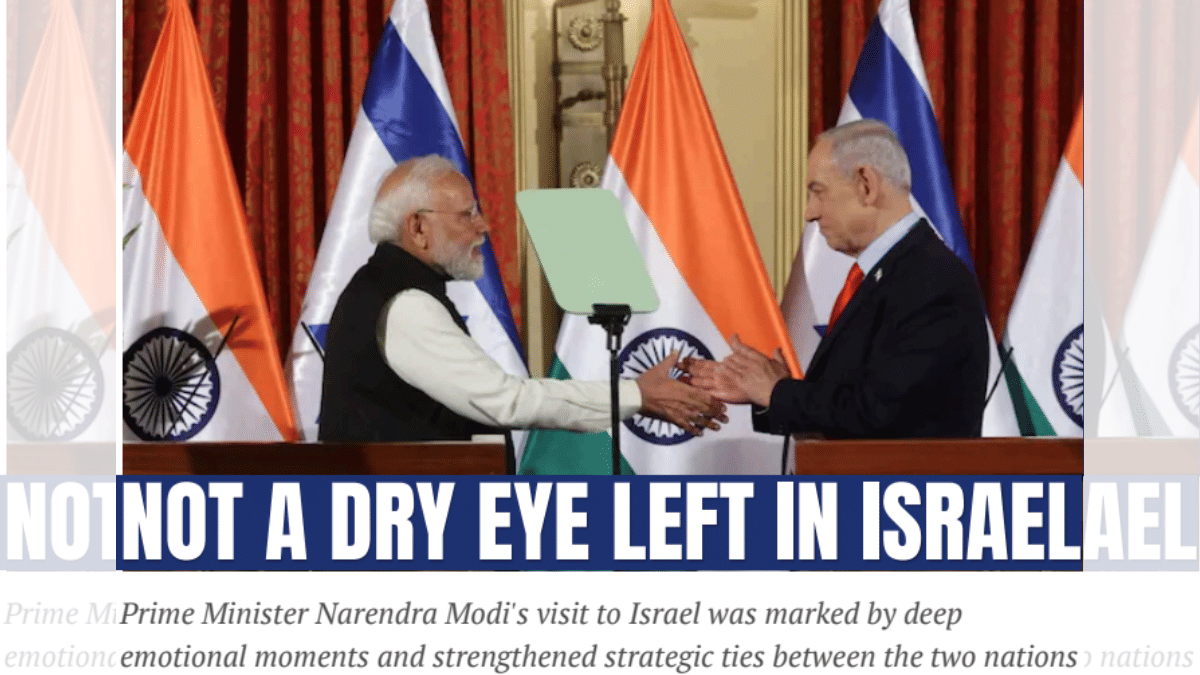
It carries another story on how Netanyahu hailed Modi’s February 2026 Israel visit as “extraordinarily productive and moving”. It has reproduced some articles from Israel’s newspapers on PM Modi’s visit, speaks about the diplomatic contrast between PM Modi and PM Nehru with regards to Israel and included a lot of photos from the visit.
On the lighter side, it carries a piece on how both the Israeli and Indian cultures love the humble chickpea, complete with a recipe of the curried chickpea sabich and a masala chopped salad, very similar to the Indian cucumber salad, that’s said to be a staple on plates in Tel Aviv.
It also has a list of eight common phrases and the Hindi and Hebrew words for them.
The magazine mainly relies on government advertisements with the latest issue having a full page ad on Maharashtra’s ‘Ladki Bahin’ scheme.
We want to stay out of any kind of unsavoury comments. We think everyone belongs to us, and we are just going ahead with our mission of promoting amity—Tarun Vijay, Editor, Namaste Shalom.
The annual subscription of Namaste Shalom has been fixed at Rs 500 for within India and $30 for outside India, institutional subscription is for Rs 600 and $40, respectively. A single copy is available for Rs 50 or $1.5.
Renewed demands for memorial
It is said that the Bene Israeli Jews came to India over 2,000 years ago by sea at the Konkan coast at Navagaon village in Alibaug. Their ship was wrecked and a vast majority of them died. Only seven couples survived, and were accepted by the local community there.
In his interview published in the 2018 edition, Fadnavis had said there’s a memorial pillar near the Jewish cemetery there in the memory of the 14 people who took refuge in Navagaon.
“The Maharashtra government will surely extend all support for the construction of the Jewish memorial at Navagaon,” Fadnavis said.
With Namaste Shalom’s relaunch, this demand has been rekindled.
“The Jews came to India after being discarded by 86 countries around the world, no Christian country gave them shelter, no Muslim country gave them shelter. They were given full warmth and shelter by local Hindus of Maharashtra at the time,” Vijay said.
At the relaunch on Sunday, architects SR Mahumutra, Shruti Mahimutra and Forum Gandhi presented a detailed draft of the plan for a grand memorial.
As the next step, Vijay plans to lead a delegation of Jews to CM Fadnavis, requesting the Maharashtra government to take the lead in creating the memorial.
“We have already identified the land. I had gone there once. We will present the whole request, memorandum before him. We hope that the government allots land, and they take the lead in the project,” Vijay said.
(Edited by Ajeet Tiwari)
Also Read: India calls for an end to attacks on civilian & energy infra as Israel, Iran hit Gulf energy sites