





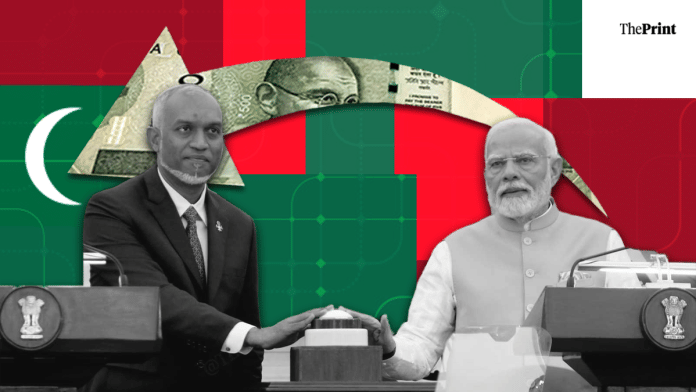


New Delhi: The Maldivian government has requested India to extend the $400 million currency swap agreement for a third time. New Delhi is considering this move, but a third extension of the debt may be difficult due to stringent rules in place on the deal, ThePrint has learnt. This is the largest repayment owed by the Maldives to India this year.
Another two loan instruments—two treasury bills worth $50 million each—are also due before September 2026.
Malé’s financial situation has been challenging for the last few years, with a consistent balance of payment crisis due to low foreign exchange reserves. The government of Maldives has borrowed heavily over the years to carry out big-ticket infrastructure projects, primarily through loan instruments issued in different markets.
In 2024, when Malé was under severe financial stress, Maldivian President Mohamed Muizzu requested India to roll over the treasury bills worth $100 million. India acceded to the request at that time.
In October 2024, during Muizzu’s visit to New Delhi, the two governments signed two financial agreements: a $400 million currency swap facility and a second swap line worth Rs 3,000 crore denominated in Indian Rupees, totaling $700 million in financial aid to Malé.
India has since extended the repayment of the $400 million dollar-denominated swap facility twice. Malé made the third request this year, a person familiar with the matter confirmed to ThePrint.
“Maldives has again asked India to extend the currency swap facility. However, while the government is considering the Maldivian request, the terms of the currency swap facility—such as the requirement of a cooling-off period between two drawls and the maximum number of roll-overs permitted—make it extremely difficult for the request to be considered,” the person said.
The stresses to the Maldivian economic system have been years in the making. The World Bank in 2024 estimated that roughly $1 billion in repayments are due by 2026.
The biggest tranche of the $1 billion in payments is a $500 million Sukuk bond, which Malé announced was repaid on 1 April, 2026. The Islamic bond, issued by the previous government led by Ibrahim Solih, included a $24.68 million interest payment.
Malé announced its repayment drawing from its foreign exchange reserves and its Sovereign Development Fund. However, paying this bond significantly depleted Malé’s foreign exchange reserves.
Maldives’ foreign exchange reserves have seen significant growth from a low of around $364 million in September 2024, to $1.32 billion in March 2026, according to its monetary authority. However, drawing on these reserves to pay the Sukuk bond is likely to stress a financial system that has been heavily impacted by the war in West Asia.
The country also may struggle to raise further loans, as credit rating agencies continue to maintain a dim view of its economic health. In 2024, Fitch Ratings had downgraded the sovereign credit rating of Maldives to CC, or junk status, due to the structural economic vulnerabilities.
The American credit ratings agency maintained the rating in 2025. The economy remains fragile, relying heavily on tourist inflows, while importing almost its entire energy needs.
Tourist flows have significantly dropped in the last month since the war in West Asia began. In March, a total of 166,616 tourists arrived in the Maldives, a drop from 207,707 during the same month in the previous year. Even month-on-month, the 166,616 tourists in March is the lowest so far in 2026.
In February 2026 roughly 254,500 tourists visited the island archipelago. For the first 15 days of April, the number of tourists flocking to the Maldives’ has also fallen in comparison to the same period last year. Around 76,000 tourists made the trip to the Maldives during the first 15 days of this month, while last year, the number stood at 104,357, according to statistics published by the country’s tourism authority.
Maldives’ also relies almost entirely on energy imports, which have been impacted by the US-Israel war with Iran. Malé has engaged with the Government of India to ensure the flow of energy to the island archipelago, Randhir Jaiswal, the official spokesperson of the Ministry of External Affairs (MEA) confirmed Friday at a regular press briefing.
The fall in tourists and surge in prices of energy has had negative impacts on the Maldivian economy. The sense within New Delhi is that the Indian government will likely step in if the country’s economic situation worsens.
India did so when Sri Lanka declared bankruptcy in 2022, by issuing over $3 billion in emergency funding that aided Colombo during the worst of its financial crisis at the time. However, the repeated roll overs and inability of the Maldivian government to honour existing financial agreements, has raised warning signs across New Delhi.
Bloated public sector expenditure
Furthermore, a unique feature of the Maldivian government is the appointment of political appointees by the President across ministries.
These political appointees are able to draw salaries from the state exchequer with associated benefits. The practice has been common through varied administration. Muizzu had promised to cap this practice to a maximum of 700 appointments, a limit that has since been broken, according to Maldivian media reports in the last two years.
As of July 2025, the President had appointed 922 individuals across ministries, according to the Maldivian media outlet See.mv.
The cap—700—was broken within the first few months of assuming office, according to another Maldivian media outlet Adhadhu.
Muizzu taking stock of the state of the Maldivian economy had issued a directive to all state-owned enterprises to cut its staff by 33 per cent earlier this month, reported See.mv. These measures were introduced as a result of the shock of the West Asian crisis on Malé’s economy.
The move to stabilize the country’s financial status came after Muizzu faced a mid-term jolt earlier this month, losing both a majority of seats in the local council elections, as well as a referendum on his signature proposal of holding simultaneous elections across the country. The double losses, have created cracks across the ruling government’s position within the country, as Muizzu finishes half his term ahead of Presidential polls in 2028.
(Edited by Amrtansh Arora)