





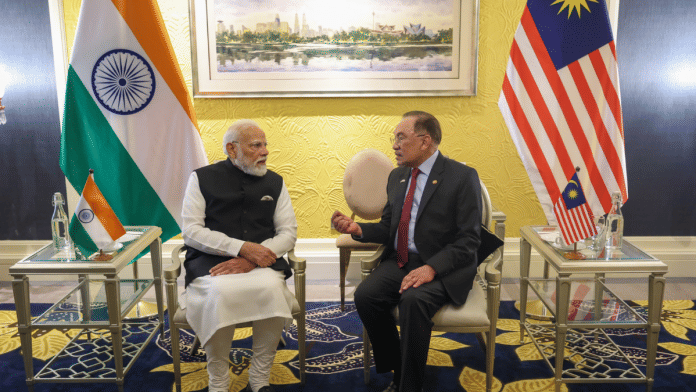



New Delhi: Signalling a shift in position, India and Malaysia Sunday “strongly condemned” terrorism in all its forms, including “cross-border terrorism”, in a joint statement issued after a meeting between Prime Minister Narendra Modi and his Malaysian counterpart Anwar Ibrahim in Kuala Lumpur.
“The two Prime Ministers unequivocally and strongly condemned terrorism in all its forms and manifestations, including cross-border terrorism. They called for zero tolerance of terrorism and for concerted international efforts to combat terrorism in a comprehensive and sustained manner,” the Joint Statement said.
“They agreed to counter radicalisation and violent extremism; combat financing of terrorism; prevent use of new and emerging technologies for terrorist purposes, through cooperation in information and knowledge sharing, exchange of best practices and capacity building.”
The two leaders also agreed to “cooperate” in the area of fighting against transnational organised crime, while affirming their intention to “strengthen bilateral and multilateral cooperation” at fora such as the United Nations and the Financial Action Task Force (FATF).
India has long faced the challenge of terrorism emanating from Pakistan. In the past, Malaysia has been perceived as a country that strongly supports Pakistan at international fora such as the UN. In September 2019, months after the abrogation of Article 370, then Malaysian Prime Minister Mahathir Mohamad at the UN General Assembly described India as “an invader and occupier” of Jammu and Kashmir.
However, despite these challenges, New Delhi and Kuala Lumpur have maintained stable ties. The other irritant in ties is Zakir Naik, the controversial preacher currently in Malaysia and wanted in India on the charges of propagating hate speech and money laundering.
Modi, in his joint press statement with Ibrahim, said, “And our message on terrorism is clear: No double standards. No compromise.”
The PM is on a two-day state visit beginning 7 February to Malaysia. He addressed an Indian community event Saturday, and apart from the official engagement with the Malaysian government Sunday, is also expected to meet a number of business leaders before departing for India.
The visit led to 16 outcomes, including MoUs in audio-visual co-production, cooperation in disaster management, combating corruption, cooperation in UN Peacekeeping Forces missions, an agreement on semiconductors, the framework agreement for Malaysia joining the International Big Cats Alliance (IBCA), NSA-level security cooperation and one on cross-border payments by the National Payments Corporation of India (NPCI) and PayNet Malaysia.
Also Read: Agenda for Modi’s Malaysia visit: UPI, potential Dornier order & ASEAN-India trade pact review
Defence, security & trade
High on India’s agenda was increasing defence and security cooperation, with New Delhi offering the Hindustan Aeronautics Limited (HAL)-manufactured Dornier aircraft, apart from proposals for upgrading and maintenance of Malaysia’s Sukhoi Su-30 fleet of fighter aircraft.
“In the field of security, we will strengthen cooperation in counter terrorism, intelligence sharing, and maritime security. We will also broaden defence cooperation,” Modi said in his statement.
The Joint Statement said, “The Leaders expressed satisfaction with the robust defence relationship between Malaysia and India, underscored by the regular exchanges, visits, staff talks, exercises, training courses and defence industry collaboration. They welcomed the successful outcomes of the Malaysia-India Defence Cooperation Committee (MIDCOM) and its subcommittees, including the Terms of Reference on establishment of a Strategic Affairs Working Group (SAWG) and Su-30 Forum.”
The defence sector remains one of keen interest between both sides. Similarly, the two leaders also “expressed satisfaction” with the establishment of security cooperation between the two countries under the Malaysia-India Security Dialogue.
“Both Leaders appreciated India’s steadfast engagement in the ASEAN Defence Ministers’ Meeting Plus framework and welcomed the co-chairmanship with Malaysia of the Counter-Terrorism Working Group for the 2024-2027 term. The Leaders extended an invitation to all ADMM-Plus members to participate in the forthcoming Expert Working Group on Counter Terrorism Table-Top Exercise (EWG CT TTX), co-chaired by India and Malaysia, and scheduled to be hosted by Malaysia in 2026,” the statement said.
Trade was expected to figure heavily in the discussions between the two leaders. India-Malaysia bilateral trade stood at roughly $19.5 billion in the 2024-2025 financial year. The two leaders discussed the review of the ASEAN-India Trade in Goods Agreement (AITIGA), a process which has been ongoing since 2020. Malaysia is the current co-chair of the review mechanism.
The AITIGA agreement signed between India and the 10 member-states of the Association of Southeast Asian Nations (ASEAN) has seen trade grow multiple-fold between 2011 and 2026—although heavily in favour of the Southeast Asian nations. The trade deficit for India grew from around $7.5 billion annually in 2011 to about $44 billion in 2023.
“The Leaders emphasised the importance of the Malaysia-India Comprehensive Economic Cooperation Agreement (MICECA) and the ASEAN-India Trade in Goods Agreement (AITIGA). Both leaders welcomed the ongoing review of AITIGA to make it mutually beneficial, trade facilitative and relevant to current global trading practices. Both Leaders also appreciated MICECA for its potential for deepening economic relations and encouraged its optimum utilisation,” the statement said.
(Edited by Tony Rai)