





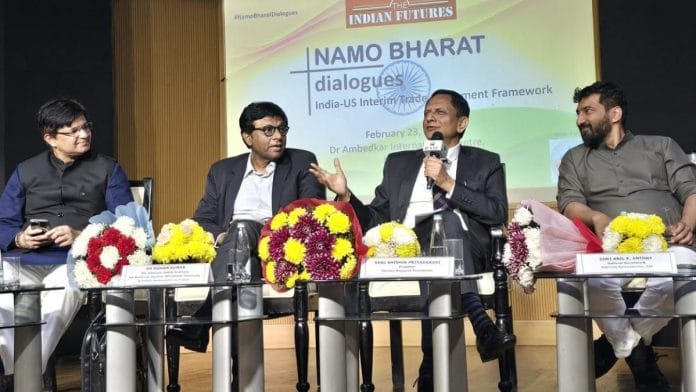



New Delhi: Ahead of the impending US-India Interim Trade negotiations, Ambassador Mohan Kumar, former ambassador to France, said at a panel discussion that India is facing a “1991 moment” in its trade relations with the United States.
The discussion, titled ‘India-US Interim Trade agreement framework’, held at Dr Ambedkar International Center in Delhi, threw up divergent views on India’s economic reform. However, there was consensus amongst the panel was that while the current trade environment is defined by ‘legal uncertainty’, the strategic partnership between New Delhi and Washington remains an unshakeable pillar to counter the growing power differential with China.
Ambassador Mohan Kumar said: “The shifting US legal frameworks under a volatile presidency of Donald Trump is a ‘perfect crisis,’ similar to the 1991 crisis for New Delhi to look inward and do decade-long domestic reforms.”
He added, “We reform under compulsion,” urging policymakers to use this “perfect crisis (Trump’s tariffs)” to carry out deep-seated reforms that have been postponed for decades.
The discussion, organised by New Delhi think tank The Indian Futurs, also included Shishir Priyadarshi, President of Chintan Research Foundation, Anil K. Antony, BJP’s national spokesperson, and was moderated by Professor Manish Dabhade, founder of the Indian Futurs and associate professor at the School of International Studies, JNU.
Responding to the Ambassador, Professor Manish Dabhade differed and said, “Reforms in India no longer come in one dramatic ‘big bang’. They tend to arrive as cumulative, often quiet shifts. The current political climate does not resemble 1991 in terms of macroeconomic crisis, but there is a different kind of urgency: Technological disruption, climate risk, and geo‑economic fragmentation.”
US Judiciary & Trump
Ambassador Kumar opened the discussion by outlining a “major battle” between the US’ judiciary and the executive over the power to impose tariffs.
He noted that Article I of the US Constitution grants the primary power of taxation to Congress. However, the executive headed by President Trump has frequently tested these boundaries.
The recent US Supreme Court decision striking down President Trump’s use of the International Emergency Economic Powers Act (IEEPA) to impose broad duties was described as a significant turning point.
“That has been struck down for good,” Kumar said, noting that the administration has pivoted to Section 122 of the Trade Act of 1974, a provision regarding international balance of payments, to impose a 15 per cent duty for a limited 150-day window.
This window for the tariffs, Kumar argued, should be viewed as “breathing space” for negotiators. He expressed satisfaction over Indian Ministry of Commerce and US officials postponing high-level talks by “mutual agreement”, suggesting that New Delhi needs clarity on tariffs before finalising any deal.
During a conversation with ThePrint about the possibility of having a reliable and assured Interim Trade Agreement with the US, Priyadarshi said, “Any assurance from the current US dispensation must be viewed as conditional, not absolute, because the current volatility is structural, driven by domestic politics, executive discretion, and electoral signaling.”
“For India, the prudent approach is to seek front-loaded gains, clear timelines, and narrowly defined obligations rather than broad promises. Credibility will come less from verbal assurance and more from how much is locked into process—notifications, carve-outs, and administrative actions that are harder to reverse,” added Priyadarshi.
Strategic autonomy is not a trophy
The panel had a broad consensus that friction over shrimps, gems, and jewellery did not define the broader India-US relationship, underscoring the wide-ranging ambit of the relations where trade is a component.
While talking about India’s strategic autonomy, Ambassador Kumar said, “India must move out from its delusional idea of strategic autonomy.” He added, “Strategic autonomy is not a trophy to be stored, but a tool to be used to defend national interests, specifically in the face of an ‘unbridgeable’ power gap with China.”
The consensus remained that while some truths may “lie in the shadows”, the partnership with the United States is the most consequential anchor for India’s future in a multipolar world.
(Edited by Viny Mishra)
Also read: India’s outward-looking trade policy has an inward-looking problem