





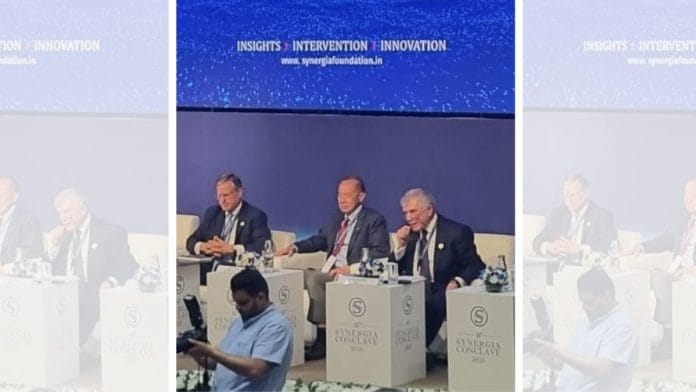



New Delhi: Ahmet Ünal Çeviköz, a retired Turkish diplomat, said Thursday that the war in West Asia has put Asia’s traditional pillars of stability under pressure due to great power rivalry. However, he said, this simultaneously paved the way for middle powers such as India, Australia, and Japan to act as bridges in a fractured international system.
“In today’s international environment, middle powers are no longer merely observers of great power competition. Countries such as India, Japan, Australia and others increasingly act as connectors within the international system,” Çeviköz said.
The former diplomat said middle powers maintain relationships across different geographical centres, acting as a stabilising factor in an increasingly rigid global order. Focusing on India, he stressed that the country now holds a key position as a stabilising power.
Speaking at the 10th Synergia Conclave organised by the Synergia Foundation at the Manekshaw Centre in New Delhi, Çeviköz argued that the international system was transitioning towards a “polycentric reality”, where stability would not be guaranteed by a sole superpower.
The strategic ‘mandala’
Çeviköz suggested that the future would depend on the layered diplomatic architecture that middle powers develop and balance in the coming years.
He underscored that New Delhi’s credibility stems from its longstanding commitment to strategic autonomy, which allows India to maintain engagements with multiple partners. This makes its diplomacy an increasingly relevant model that could shape new international norms, he added.
Invoking Kautilya’s Arthashastra and its ‘Mandala theory’—an ancient concept of statecraft—Çeviköz said the theory anticipated contemporary geopolitical dynamics more than 2,000 years ago. According to this idea—he noted—stability emerges not only from permanent alliances but also through careful management and balancing of relationships.
“I think in many ways this insight feels remarkably contemporary,” Çeviköz added. “Asia today is once again navigating a complex strategic ‘mandala’ where multiple actors interact in a dynamic environment. The lesson may be that stability rarely comes from rigid alliances.”
In a follow-up interaction on the conflict in West Asia and the instability it has created in the region, he said Türkiye’s position has largely been limited to trying to bring the warring sides to the negotiating table.
He said that since the war broke out in Iran, Türkiye had offered to bring all the parties—United States, Israel, and Iran—together in Ankara for talks, but had not received a response from either side.
Çeviköz warned that while competition among countries Is inevitable, its escalation into kinetic conflict is unnecessary. As a diplomat, he said, he would always favour “cooperative multilateralism”, where active and inclusive diplomacy could generate innovative solutions.
(Edited by Madhurita Goswami)
Also Read: McMahon Line lacks international validity, says Singapore’s ex-FM at Delhi conclave