





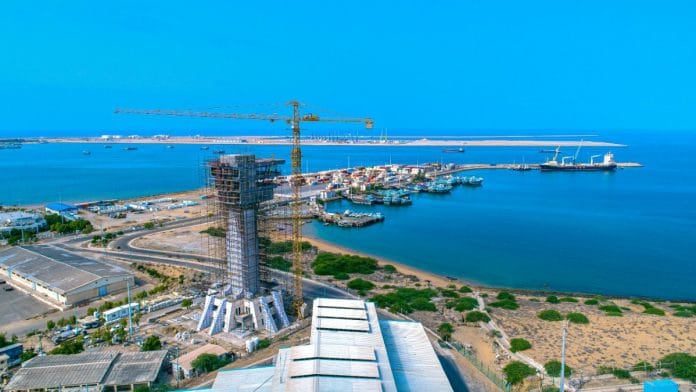



New Delhi: The deadline for the extended waiver on US sanctions on Chabahar looming, Iran’s Embassy in India shared a post Thursday calling the Iranian port city “the golden bridge of Iran-India friendship”.
India operates the Shahid Beheshti terminal, one of two terminals within the Chabahar Port complex. But, post the US sanctions, New Delhi has indicated its intent to minimise its role there. The post by the Iranian Embassy appears to signal that Tehran does not want India to pull out of Chabahar.
The initial waiver on sanctions, which enabled India to continue operations at Chabahar, was extended in October 2025 and is due to lapse on 26 April 2026.
“Our position remains the same as what I had conveyed earlier. This particular issue, the sanctions waiver that was given to us, is valid till 26 April 2026. The Government of India remains engaged with all concerned in order to address the implications of these developments,” MEA spokesperson Randhir Jaiswal had said at a press briefing on 2 April.
The post on X was first shared by Iran’s Embassy in Serbia with accompanying visuals of Chabahar, captioned: “Chabahar of Iran is where the desert shakes hands with the ocean. A hidden paradise with colors you won’t believe until you see them. Pure, untouched magic!” The post was then shared by the Iranian Embassy in India with the caption: “Chabahar is the golden bridge of Iran-India friendship.”
Images of the beauties of Chabahar Port;
Chabahar is the golden bridge of Iran-India friendship. https://t.co/CaDwP1TZDL
— Iran in India (@Iran_in_India) April 9, 2026
According to people familiar with the matter in India, New Delhi has cleared its dues to Tehran regarding Chabahar. While it remains engaged with all parties to ensure continuation of the sanctions waiver post April, it is also looking at how it can be involved with the project without falling afoul of the sanctions.
India Ports Global Limited (IPGL), which operated the Shahid Beheshti terminal at Chabahar under a decade-long, $370 million agreement signed in 2024, winded down operations earlier this year. Government-appointed directors resigned en masse and the company’s website was taken offline to protect officials from exposure to US sanctions.
In January this year, India confirmed that it had fulfilled its Chabahar-related financial commitments to Tehran, reported to be $120 million. In February, the Indian government made no allocation for Chabahar in the Union Budget, marking the first such omission in nearly a decade. Previous allocations ranged from Rs 100 crore to Rs 400 crore annually, a further sign of India moving towards minimising its role in operations at the Iranian port.
For years, Chabahar, strategically located outside the Strait of Hormuz, served as India’s gateway to Afghanistan and Central Asia, bypassing Pakistan. The port is central to India’s ambitions for regional trade and forms a cornerstone of the International North-South Transport Corridor (INSTC), which offers a 30-40 percent faster trade route connecting India, Russia and Iran through multimodal transport including sea and rail.
India has long operated Chabahar Port under the shadow of US sanctions against Iran.
Chabahar is situated in Iran’s Sistan-Baluchestan province, just outside the Strait of Hormuz, a critical global energy chokepoint. The port carries regional strategic significance as well. About 170 kilometres away lies Gwadar in Pakistan, developed by China under the Belt and Road Initiative (BRI). Chabahar has long been viewed as India’s counterbalance to the China-Pakistan partnership in the Arabian Sea and the western Indian Ocean.
Washington reimposed harsh sanctions against Tehran after US president Donald Trump pulled the US out of the Joint Comprehensive Plan of Action (JCPOA) agreement with Iran in 2018, making investments in Chabahar risky.
However, the US granted India a sanctions waiver to continue operating the port in view of it being a potential trading route with Afghanistan.
India began discussions with Iran over Chabahar in 2003, culminating in a memorandum of understanding in 2015. By December 2018, India had taken over operations of a portion of the Shahid Beheshti terminal. In 2024, the two countries signed a 10-year agreement, replacing years of stopgap arrangements and signaling New Delhi’s intent to maintain a long-term presence in Iran. India also committed to developing rail links from Chabahar to Zahedan on the Afghan border. Integrated with Iran’s national rail network and the INSTC, the port opened access to multiple regional markets.
(Edited by Amrtansh Arora)
Also Read: Iran’s Chabahar exposes the gap between India’s standing and Modi’s grandstanding