





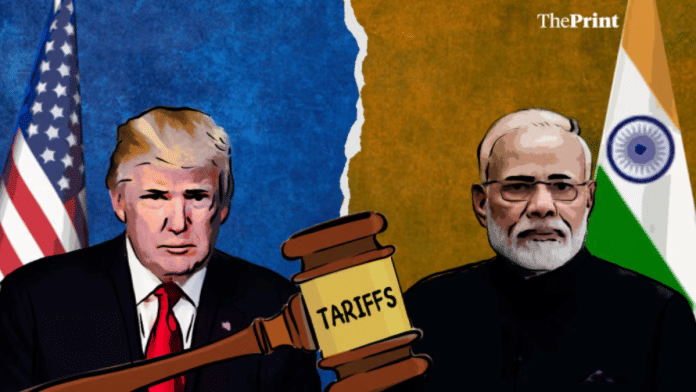



New Delhi: The India-US trade deal will be signed only when the Donald Trump administration has “put in place” its global tariff architecture, after an American court struck down the previous reciprocal tariff system in February, according to government sources.
“The US [trade] deal was to be signed in March. With the [US] Supreme Court judgement, the tariffs per se don’t exist. As of now there are tariffs that have been imposed on the basis of a balance of payments crisis which is temporary for five months and at around 10 percent,” one of the sources said Monday.
“The US is working on recreating a tariff architecture. Once they are able to create that architecture, we will sign that deal. The actual signing will be done when the new tariff architecture is in place globally.”
The trade deal which was announced on 2 February, came after almost year-long negotiations and was based on a set of reciprocal tariffs imposed by US President Donald Trump under the International Emergency Economic Powers Act (IEEPA) of 1977 in April 2025.
Trump imposed reciprocal tariffs on India of 25 percent in early August 2025, and later introduced a second set of additional tariffs of 25 percent, as a punitive measure due to New Delhi’s large purchases of Russian oil. However, the deal was announced last month, following a discussion between Prime Minister Narendra Modi and Trump. The reciprocal tariffs were cut to 18 percent from 25 percent, while the punitive duties were removed completely, as a part of the interim trade deal.
However, the US Supreme Court striking down the tariff structure imposed by Trump, impacts the final details of the interim trade agreement.
The source was clear that discussions between the two trade teams continue, to iron out the final details on non-tariff measures as well as other tariffs imposed under different legal instruments by the American administration, such as Section 232 investigations.
“We are using this time constructively. There are many things as a part of the framework deal. There are certain non-tariff barriers and Section 232 tariffs that need to be ironed out. We are using this time to iron out these differences.”
While the contours of the interim agreement have been agreed and announced, any legal signing of the final agreement depends on how the US sets up its new tariff framework, and the “comparative competitive advantages” gained by India within the new system.
Trump, following the Supreme Court order, imposed a baseline tariff of 10 percent on all imports, using a different legal instrument—Section 122 of the Trade Act of 1974—for a period of 150 days. Trump has threatened to raise this to 15 percent, but it has not been done so yet.
The office of the US Trade Representative (USTR) on 11 March announced the opening of investigations into India and 15 other economies to inquire whether these countries were using excess manufacturing capacity to export goods in a manner that hurts American businesses. The investigations are under Section 301(b) of the Trade Act.
A day later, the USTR opened an investigation into 60 countries, including India, to check whether these economies have taken sufficient steps to prohibit imports using forced labour, under the same Section 301(b) of the Trade Act. The new investigations are a part of the Trump administration’s latest efforts to find means to reimpose tariffs as a part of its trade agenda.
“We are examining the legal impact of the notices. These investigations will take time. Whenever a deal is finalised and signed in future, it will take into consideration these new investigations,” the source said when questioned on the latest investigations started by the USTR.
A number of Indian merchandise exports, especially in the automobile sector, steel and aluminium sectors face tariffs anywhere from 25 percent to 50 percent under a different American legal instrument—Section 232 of the Trade Expansion Act of 1962—imposed for “national security reasons.”
Also Read: Indians expecting equal benefits from India-US trade deal are missing power realities
Surge in Russian oil purchases
Another source confirmed that the data indicates a surge in purchase of crude from Russia, following the waiver given by the US last week to maintain stability in the global oil markets as the West Asian conflict continues for the third week.
“We are buying Russian oil. There has been an increase in purchases of Russian oil in the current month as per the data.”
Last week the US allowed India and a number of countries to purchase crude from Russia that remained stranded on the high-seas. The waiver was India-specific originally and later extended it to all countries as the US-Israel conflict with Iran continues to roil energy markets.
Brent crude futures hit roughly $105 a barrel, a 40 percent increase since 28 February when the US and Israel jointly struck Tehran
Trump has called on the international community to work with the US to secure the vital Strait of Hormuz—a global oil choke point that accounts for almost a quarter of the world’s total crude flow. Iran has focused on disrupting the flow of energy as a part of its retaliation to the US-Israel strikes.
Two LPG ships headed for India were allowed to leave the Strait of Hormuz and are expected to reach the country soon. Nevertheless, Russia continues to gain from its ability to sell its oil to global economies. The US had just months earlier sanctioned two of Russia’s largest energy manufacturers, Rosneft and Lukoil, and had imposed punitive tariffs on India for its continued purchases of crude from Moscow.
(Edited by Tony Rai)
Also Read: India-US trade deal is just like Union Budget. Sycophants are forced to praise both