





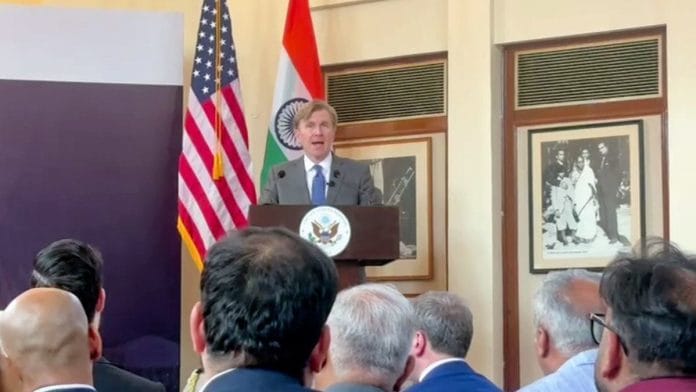



New Delhi: US Under Secretary of War for Policy Elbridge Colby, a China hawk and strong voice on the need for regional alliances, Tuesday complimented India on having a self-interest based foreign policy that resonates with the Donald Trump administration.
Colby, who is on a two-day visit to India, said the world is living through one of the most significant shifts in global power in generations.
“Indo-Pacific has become the central theater of international politics, economics, and security…Indian but also American interests and long-term prosperity will be decisively shaped by developments in this region,” he said, while speaking at Delhi’s Ananta Centre here.
Noting that no single power can sustain a stable balance of power in Asia, Colby said stability will instead depend on the collective contributions of capable states that share an interest in maintaining a free and open Indo-Pacific.
He said India is indispensable when it comes to maintaining balance of power in Asia, and the US sees India not merely as a key partner but as an essential one for long-term impact.
America approaches “our partnership with realism, clarity, and a fair dose of humility”, he added.
“Our assessment of the Indo-American partnership has its roots in practicality, what our President frequently calls common sense,” Colby further said. “In line with this, our approach to the strategic partnership is interests-based and realistic, shaped by geopolitics and incentives as opposed to gauzy aspirations or detached idealism. We clearly recognise that India has its own interests, its own strategic culture, and its own priorities, and that India is not shy about advancing them. But that is what we want.”
Colby said that the United States wants partnerships with vigorous, self-assured states, not with dependencies. “We want key partners that, in resolutely advancing their own interests, will also have the effect of advancing our own…This is a manifestation of what the National Security Strategy calls flexible realism…By aligning our efforts with those states that are willing and able to advance their own, we thereby can contribute to attaining both of our goals.”
The under secretary said American efforts to cooperate with India are designed not only to collaborate on key issues but also strengthen and enable India, in order to promote and sustain a favourable regional balance of power that serves both.
“Minister of External Affairs Dr. Jaishankar has termed India’s approach ‘Bharat First’ and its strategic approach ‘the India Way’. Like America First and flexible realism, Bharat First and the India Way emphasize the centrality of a realistic approach to foreign policy, an unabashed willingness to put one’s own national priorities first, and a results-oriented mindset about international politics,” he said.
Noting that Jaishankar has critiqued the “panjandrums of the rules-based international order” and questioned the presumptuous supremacy of the foreign policy establishment of the West, observing that “we are witnessing a return to history rather than an end to it”, Colbys said this approach resonates deeply with “our own on many levels, but most importantly at that of fundamental perspective”.
“Both of us believe that countries must operate with confidence in defending and advancing their own interests—and that that is not only prudent but also right. Both of us believe that foreign policy grounded in concrete national interests creates a stronger and more self-sustaining foundation for cooperation and indeed for peace. Both of us believe that a durable and stable balance of power in Asia is a topmost priority,” he said.
Colby argued that when the US acts to secure the safety, prosperity, and freedom of the American people, and India acts with equal determination on behalf of the Indian people, the efforts will frequently and materially reinforce one another.
“At the same time, we do not expect nor require unerring agreement. Rather, we are flexible, looking for areas of agreement where they count most. We recognize that foreign policy should be practical and about results; as Minister Jaishankar wisely advised, the circumstances of today ‘require flexible arrangements that are customized to the challenge’,” he said.
He underlined that it is actually a key strength of the US–India relationship that it rests not on “dusty formalities and unchallengeable shibboleths but on a hard-headed, clear-eyed recognition of overlapping interests”.
He said the US and India do not need to agree on everything to cooperate effectively. “What matters is that our interests and objectives increasingly converge on the most fundamental issues. Differences and even disputes are fully compatible with deepening alignment and cooperation on strategic matters. The roots of our partnership are deeper than optics and more durable than superficial comity; they are, rather, thickly embedded in lasting strategic mutual self-interest.”