








New Delhi: In what is being billed as a historic pact, India and the European Union announced the conclusion of a Free Trade Agreement (FTA) Tuesday that lowers costs of several goods, including automobiles and wines.
The pact, which comes after years of negotiations that were sped up and became more urgent in the wake of global trade turmoil unleashed by US President Donald Trump, is set to eliminate tariffs on almost 97 percent of EU exports to India.
The two sides also signed a strategic defence partnership and announced the opening of negotiations on intelligence sharing, indicating a strategic shift in ties between India and the EU.
The free trade agreement is set to create a free market for trade in goods between almost two billion people—one of the largest such trade areas.
Apart from the elimination of duties, in specific sectors such as automobiles, tariffs will be gradually lowered to as low as 10 percent over a period from the current 110 percent, while duties on wines is set to progressively decline from 150 percent to as low as 20 percent with regard to some goods. As for whiskey, the concessions are aligned with the deal India signed with the UK last year.
India is set to get zero-tariff market access in almost all non-agricultural sectors. Around 90 percent of all tariffs on Indian imports are to be eliminated on day one from when the agreement enters into force.
Another three percent of tariffs are set to be phased out over time, while six percent worth of tariffs are covered under quotas. The EU is opening a total of 96.8 percent of tariff lines for Indian goods.
The tariff elimination on Indian exports covers areas including marine products, chemicals, textiles and apparel, leather footwear, gems and jewellery, base metals and consumer goods from the day the agreement enters into force.
The overall average EU tariff on Indian goods is set to fall to 0.1 percent from around 3.8 percent.
In return for EUs concessions, India will open 92.1 percent of its tariff lines and eventually eliminate tariffs on 93 percent of European goods over a decade.
By the end of the decade from when the deal comes into force, India’s average tariff on European products is set to fall to around 2.8 percent from the current average of six to seven percent.
In the steel sector, the two sides have agreed to negotiate a separate agreement, while keeping it out of the ambit of the FTA.
The Carbon Border Adjustment Mechanism (CBAM)—a mechanism imposed on EU importers in seven carbon-intensive areas, including steel— is another contentious issue. If the EU creates any exception to its CBAM mechanism, it will apply to India as well. The two sides are set to establish a technical dialogue around the CBAM.
The agreement will remain a “living agreement” with multiple review, consultation and response mechanisms embedded within the deal that would allow the two sides to deal with emerging challenges.
Commerce and Industry Minister Piyush Goyal and EU Trade Commissioner Maros Sefcovic signed the “political declaration on the conclusion of the FTA negotiations”.
External Affairs Minister S. Jaishankar and the High Representative of Foreign Affairs of the EU, Kaja Kallas, signed the security and defence partnership.
Apart from signing a comprehensive framework on mobility, the two sides exchanged a number of agreements in areas such as disaster management, constitution of a green hydrogen task force, and an MoU between the Reserve Bank of India (RBI) and the European Securities Authority.
“India has concluded its largest FTA in its history. Today is the 27th, it is indeed a happy coincidence that this FTA we have announced with 27 member states of the EU. This historic agreement will make access to the EU market easier for our farmers and small businesses,” Prime Minister Narendra Modi said at the joint press statement after the India-EU Summit Tuesday.
”Not just this, this FTA will boost investment between India and the EU. It will help forge new innovative partnerships and will strengthen supply chains at a global level. This is not just a trade agreement, it is a new blueprint for shared prosperity.”
On ‘X’, Modi shared various facets of the agreement, such as tariff abolishment on 9,425 lines of Indian exports.
This landmark deal between the 2nd largest and 4th largest economies of the world promises to create unprecedented opportunities and open new avenues of growth as well as cooperation. This deal will benefit the entire global community.
It would help create quality jobs in key… pic.twitter.com/9RAv8vY0W9
— Narendra Modi (@narendramodi) January 27, 2026
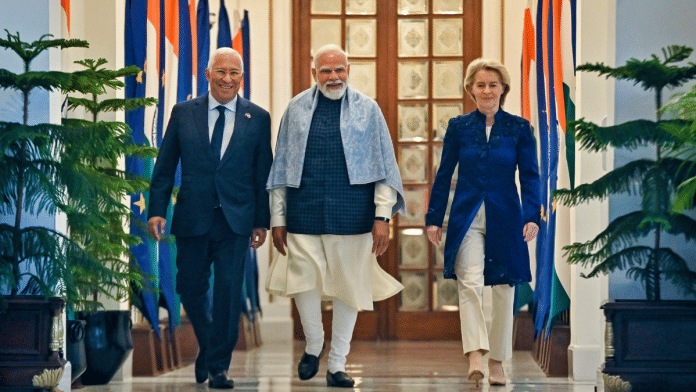
The conclusion of negotiations for the deal, as well as a raft of announcements, including the comprehensive joint agenda for the next half-decade, were all announced during EU Commission President Ursula von der Leyen and Council President Antonio Costa’s visit to India. The Commission President landed on 24 January and is set to depart on 28 January.
The two European presidents were also chief guests for India’s Republic Day Monday. It is the first time that EU leaders were chief guests for the Republic Day celebrations.
“India has risen and Europe is truly glad for it. When India succeeds, the world is more secure, more prosperous and we all benefit from it…We did it. We did the mother of all deals. This is a tale of two giants…two giants who choose partnership in a win-win fashion,” Ursula von der Leyden, the EU Commission President, said at the joint press statement.
At the 16th India-EU Summit, the three leaders discussed a number of issues, including global and regional issues like the ongoing Russia-Ukraine war.
Modi announced that the strategic defence partnership will allow for “co-development and co-production” of defence equipment, underlining that the strategic relationship is underlined by this agreement.
Apart from the elimination of duties, in specific sectors such as automobiles, tariffs will be gradually lowered to as low as 10 percent, while duties on wines is set to progressively decline from 150 percent to as low as 20 percent with regards to some goods. As for whiskey, the concessions are aligned with the deal India signed with the UK last year.
The liberalisation of tariffs in automobiles will see EU auto makers introduce their models in higher price brands and also open the possibility for these manufacturers to set up factories in India and export thereon in the future. The 50 percent tariffs on processed foods, including pasta and chocolate, will be completely eliminated once the deal comes into force.
The FTA negotiations concluded Friday, and the final contours of the deal were approved by the Union Cabinet Saturday. Sensitive agricultural issues such as poultry, meats and dairy products are excluded from the deal, while India has gained access to export grapes. The EU, in turn, has gained access to Indian markets for its wines.
The goal is to hit EUR 200 billion in trade and EUR 125 billion in services by 2030. The agreement has 21 chapters, which have been reduced from 24 after merging different chapters. The deal is expected to be signed after the ongoing legal review.
The expectations from both sides are that the agreement is to come into force within a year after all legal requirements are met.
(Edited by Tony Rai)
Also Read: Thank you Donald Trump, again. India now has reason to shed fear of trade deals and risky reform
A country which takes 25 years to sign a free-trade deal is a basket case.