





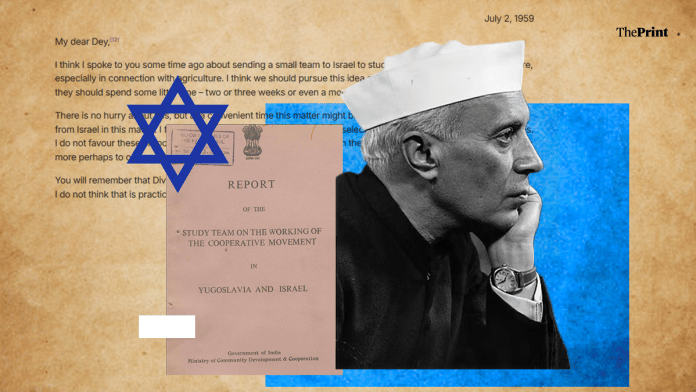



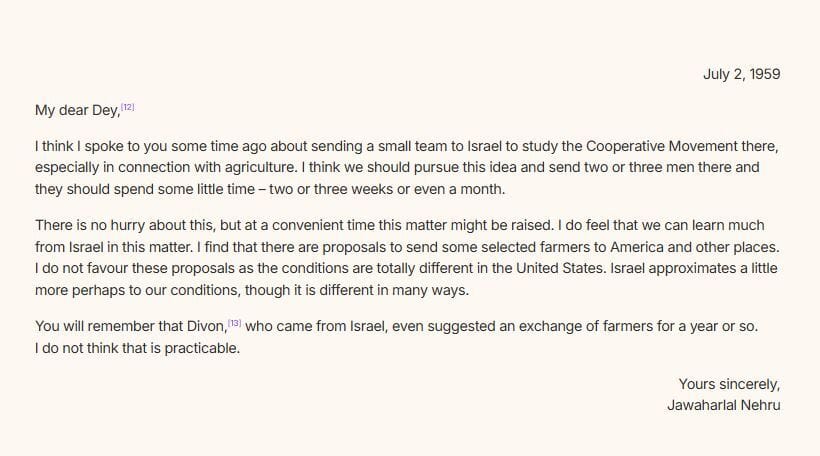
New Delhi: In July 1959, Jawaharlal Nehru wrote to his Minister of Community Development, S.K. Dey, expressing an unusual interest: to learn from a country India did not have a diplomatic relationship with, and whose creation it had voted against in 1947.
The letter reminded Dey of an earlier conversation about sending a small team to Israel to study its cooperative movement, especially in agriculture.
“I think we should pursue this idea and send two or three men there, and they should spend some little time—two or three weeks or even a month,” Nehru wrote.
He didn’t feel there was any hurry, but was clear that “we can learn much from Israel in this matter”.
Although India and Israel hadn’t established diplomatic relations yet, this was a conversation that sparked interest among policymakers, socialist leaders and Sarvodaya workers to look to Israel’s experiments with cooperative farming for inspiration.
Months after Nehru’s letter, Dey made it happen.
A six-member study group, sponsored by the Ford Foundation, visited Israel and Yugoslavia between November 1959 and January 1960 to study cooperatives in the two countries.
In its 125-page report, the team felt that while it seemed “futile” to presume that the forms of agricultural cooperation flourishing in Israel could be transplanted to India, they offered “rich and valuable experience” that could be considered to shape cooperative policies and practices in India.
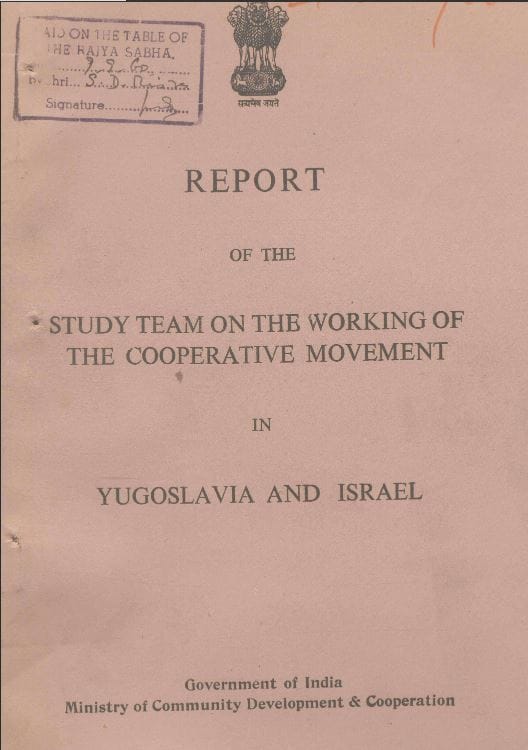
It declared the kibbutz, a traditionally voluntary agrarian community settlement, the “proudest achievement of the Jewish people” in the realm of cooperative and community organisation.
The study group wasn’t India’s or Nehru’s only interaction with Israel at the time. The road to Israel for all these leaders also seems to have gone through India’s villages and farmers.
Correspondence from the time reveals that several Indian leaders—including Nehru, Jayaprakash Narayan, Karpoori Thakur, Acharya J.B. Kripalani and Ashok Mehta—felt kinship with the cooperative movement in Israel.
“India in the 1950s was looking at democratic, socialist but non-communist places to look at land distribution, cooperative societies and agricultural innovations, and Israel appeared to be a very promising case study,” Khinvraj Jangid, Director of the Jindal Centre for Israel Studies, told ThePrint.
He added that several prominent leaders from the time travelled to Israel with “full knowledge and support of Jawaharlal Nehru”.
“My work on those decades has found that early Indian leaders, including Nehru, found Israel as a sister democracy and a sister socialist country, and that India and Israel could work really well together,” he told ThePrint.
However, Jangid added that India couldn’t have diplomatic relations with Israel due to external factors, such as dependency on oil from the Arab world.
India voted against the United Nations Partition Plan for Palestine that led to the creation of Israel in 1947, and formally recognised Israel in 1950—on the day that Prime Minister Narendra Modi was born, as he recalled in his address to Israeli Parliament Knesset this year.
However, it was only in 1992 that Israel opened an embassy in Delhi, and India opened its mission in Tel Aviv. The period between 1950 and 1992 is often considered a black chapter or a “cold peace” in relations between the two countries.
“India also looked at Arab countries as Muslim countries that would vote for India on Kashmir, rather than Pakistan. So these were two very pertinent issues, Kashmir and oil, for which India wanted to appease the Arab countries,” he says.
Jangid points to then Israeli Prime Minister David Ben-Gurion holding Nehru in high regard, despite the latter keeping his distance from the country.
“It is not for me to judge him [for his frostiness towards Israel]. He is a great man. I admire him. There is democracy in India; it is the only country in Asia, which is democratic except Japan. If Nehru goes, I am not sure what will happen; but [for] now it has democracy,” Ben-Gurion told the then US President John F. Kennedy in May 1961.
Also Read: Spectrum is a warfighting asset — India can’t keep auctioning it off for viral videos
Present day: Congress & India-Israel
Decades later, the Indian National Congress and its leaders have displayed a harder stance on Israel.
In a recent op-ed, Sonia Gandhi alleged that the Modi government’s response to the hostilities between Israel and Palestine “appears to be driven primarily by the personal friendship between the Israeli premier and Mr. Modi rather than India’s constitutional values or its strategic interests”.
As Modi departed for a two-day visit to Israel in February, Priyanka Gandhi posted on X, “India has stood for what is right throughout our history as an independent nation, we must continue to show the light of truth, peace and justice to the world.”
Analysts said Nehru’s stand on Israel was driven by pragmatism.
“He engaged with Israeli leaders and didn’t blame them for the non-resolution of the conflict with the Palestinians,” Jangid said.
In the absence of formal diplomatic relations, what would such an exchange of people and ideas during Nehru’s prime ministership be called?
Jangid said that “nothing was off the record or under the table” when it comes to these informal interactions between the two countries during Nehru’s prime ministership.
“Everything was public. India couldn’t have diplomatic exchange with Israel because of the external conditions, but India did not keep a distance from Israel. India did not hold an anti-Zionist boycott of Israel, and India really believed that diplomatic relations would be established whenever the circumstances permit,” he told ThePrint.
“What would I call it? I would call it a full-fledged engagement without diplomatic relations,” he added.
In contrast, Jangid called the Congress party’s stand on Israel today “dubious”, saying, “Many a times, it seems like Congress just criticises Israel because Narendra Modi praises Israel.”
“Sometimes, it is the nostalgia for Indira Gandhi’s foreign policy, which was anti-American and anti-Israel. I think there is no coherent policy, it is more for public consumption that a few of its leaders tend to condemn Israel for its regional policies, but none have criticised Israel and its growing relevance for Indian foreign policy,” he said.
‘A sister democracy’
Despite the lack of formal diplomatic ties, Nehru’s early engagement wasn’t surprising.
A key bridge to Nehru’s interest in cooperatives was Shmuel Divon, Ben-Gurion’s special adviser on Arab affairs, who was the only member of the Israeli diplomatic corps with a command of Hindi and Urdu.
In a letter dated 21 May 1959, Nehru wrote about meeting Divon, who he described as a “very interesting man from Israel”, to then Agriculture Minister Ajit Prasad Jain.
Divon, Nehru wrote, had been in India for five or six months and had wandered all over the country, in every state, living in the villages there.
Nehru said he had had long talks with Divon, whom he spoke of with admiration, saying that the Israeli adviser was an “able and observing man and he has come to know a great deal about our village life and agricultural conditions”.
Divon had told Nehru about their “advanced cooperative system” and how completely infertile and saline areas in Israel were converted into cultivable land.
Months before the delegation was sent to Israel, Dey’s Community Development Ministry, as well as Acharya Vinoba Bhave, the pioneer of the Bhoodan Movement, met Divon.
“This man Divon has been in close touch with the Community Development Ministry. He, in fact, was taken to various places. He has also lived with the peasants,” Nehru wrote in his letter dated 21 May 1959.
The letter also revealed that Divon had also “marched some days with Vinobaji”. During his visit to India, he had met renowned agricultural scientist Kailas Nath Kaul as well, and discussed methods of reclaiming alkaline or saline land.
Kaul was Kamala Nehru’s brother, and his association with Divon seemed to have caught Nehru’s eye.
“There was much in common with their approach and both agreed that it was possible to make any land, however bad it might be, cultivable by certain treatment. In fact, in Israel they had succeeded remarkably,” Nehru wrote about Kaul and Divon.
Nehru appeared to have discussed a wide range of issues with Divon. The Israeli man was referred to in another correspondence from Nehru to the chief ministers on 28 May 1959.
Without naming Divon, he says that a person experienced in cooperatives and agriculture who came from Israel was “much struck by this Banthra farm”.
He was referring to the landmark experiment in the reclamation of saline-alkaline land at the Banthra farm, near Lucknow, in the 1950s by the National Botanical Research Institute (NBRI). Incidentally, the Banthra farm was Kaul’s brainchild.
“He (Divon) said that in Israel they adopted many such practices because they did not believe that any land, however bad it appeared to be, should be considered as incapable of being cultivated. All that was required was science and effort and indeed in Israel they have brought into cultivation the desert and the most unpromising lands,” Nehru wrote.
‘Learnt experiences from Israel’
The delegation the Ministry of Community Development and Cooperation sent to Israel in 1960 studied different types of cooperatives in Israel, and seemed most impressed by the kibbutz.
Israel historically housed several agricultural cooperatives, most notably the kibbutz, moshav ovdim and moshav shitufi.
The word ‘kibbutz’ literally means “gathering” or “clustering” in Hebrew, and the first such gathering, the Degania Alef, was established on the banks of the river Jordan in 1909.
A kibbutz is essentially a collective living community that typically works together in agriculture, with members meeting several times daily in the dining hall.
Apart from collective cultivation, this cooperative also provides for all the needs of its members, including housing, food, clothing, medical aid, education, and cultural and social services.
Moshav ovdim literally translates to “workers’ settlement”. Unlike a kibbutz, this cooperative does not involve collective farming and living, but is a service cooperative that provides facilities for the production and marketing of the produce of its members.
Moshav shitufi is a mixture of the other two: it has joint cultivation like a kibbutz, but members live individually like in a moshav ovdim.
The Ministry of Community Development and Cooperation’s delegation that visited Israel wrote that “nothing in the cooperative movement of Israel is, perhaps, as significant as the collective villages known as kibbutzim” (plural for kibbutz).
The delegation represented many different agricultural interests.
Led by ICS B.D. Pande, the then Bihar Development Commissioner, it also comprised A.C. Subba Reddy, an MLA and president of Andhra Pradesh Apex Marketing Society; Shri Maydeo of the Subhash Cooperative Farming Society of Poona; S.S. Puri, the deputy secretary of the Department of Cooperation in the Union Ministry of Community Development and Cooperation; A.K. Dutt, the Registrar of Cooperative Society in West Bengal; and D.S. Verma, the Deputy Registrar of the UP Pradeshik Cooperative Federation.
“We have also learnt many experiences from Israel from which we should gain,” Dey told Parliament in April 1960.
‘A nearly Gandhian state’
“Earth provides enough to satisfy every man’s needs, but not every man’s greed,” Mahatma Gandhi had famously said.
The exchange of individuals and ideas between the two nations, especially in the area of “agrarian socialism” in the years after India’s Independence and Israel’s creation, also stemmed partly from the idea of the Sarvodaya movement founded by Mahatma Gandhi.
At its core, the movement dreamt of the establishment of a network of self-supporting village communities.
And in the Sarvodaya society of Gandhi’s dreams, every member was to follow the motto of simple living. The gospel of Sarvodaya, literally “upliftment of all”, was Gandhi’s answer for tackling socio-economic evils in the country.
After Gandhi’s assassination, Acharya Vinoba Bhave and Jayaprakash Narayan sought to implement this idea. The most prominent effort was the Bhoodan movement, under which landowners were persuaded to voluntarily give up a part of their land to the landless.
A 2020 paper written by Benjamin Siegel, Associate Professor of History at Boston University, documents several of these visits by Indian leaders. The paper is titled ‘The Kibbutz and the Ashram: Sarvodaya Agriculture, Israeli Aid, and the Global Imaginaries of Indian development’.
Documenting JP’s visit to Israel, Siegel said that the leader declared Israel to be “nearly a Gandhian state”, and suggested that the Sarvodaya movement shared the goal of a transformed agrarian society with Israel’s collective agricultural communities.
After JP’s visit, several Sarvodaya workers made their way to Israel.
In the last week of February 1960, 26 farmers of the Sarva Seva Sangh visited Israel to attend a seminar on Cooperation, held under the auspices of the Histadrut—General Federation of Labour in Israel.
Bread and freedom
“Kibbutzim in Israel have proved beyond all doubt that bread and freedom can go together,” socialist leader Karpoori Thakur declared during his two month visit to Israel in 1959 to study its cooperative organisations and agricultural settlements.
Jangid, who has accessed Israeli archives on Thakur’s trip, says that Thakur wrote about how leaders like Acharya Narendra, Acharya J.B. Kripalani, Shri Ashok Mehta, Shri Jai Prakash Narain and several other socialist and Bhoodan workers had visited Israel and were “greatly impressed with the progress and way of life and standard of living of the kibbutzim”.
Senior journalist Qurban Ali, who is documenting the socialist movement in India, says that Israel’s support by many of India’s socialist leaders may have stemmed from their opposition to Nehru, who hadn’t established diplomatic relations with the country.
“Mostly, the socialists, who were in the Congress party and left soon after the assassination of Mahatma Gandhi and formed their own Socialist Party, were dead against Nehru and his policies. This was a prominent reason for them to support Israel,” he told ThePrint.
He also pointed out that Israel was a part of the ‘Socialist International’, an association of political parties and organisations that seek to establish democratic socialism.
Diplomatic ties
Israel established its first consulate in Mumbai (then Bombay) in 1953, three years after it was recognised by India. However, a formal relationship still eluded the two countries until 1992.
For instance, on 7 April 1964, the government advised the Consul of Israel not to hold the Israeli National Day reception a week later in Delhi.
The government defended its decision in Parliament, saying that it was not customary for a Consul to hold his country’s National Day in Delhi when the consulate was not located in Delhi, but in Bombay (now Mumbai).
“In holding his country’s National Day reception in New Delhi, the Israeli Consul appeared to be trying, without proper authority, to assume the role of a diplomatic agent when he is required to confine himself to consular functions,” it said.
In response to criticism by Constituent Assembly member H.V. Kamath over the statement, the government clarified that the Consul had been holding the National Day functions in Bombay for the last 14 years, and informed the Consul of Israel that “this was not the correct way of doing things”.
Before 1992, Indian passports had a strict declaration: they were not valid for South Africa or Israel.
Cut to 2021, the unveiling of a “Bhoodan Grove” plaque at the Jerusalem Forest by External Affairs Minister S. Jaishankar formally revealed the evidence of an intellectual exchange between the two countries much before 1992.
The grove was planted by a team of around two dozen members, all part of the Sarvodaya movement in India. The team spent six months in Israel from February to August 1960, studying the kibbutz movement.
In his speech, Jaishankar spoke about Jayaprakash Narayan visiting Israel in 1958, and many followers of Vinoba Bhave also finding their way to the country to understand the kibbutz movement in 1960.
He attributed this interest in the kibbutz movement to a “quest to build on the Gandhian concept of ashram or village as a self-sustaining unit of development”.
“In modern post-Independence times, there are also the relatively less known aspects of how major socialist political leaders and streams in India felt a kinship with the kibbutz movement in Israel,” Jaishankar said in Jerusalem.
(Edited by Sugita Katyal)
another fake news peddler from the fake news university of coupta.
Nehru had all opportunity to recognise israel officially . he did not as he wanted to pamnder to muslim vote bank.
so stop lying