





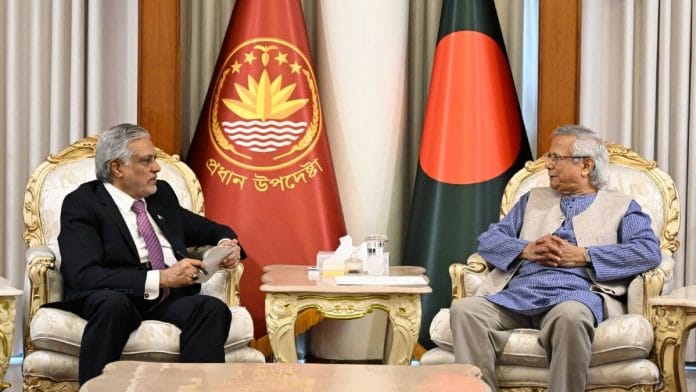



New Delhi: Pakistan Foreign Minister Ishaq Dar has claimed the year 2025 was a turning point in Pakistan-Bangladesh relations, describing it as a “major” ice-breaker after years of diplomatic coldness. Dar also termed the two nations as “brothers” while speaking at a year-ending press conference in Islamabad Saturday.
Dar had visited Bangladesh this August, marking the first foreign ministerial visit to the country in 13 years. The last visit was in 2012 by then foreign minister Hina Rabbani Khar.
“There was a very warm feeling throughout the 36 hours (of my visit). Pakistan intends to proactively engage with Bangladesh after its general elections scheduled for February,” he said Saturday.
He also claimed that the previous government in Bangladesh, led by Sheikh Hasina, was “anti-Pakistan”.
Dar recalled that when Khar had visited Bangladesh in 2012 to extend invitations for multilateral meetings, she received “no response” from the government.
“When Hina Rabbani Khar went to give an invitation, there was no response because the government at that point was very anti-Pakistan and she had gone to invite them for multi-lateral meets but no meetings took place,” he said.
In contrast, he added, his 36-hour visit to Bangladesh this year was “very engaging” and marked by “an atmosphere of goodwill and warmth”.
Elaborating on Pakistan’s ties with South Asian countries, he said that be it Bangladesh, Nepal or Sri Lanka, Islamabad was actively engaging with all.
In the context of Bangladesh, Dar said “they are our brothers”, and asserted that relations would improve further in the coming months.
During the short August trip, he said he met Bangladesh’s chief adviser Muhammad Yunus, foreign minister, cabinet ministers and senior advisers, as well as leaders across the political spectrum.
These included representatives of the Bangladesh Nationalist Party (BNP), Jamaat-e-Islami and National Citizen Party (NCP). Dar said he also interacted with civil society members, students and cultural figures at the Pakistan High Commission in Dhaka.
In a media interaction following the August meeting in Dhaka, Dar had claimed that all issues stemming from the 1971 Liberation War had been “settled” between both countries and that Bangladesh should now “clean” its heart.
He cited the 1974 tripartite agreement between Bangladesh, Pakistan and India, as well as former Pakistani President Pervez Musharraf’s 2002 visit to Dhaka as evidence that the chapter had been closed.
Bangladesh’s interim leadership, however, publicly rejected the assertion.
In response to Dar, Bangladesh Foreign Adviser Touhid Hossain had said: “No, I don’t (accept that). If I did, the problem would have been solved.”
He reiterated Dhaka’s long-standing demands: a formal apology, repatriation of Pakistani citizens who remain stranded in Bangladesh and a fair share of pre-1971 financial assets.
Hassan added that dialogue would continue with Pakistan but acknowledged that “the issues of 1971 cannot be solved in a day”.
Despite the differences, however, both sides struck a conciliatory tone in their public statements, agreeing to continue dialogue and expand cooperation in trade, education, and regional forums.
Hassan also dismissed suggestions that Bangladesh’s renewed engagement with Pakistan was driven by China’s push for a trilateral framework, saying Dhaka preferred broader, more inclusive cooperation. He noted that relations with Pakistan had been deliberately downplayed by the previous government, a policy the current administration is now reversing as part of a broader effort to normalise ties globally.
Dar had also held talks with Yunus, with both leaders stressing on the need to revitalise the South Asian Association for Regional Cooperation (SAARC). Yunus described ties with Pakistan and other SAARC members as a “high priority”, while Dar pointed to the “complementary” nature of the two economies.
The visit also led to a series of agreements. Bangladesh and Pakistan signed six MoUs, including a visa waiver agreement for diplomatic and official passport holders, the establishment of a Joint Working Group on Trade, pacts between strategic and media institutions of both countries, a cultural exchange programme, and an academic exchange agreement between the two nations’ foreign service academies.
Pakistan also announced a “Pakistan–Bangladesh Knowledge Corridor,” offering 500 scholarships to Bangladeshi students and 100 training slots for civil servants over five years, alongside a fivefold increase in technical assistance scholarships.
(Edited by Nida Fatima Siddiqui)